
Introduction
Children’s Hotel Furniture | A family checks into a hotel after a long journey. The parents are looking forward to relaxing, while the children are ready to explore everything in the room. Within minutes, a chair becomes a climbing step, a bedside table becomes a play surface, and every drawer, corner, shelf, and loose accessory suddenly gets tested.
This is exactly why children’s hotel furniture needs more thought than simply choosing smaller chairs and colorful tables.
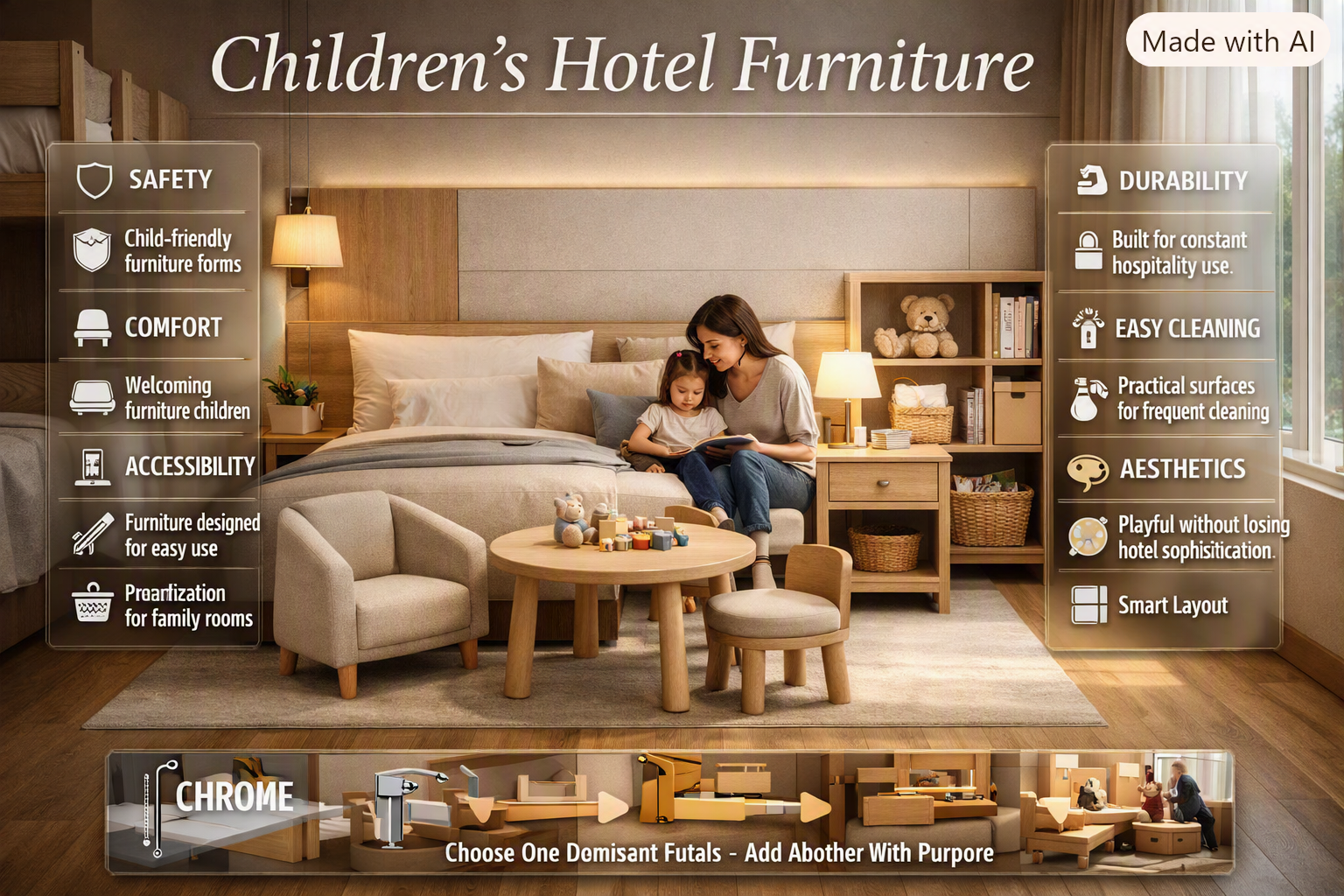
Furniture in a child-friendly hotel has to work for two very different audiences at the same time. Children need comfort, accessibility, freedom to move, and an environment that feels welcoming. Parents need safety, cleanliness, storage, convenience, and confidence that the room has been properly designed. Meanwhile, the hotel needs furniture that can survive constant use, frequent cleaning, and years of hospitality operation.
That balance is what separates genuinely successful family-friendly interiors from rooms that merely look playful.
For broader interior planning and design inspiration, Design Mode 24 Interior Design provides a useful starting point for understanding how furniture, layout, color, storage, and functionality can work together.
This guide explores how to select and plan children’s hotel furniture, from safety and materials to furniture sizing, storage, room layouts, maintenance, aesthetics, sustainability, and purchasing decisions. It also explains common mistakes and practical strategies that can help designers and hotel owners create spaces that work in real-world hospitality conditions.
What Is Children’s Hotel Furniture?
Children’s hotel furniture is furniture selected or designed specifically for spaces used by young hotel guests. It includes beds, chairs, tables, storage units, benches, desks, stools, activity furniture, and other pieces adapted to children’s physical proportions, behavior, safety requirements, and everyday activities.
The important distinction is that children’s furniture isn’t simply adult furniture made smaller.
A properly designed children’s hotel chair considers how a child sits, moves, climbs, reaches, and gets in and out. A children’s table considers comfortable posture and accessibility. A storage unit considers what a child can safely reach while recognizing that some belongings should remain under adult control.
Hotel use adds another layer.
Residential children’s furniture may serve one family for several years. Hotel furniture can be used by hundreds or thousands of different children during its service life. That means commercial durability, cleaning requirements, repairability, stability, and long-term performance are essential parts of the design decision.
A successful children’s hotel room therefore needs furniture that combines:
- Safety
- Comfort
- Appropriate proportions
- Durability
- Easy maintenance
- Practical storage
- Attractive design
- Efficient use of space
- Family-friendly functionality
Why Is Children’s Hotel Furniture Important?
Children’s hotel furniture matters because furniture directly influences how safely and comfortably young guests experience a property.
Parents often judge a family-friendly hotel by small practical details. They notice whether their child can sit comfortably, whether storage is accessible, whether the furniture feels stable, whether surfaces are easy to clean, and whether the room provides enough space for children to move without constantly bumping into things.
Good furniture can also reduce operational problems for the hotel.
Well-designed pieces are easier to clean, easier to inspect, less likely to suffer premature damage, and often more adaptable to different room configurations. Poorly selected furniture can create the opposite result: frequent repairs, replacement expenses, housekeeping difficulties, and negative guest experiences.
There is also a branding advantage.
A hotel that deliberately designs for families communicates that children are welcome rather than merely tolerated.
That distinction matters.
A generic hotel room with a plastic children’s chair placed beside the bed doesn’t necessarily feel family-oriented. A thoughtfully planned room, where the furniture, colors, storage, lighting, and circulation all work together, creates a much stronger impression.
What Furniture Does a Child-Friendly Hotel Room Need?
A hotel doesn’t need to fill every room with specialized children’s products. In fact, adding too many pieces can make a room feel crowded and difficult to maintain.
The better approach is to identify the activities children are likely to perform and select furniture around those needs.
Typical children’s hotel furniture may include:
| Furniture Type | Primary Function | Key Requirement |
|---|---|---|
| Children’s bed | Sleeping | Stable and appropriately sized |
| Child-sized chair | Sitting | Comfortable and sturdy |
| Activity table | Drawing, games, reading | Easy-clean surface |
| Low storage | Toys and personal items | Accessible and stable |
| Bedside table | Books and small belongings | Safe edges |
| Bench | Sitting and storage | Strong construction |
| Reading seat | Quiet activity | Comfortable upholstery |
| Desk | Homework or creative activities | Appropriate height |
| Wardrobe | Clothing | Secure construction |
| Convertible furniture | Multiple activities | Reliable mechanisms |
The correct mix depends on the hotel’s target market.
A resort catering to families with toddlers will have different requirements from a business hotel that occasionally accommodates children. A dedicated family suite can justify more specialized furniture than a standard room with limited floor area.
The key is to design according to actual use rather than adding children’s furniture simply because it looks attractive.
How Should Children’s Hotel Furniture Be Designed for Safety?
Children’s furniture should be evaluated for safety before appearance, color, or decorative appeal. Stable construction, suitable dimensions, softened edges, secure hardware, appropriate finishes, and careful placement all contribute to a safer environment.
Safety should be built into the furniture specification from the beginning.
Use Softened or Rounded Edges
Sharp corners can become problematic when children run, turn quickly, play on the floor, or move between furniture.
Rounded or softened edges are particularly useful on:
- Children’s tables
- Bedside tables
- Low cabinets
- Benches
- Desks
- Shelving
- Storage units
This doesn’t mean furniture needs to look childish.
Contemporary furniture can use subtle radius details that maintain a sophisticated appearance while reducing unnecessarily sharp contact points.
Prioritize Stability
Children interact with furniture differently from adults.
A child may lean heavily against a chair, pull a drawer, sit on a cabinet, or use a table to help stand up. Furniture that feels perfectly stable during normal adult use may behave differently under these situations.
Furniture should therefore have:
- A stable base
- Strong joints
- Appropriate weight distribution
- Secure hardware
- Suitable structural strength
- Proper installation
Tall or potentially unstable storage furniture should be secured according to the manufacturer’s installation requirements and applicable safety practices.
⚠ Common Mistake: Choosing furniture solely because it is lightweight and easy for hotel staff to move. Excessively lightweight furniture may be convenient for housekeeping but can become less stable when children interact with it.
What Materials Work Best for Children’s Hotel Furniture?
Material selection affects safety, durability, appearance, cleaning, cost, and maintenance. There isn’t one universal “best” material because different furniture pieces perform different functions.
Wood and Wood-Based Furniture
Wood can give a children’s hotel room a warm, residential character.
It works particularly well in:
- Family resorts
- Boutique hotels
- Luxury suites
- Nature-inspired interiors
- Scandinavian-inspired rooms
- Premium family accommodation
Wood also pairs easily with neutral colors, textiles, and natural materials.
However, exposed wood should have a suitable durable finish where frequent cleaning and spills are expected.
High-Pressure Laminate
High-pressure laminate is a practical option for tables, desks, cabinets, and storage surfaces.
Its advantages include:
- Easy cleaning
- Broad design choices
- Good resistance to everyday wear
- Consistent appearance
- Practical maintenance
- Availability in wood, stone, and solid-color effects
For high-traffic hospitality environments, laminate can provide an effective balance between appearance and practicality.
Metal Frames
Metal frames are useful for chairs, tables, benches, and other furniture requiring structural strength.
The frame should be properly finished, and any exposed areas should be designed to avoid creating unnecessary hazards.
Performance Upholstery
Upholstered seating can make a hotel room much more comfortable, but fabric selection matters.
For family spaces, consider upholstery that is:
- Durable
- Easy to maintain
- Appropriate for commercial use
- Comfortable
- Resistant to expected wear
- Compatible with the hotel’s cleaning procedures
A beautiful fabric that requires delicate treatment may become an operational headache in a children’s area.
How Do You Choose the Right Size of Children’s Furniture?
Furniture size should be based on the intended age group, not simply the label “children.”
A toddler, a preschooler, and an eight-year-old have very different physical proportions.
Before purchasing furniture, determine:
- The primary age range
- Average expected height
- Intended activities
- Available room dimensions
- Whether parents will also use the furniture
- Whether the furniture needs to accommodate growth
Child-sized furniture is especially useful when children have dedicated activity zones. However, hotels often benefit from adaptable furniture because guest demographics change.
⭐ Expert Tip: Design around activities before dimensions. Ask what children will actually do—sleep, read, draw, play, eat, relax, or store belongings—and then select furniture that supports those activities.
This prevents unnecessary furniture purchases.
How Can Hotels Design Children’s Furniture for Different Age Groups?
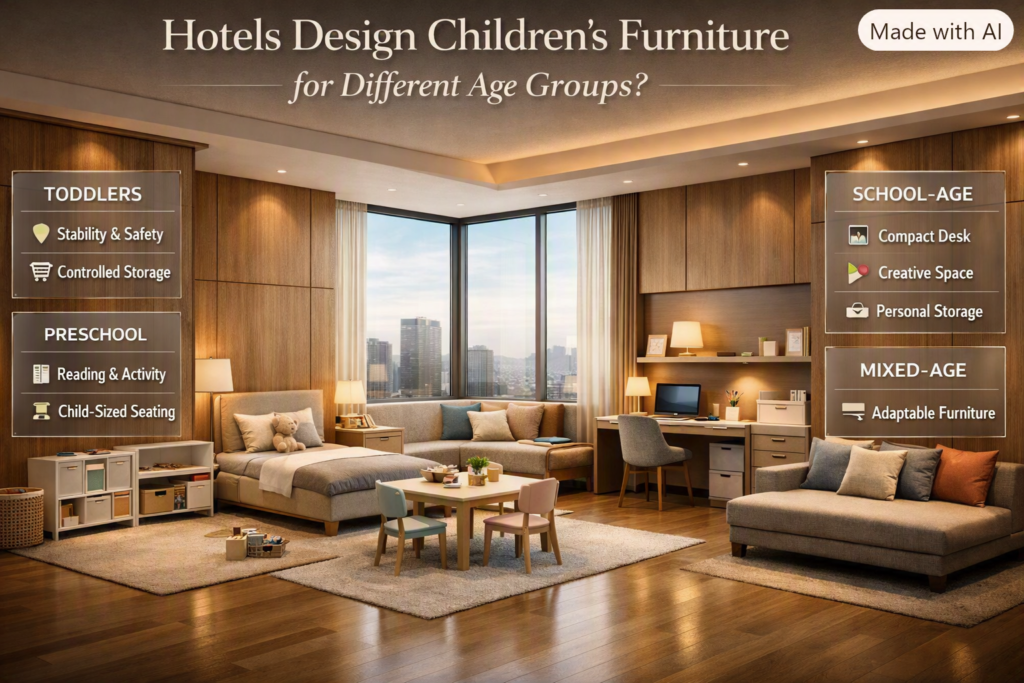
A major mistake is treating all children as one design category.
Toddlers
Toddlers require particularly careful attention to stability, accessibility, edges, and furniture interaction.
Their environment should have:
- Stable furniture
- Accessible but controlled storage
- Simple layouts
- Clear floor areas
- Easy-clean materials
- Minimal unnecessary objects
Preschool Children
Preschoolers need more independence.
They may use:
- Small activity tables
- Reading seats
- Low storage
- Child-sized chairs
- Creative activity furniture
Furniture can encourage independent use while remaining easy for parents to supervise.
School-Age Children
Older children may need furniture for:
- Reading
- Homework
- Gaming
- Drawing
- Personal storage
- Relaxation
A compact desk or flexible activity zone can be more valuable than purely decorative furniture.
Mixed-Age Families
Mixed-age rooms are more challenging.
In these spaces, adaptable furniture often provides the best solution.
For example, a comfortable bench can serve a younger child while also providing useful seating for an older child or parent.
How Can Small Hotel Rooms Fit Children’s Furniture?
Small rooms don’t necessarily need fewer functions. They need better planning.
The first principle is to protect circulation.
A room may look spacious on a floor plan but feel cramped once beds, chairs, tables, luggage, and storage are added. Children need clear movement areas because they naturally move less predictably than adults.
Useful solutions include:
- Under-bed storage
- Storage benches
- Foldable tables
- Nesting stools
- Wall-mounted shelving
- Narrow cabinets
- Convertible desks
- Integrated bedside storage
- Multi-purpose seating
The objective is to make each furniture piece perform more than one useful job whenever practical.
For example:
BENCH
→ seating
→ luggage support
→ hidden storage
This is more efficient than installing three separate pieces.
For more practical planning principles, see Practical Home Improvement Guides.
How Should Furniture Be Arranged in a Children’s Hotel Room?
Furniture placement should create clear functional zones instead of distributing pieces randomly around the room.
A simple arrangement can be:
SLEEPING ZONE → STORAGE ZONE → ACTIVITY ZONE → RELAXATION ZONE
Each zone should have a clear purpose.
Sleeping Zone
Keep unnecessary furniture away from the sleeping area.
A bedside table, small storage unit, or integrated shelf may be enough.
Activity Zone
Place the activity table where there is sufficient natural or artificial light and enough space for children to pull out chairs safely.
Storage Zone
Put frequently used children’s belongings within reasonable reach while keeping adult-controlled items higher or secured.
Relaxation Zone
A bench, small sofa, reading chair, or cushioned seat can create a comfortable space away from the bed.
Good furniture planning should also account for doors, windows, curtains, heating or cooling equipment, outlets, and housekeeping access.
How Can Children’s Hotel Furniture Look Stylish Instead of Childish?
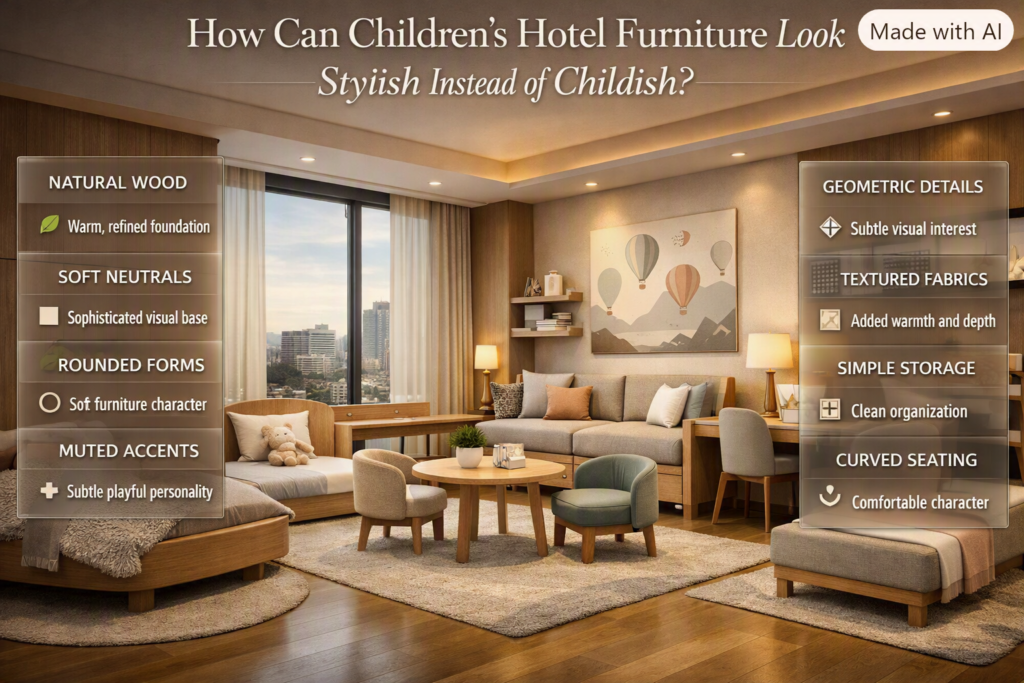
This is one of the most important design questions for hotels that want a premium appearance.
Child-friendly doesn’t mean cartoon-themed.
A sophisticated children’s room can use adult-level interior design with carefully selected playful details.
Consider:
- Natural wood
- Soft neutral walls
- Rounded furniture
- Subtle geometric patterns
- Muted accent colors
- Illustrated artwork
- Textured fabrics
- Simple storage
- Curved seating
Instead of making every furniture piece bright yellow, blue, or red, designers can use a neutral foundation and introduce personality through smaller elements.
This allows the room to appeal to both parents and children.
For broader interior concepts, Interior Design provides additional inspiration for coordinating furniture with the overall interior.
What Colors Are Best for Children’s Hotel Furniture?
Color should support the hotel’s atmosphere and target audience.
Bright colors can work well in dedicated children’s playrooms, but an entire hotel suite covered in highly saturated colors can quickly become visually exhausting.
More adaptable combinations include:
- Natural wood + soft green
- Cream + muted blue
- Beige + warm yellow
- White + terracotta
- Light wood + sage
- Neutral upholstery + colorful accessories
A useful strategy is to keep expensive, permanent furniture relatively timeless and use replaceable accessories for stronger seasonal or playful colors.
For guidance on coordinating furniture with interior palettes, explore Paint Color.
How Does Children’s Furniture Affect Hotel Guest Experience?
Furniture influences the guest experience in ways that aren’t always obvious.
Imagine two family rooms.
Room A has a standard adult chair, a large desk, limited storage, and no dedicated space for children.
Room B has a comfortable family seating area, a small activity surface, accessible storage, and furniture that allows children to use the room more independently.
The second room immediately communicates greater thoughtfulness.
Parents don’t necessarily need luxury children’s furniture. They need furniture that solves practical problems.
A small storage unit can prevent toys from spreading across the floor. A comfortable child-sized chair can make reading easier. A bench can give parents a place to sit while helping children get ready.
The best furniture often solves these small problems quietly.
How Important Is Storage in Children’s Hotel Furniture?
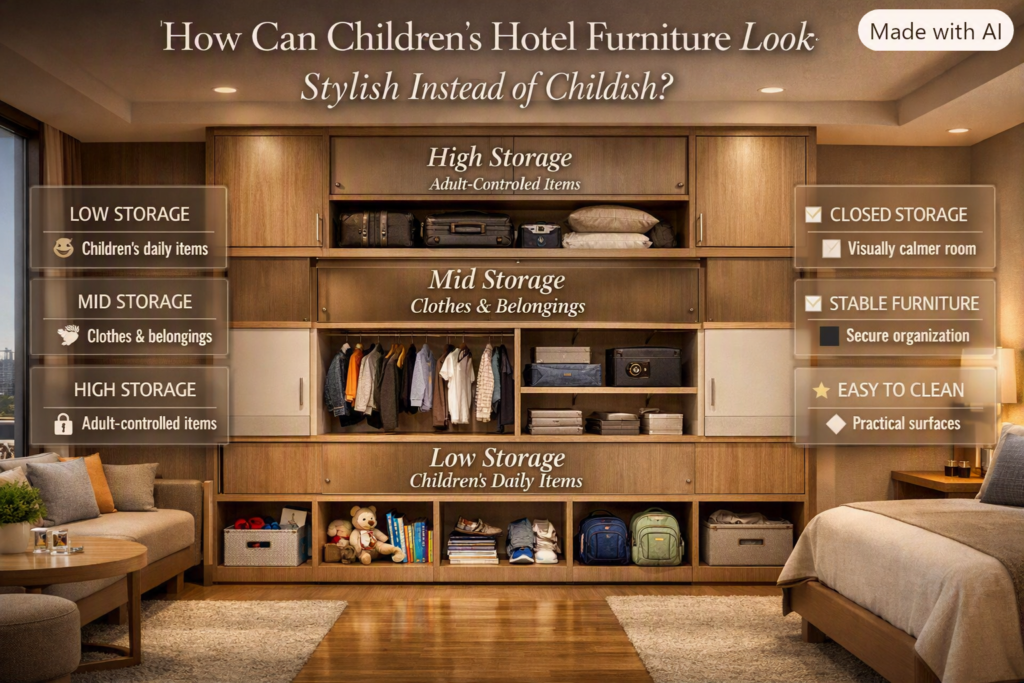
Storage is one of the most underestimated elements of family-friendly hotel design.
Families often arrive with considerably more belongings than individual business travelers.
Children may have:
- Clothes
- Shoes
- Books
- Toys
- Backpacks
- Tablets
- Chargers
- School items
- Sports equipment
Without appropriate storage, these belongings quickly occupy chairs, beds, floors, and tables.
A smart storage hierarchy can help:
LOW STORAGE → CHILDREN’S DAILY ITEMS
MID STORAGE → CLOTHES & PERSONAL BELONGINGS
HIGH STORAGE → ADULT-CONTROLLED ITEMS
Open cubbies are convenient for frequently used items, while closed storage keeps the room visually calmer.
Storage furniture should also remain stable and easy to clean.
For additional organization strategies, Smart Storage and Organization Ideas can complement a family-room furniture plan.
How Can Hotels Use Multifunctional Children’s Furniture?
Multifunctional furniture is particularly valuable where space or budgets are limited.
A single piece might provide two or three functions.
Examples include:
- Bench + storage
- Bed + drawers
- Desk + shelving
- Ottoman + seating
- Side table + storage
- Foldable table + activity surface
- Sofa + sleeping function
The advantage isn’t just saving floor space.
Fewer furniture pieces can also mean:
- Fewer surfaces to clean
- Fewer components to repair
- Easier housekeeping
- More flexible layouts
- Lower visual clutter
However, multifunctionality should never come at the expense of safety or reliability.
A complicated mechanism that frequently breaks isn’t genuinely practical.
How Should Hotels Choose Children’s Beds?
Beds require especially careful consideration because sleeping is the primary function of a hotel room.
The bed should be selected according to:
- Age group
- Room size
- Expected occupancy
- Mattress requirements
- Safety considerations
- Cleaning access
- Structural durability
For younger children, hotel operators may consider dedicated children’s sleeping arrangements where appropriate.
For mixed family accommodation, convertible or integrated solutions can sometimes provide greater flexibility.
The bed should also fit naturally into the overall room design rather than looking like an unrelated children’s product.
How Should Children’s Hotel Furniture Be Maintained?
Maintenance should be planned before the furniture is purchased.
Hotel furniture doesn’t simply need to survive use; it needs to remain presentable after repeated cleaning and handling.
Housekeeping and maintenance teams should routinely inspect:
- Loose screws
- Damaged edges
- Worn upholstery
- Broken handles
- Unstable chairs
- Damaged finishes
- Loose drawers
- Faulty mechanisms
- Structural damage
A furniture inspection system can be simple:
USE → INSPECT → CLEAN → REPAIR → RETURN TO SERVICE
If a component creates a safety concern, it should not remain in use simply because the damage appears minor.
💡 Pro Tip: Specify furniture with replacement parts whenever possible. Being able to replace a damaged handle, caster, panel, or upholstery component can extend the useful life of an otherwise good piece.
What Makes Commercial Children’s Furniture Different?
Residential furniture and hospitality furniture operate under very different conditions.
Residential furniture may be used by the same family for years. Hotel furniture is used by constantly changing guests with different behaviors.
Commercial furniture therefore needs to account for:
- High frequency of use
- Frequent cleaning
- Accidental impacts
- Moving furniture
- Intensive housekeeping
- Repairs
- Replacement cycles
This is why a product that looks suitable in a showroom may not necessarily be appropriate for a hotel.
Ask for specifications related to commercial or hospitality use where relevant, and evaluate the furniture as an operational asset rather than simply a decorative purchase.
Children’s Furniture vs Standard Hotel Furniture
| Feature | Standard Hotel Furniture | Children’s Hotel Furniture |
|---|---|---|
| Dimensions | Adult-focused | Child-appropriate where needed |
| Edges | May be angular | Softened or rounded preferred |
| Storage | Adult access | Child-accessible zones |
| Seating | Adult proportions | Child or adaptable proportions |
| Durability | Hospitality-grade | Hospitality-grade with child use considered |
| Design | General aesthetic | Playful but coordinated |
| Maintenance | Regular | Frequent and practical |
| Function | Adult activities | Family and child activities |
The goal isn’t to replace all standard hotel furniture.
Instead, the best family hotel design combines adult furniture with carefully selected child-focused pieces.
What Are the Most Common Children’s Hotel Furniture Mistakes?
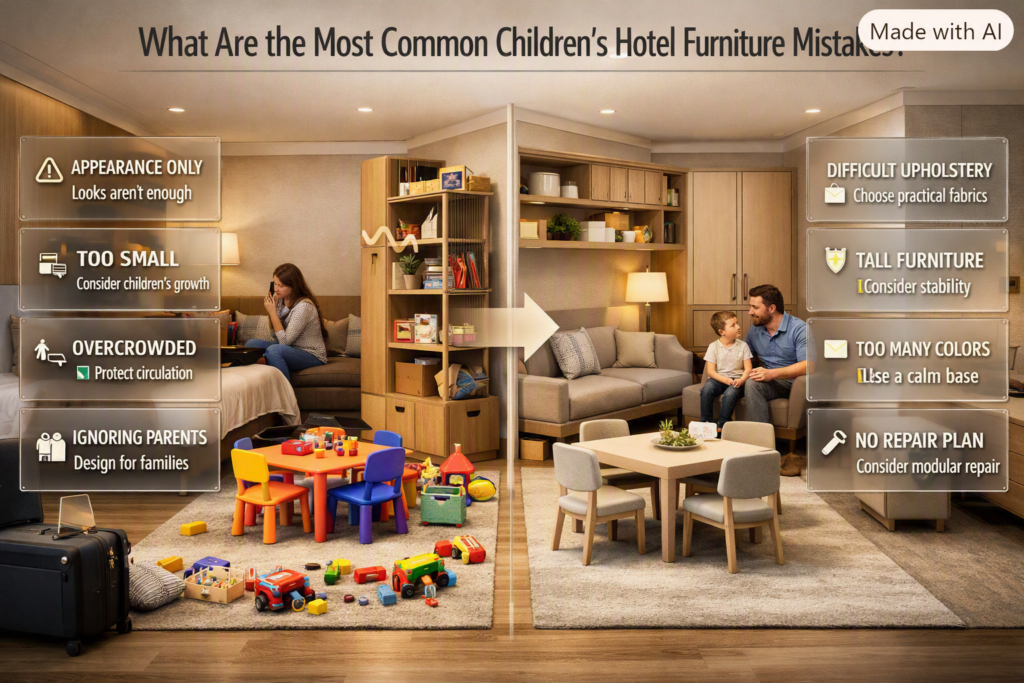
Buying Furniture Only for Appearance
A colorful chair may photograph beautifully but still be unstable, difficult to clean, or uncomfortable.
Solution: Evaluate safety, durability, comfort, cleaning, and appearance together.
Making Everything Extremely Small
Furniture designed for very young children can become useless as children grow.
Solution: Define the target age range before selecting dimensions.
Overcrowding the Room
Too many children’s furniture pieces reduce circulation and make housekeeping harder.
Solution: Prioritize multifunctional furniture.
Ignoring Parents
Children aren’t the only guests.
Parents need comfortable seating, storage, luggage space, charging access, and easy movement.
Solution: Design for the family unit.
Choosing Difficult-to-Clean Upholstery
Delicate fabrics may create maintenance problems.
Solution: Select practical commercial-grade upholstery suited to the hotel’s cleaning procedures.
Installing Tall Furniture Without Proper Stability Considerations
Storage furniture can create unnecessary risk if it isn’t appropriately secured.
Solution: Follow manufacturer installation requirements and applicable safety practices.
Using Too Many Bright Colors
A room can become visually chaotic when every surface competes for attention.
Solution: Use a calm base palette and introduce playful accents selectively.
Forgetting Replacement and Repair
Even durable furniture eventually gets damaged.
Solution: Consider replacement parts, modular construction, and repairability during procurement.
How Can Designers Create Better Children’s Hotel Furniture Packages?
Instead of selecting each furniture item independently, designers can create a complete furniture package.
For example:
Basic Family Room Package
- Compact children’s chair
- Small activity table
- Low storage unit
- Bedside storage
- Durable bench
Premium Family Suite Package
- Child-sized reading chair
- Activity desk
- Integrated storage
- Multi-use bench
- Premium upholstery
- Custom bedside furniture
Resort Children’s Room Package
- Playful seating
- Activity furniture
- Open cubbies
- Soft furnishings
- Durable wood furniture
- Flexible storage
Packages make procurement easier and help maintain visual consistency.
They also reduce the risk of ending up with furniture pieces that look like they belong to completely different design concepts.
How Can Interior Design Support Children’s Hotel Furniture?
Furniture doesn’t exist independently.
Wall color, flooring, lighting, window treatments, artwork, storage, and accessories all influence how furniture performs visually and functionally.
For example, a dark wooden children’s table may look heavy against a dark wall but balanced against a warm neutral background.
Likewise, colorful furniture may need a calmer surrounding palette.
The overall goal is coordination.
For broader residential and hospitality-inspired design thinking, Room-by-Room Interior Design Inspiration can provide useful ideas for thinking about each space as part of a larger interior system.
How Can Bedroom Planning Improve Children’s Hotel Rooms?
The bedroom is where furniture decisions become especially important because sleeping, storage, movement, and relaxation all compete for limited space.
A good bedroom plan should establish:
- Bed position
- Bedside access
- Storage
- Children’s activity area
- Parent seating
- Walking route
- Luggage location
Avoid pushing every piece against the wall simply because it appears to maximize floor space. Sometimes a slightly different arrangement creates better circulation and a more comfortable room.
For additional planning concepts, Bedroom Layouts provides useful guidance on organizing furniture around movement and function.
You can also explore Bedroom Ideas for broader bedroom design inspiration.
How Can Bathrooms Complement Family Hotel Furniture?
Children’s hotel furniture doesn’t stop at the bedroom.
Bathrooms also form part of the family experience.
Where appropriate, designers can consider:
- Step stools
- Accessible storage
- Rounded accessories
- Easy-clean surfaces
- Family-friendly organization
- Clear floor areas
The bathroom should remain practical for adults while providing appropriate support for younger users.
Furniture and storage choices should also coordinate visually with the rest of the suite.
For broader bathroom design inspiration, Bathroom Inspiration is a useful complementary resource.
Can DIY Elements Be Used in Children’s Hotel Furniture?
DIY-style ideas can inspire decorative details, but hotel operators should distinguish between visual inspiration and commercial furniture construction.
A decorative wall feature, removable artwork, or simple accessory may be suitable for a hotel.
Structural furniture, however, should meet the hotel’s safety, durability, installation, and maintenance requirements.
DIY concepts can still influence:
- Color treatments
- Decorative panels
- Artwork
- Storage labeling
- Activity boards
- Soft accessories
For home-oriented project inspiration that can inform decorative thinking, DIY Home Projects offers additional ideas.
How Should Hotels Budget for Children’s Furniture?
Budgeting should consider the complete lifecycle of the furniture.
Don’t look only at:
Purchase Price
Also consider:
Purchase + Delivery + Installation + Maintenance + Repairs + Replacement
A cheaper chair that needs replacement every two years may ultimately cost more than a durable chair that remains functional for five years.
A simple comparison can help:
| Option | Initial Cost | Expected Durability | Maintenance | Long-Term Value |
|---|---|---|---|---|
| Budget furniture | Low | Lower | Higher | Variable |
| Mid-range commercial | Medium | Good | Moderate | Strong |
| Premium hospitality | Higher | High | Lower/controlled | Strong for high traffic |
The correct choice depends on the hotel’s operating model.
A luxury resort may prioritize premium finishes and long-term durability, while a budget property may focus on robust, easily replaceable components.
How Can Hotels Make Children’s Furniture More Sustainable?
Sustainability shouldn’t be reduced to material labels.
Longevity matters.
Furniture that lasts longer, can be repaired, and doesn’t need frequent replacement can reduce waste and purchasing cycles.
Consider:
- Durable construction
- Repairable components
- Replaceable upholstery
- Modular parts
- Responsible material sourcing
- Long-lasting finishes
- Adaptable furniture
- Reduced replacement frequency
A modular chair, for example, may be more sustainable operationally if its seat component can be replaced without discarding the entire frame.
The same principle applies to storage, desks, benches, and other frequently used furniture.
How Can Hotels Test Furniture Before Buying in Bulk?
A sample installation can reveal problems that product photographs and specifications don’t show.
Before ordering large quantities, test representative furniture for:
Comfort
Can children sit naturally?
Stability
Does the furniture remain stable during normal child interaction?
Cleaning
Can housekeeping clean the surfaces efficiently?
Durability
Do joints, edges, hardware, and finishes feel robust?
Appearance
Does the furniture actually work with the hotel’s interior?
Maintenance
Can damaged components be repaired or replaced?
A short testing period can prevent a much larger procurement mistake.
⭐ Expert Tip: If possible, let housekeeping staff evaluate the furniture too. Designers see aesthetics and user experience; housekeeping teams see cleaning difficulty, weight, access, and maintenance problems that may otherwise be missed.
How Can Hotels Keep Children’s Furniture Flexible?
Hotel rooms change over time.
Guest demographics shift. Design trends evolve. Rooms may be renovated. A furniture package that works today may need to accommodate a different audience later.
Flexible furniture can help.
Look for pieces that:
- Work with different layouts
- Serve multiple age groups
- Coordinate with neutral interiors
- Can be reupholstered
- Can be repaired
- Can be moved safely
- Can be combined with other pieces
This is another reason to avoid overly themed furniture.
A cartoon-shaped chair may appeal strongly to a specific age group today but become visually outdated quickly.
A beautifully designed rounded chair with a playful cushion can remain useful for much longer.
What Should Hotels Look for in Children’s Hotel Furniture Suppliers?
A good supplier should provide more than attractive product photographs.
Before purchasing, ask about:
- Construction
- Commercial-use suitability
- Material specifications
- Cleaning recommendations
- Available finishes
- Warranty
- Replacement components
- Lead times
- Installation
- Maintenance
- Customization options
For larger hospitality projects, consistency matters too.
If a hotel is furnishing 30 family rooms, furniture should remain consistent across batches.
Replacement availability is another important consideration.
If a particular chair becomes unavailable after two years, replacing one damaged unit can become difficult if the original design is highly specialized.
Step-by-Step: How to Plan Children’s Hotel Furniture
Step 1: Define the Guest Profile
Determine whether the hotel mainly serves toddlers, families with school-age children, teenagers, or mixed-age groups.
Step 2: Identify Activities
List the activities children are likely to perform.
Sleeping, reading, playing, drawing, watching television, eating, and storing belongings require different furniture functions.
Step 3: Measure the Room
Record:
- Room dimensions
- Door positions
- Windows
- Existing furniture
- Storage
- Circulation routes
Step 4: Establish Safety Requirements
Review edges, stability, moving parts, installation requirements, and furniture placement.
Step 5: Select Materials
Choose materials based on cleaning, durability, appearance, and maintenance.
Step 6: Create a Furniture Schedule
List every piece, its dimensions, quantity, finish, location, and intended function.
Step 7: Test Samples
Evaluate representative pieces before committing to large-scale procurement.
Step 8: Review the Family Experience
Ask:
- Can parents move comfortably?
- Can children reach useful storage?
- Is there enough open floor space?
- Is furniture easy to clean?
- Does the room still look attractive?
Step 9: Plan Maintenance
Document cleaning, inspections, repairs, and replacement procedures.
Step 10: Review the Complete Room
Furniture should be evaluated as part of the complete interior rather than as isolated objects.
What Are the Most Important Design Principles?
Several principles consistently produce better results.
Safety Before Decoration
A beautiful room isn’t successful if furniture creates avoidable risks.
Function Before Quantity
More furniture doesn’t necessarily mean better design.
Durability Before Cheap Pricing
Purchase price should be evaluated alongside expected service life.
Accessibility Without Losing Adult Control
Children should be able to access appropriate belongings independently while adult-controlled items remain protected.
Playfulness Without Visual Chaos
Use color, shape, artwork, and accessories strategically.
Flexibility Over Excessive Theming
Adaptable furniture usually remains useful longer.
Maintenance During Design
Housekeeping realities should influence material and furniture choices from the start.
What should hotels consider when choosing children’s hotel furniture?
Choosing children’s hotel furniture requires more than selecting smaller versions of standard hotel furniture. The furniture needs to work within a commercial hospitality environment while also being safe, comfortable, durable, easy to clean, and visually appropriate for children. Hotels should consider rounded or softened edges, stable construction, secure fittings, child-appropriate dimensions, durable finishes, and materials that can tolerate frequent cleaning. Furniture should also fit naturally into the hotel’s overall interior rather than making the room feel like a temporary playroom.
The best approach is to evaluate every piece according to three factors: child safety, operational durability, and guest experience. A beautiful chair that stains easily or a decorative storage unit that can tip over isn’t a good hospitality investment.
Key points to check:
Rounded or softened exposed corners
Stable, tip-resistant construction
Durable commercial-grade materials
Easy-to-clean surfaces and upholstery
Non-toxic or appropriately certified finishes
Comfortable proportions for the intended age group
Designs that complement the hotel’s interior style
⭐ Expert Tip: Don’t judge children’s furniture only by appearance. Ask suppliers for material specifications, durability information, safety documentation, and warranty terms before approving a complete hotel furniture package.
What are the most important safety features in children’s hotel furniture?
Safety should be the starting point rather than an afterthought. Children’s hotel furniture should minimize avoidable hazards such as sharp corners, unstable storage units, exposed fasteners, pinch points, and furniture that can be easily pulled or tipped. Tables, beds, chairs, benches, wardrobes, and other frequently accessed pieces should be designed with the way children actually move through a room in mind.
Rounded edges are particularly useful on tables and other furniture placed in active circulation areas. Tall or potentially unstable storage should have appropriate anchoring or a stable, low center of gravity. Moving components should also be checked for finger-trapping and pinch hazards.
Important safety considerations include:
Rounded or radiused furniture edges
Strong joints and secure hardware
Appropriate anchoring for tall furniture
Stable bases that resist tipping
Protected or concealed hardware where appropriate
No easily accessible sharp projections
Safe positioning away from windows, cords, and other hazards
A useful hotel design principle is to conduct a child-height safety review. Inspect the room from a child’s perspective rather than standing at adult eye level. The American Academy of Pediatrics similarly recommends checking hotel rooms for accessible hazards, unstable furniture, cords, sharp edges, and tip-over risks.
What materials are best for children’s hotel furniture?
The best material depends on the specific furniture piece, expected level of use, cleaning requirements, and hotel environment. There isn’t one material that is automatically ideal for every children’s hotel room. Instead, successful specifications usually combine durable surfaces with strong structural construction and finishes that can tolerate hospitality cleaning routines.
For tables, desks, storage units, and casegoods, high-pressure laminates, quality engineered panels, and properly finished wood products can provide practical combinations of durability and cleanability. Upholstered furniture requires fabrics and internal construction capable of handling repeated use and cleaning. Moisture resistance becomes especially important for furniture close to bathrooms, sinks, or other areas where spills are likely.
Popular material choices include:
Material
Best Use
Main Advantage
Laminated surfaces
Tables, desks, storage
Easy maintenance
Solid/engineered wood
Beds, chairs, casegoods
Strong and versatile
Performance upholstery
Benches, chairs, sofas
Comfort with durability
Metal
Frames and structural components
Strength and longevity
Quality composites
Lightweight furniture
Flexible design options
📌 Professional Tip: Specify the material according to the actual job it needs to perform. A surface that looks premium in a showroom may not perform well when exposed to spilled drinks, crayons, luggage, repeated wiping, and daily housekeeping.
How can hotels make children’s furniture fit into small hotel rooms?
Small rooms don’t necessarily need less children’s furniture—they need better-planned furniture. The most effective solution is to make individual pieces perform more than one function while preserving clear circulation for children and adults.
For example, an upholstered bench can provide seating while incorporating concealed storage. A compact children’s desk can double as an activity or drawing area. A bed platform can incorporate drawers underneath, while a wall-mounted shelf can provide accessible storage without consuming valuable floor space.
The key is to avoid filling the room with small, independent pieces. Too many objects make a family room feel crowded and create additional surfaces for housekeeping to clean.
Smart space-saving strategies include:
Under-bed storage
Built-in wardrobes
Storage benches
Wall-mounted shelving
Compact activity tables
Multifunctional desks
Integrated bedside storage
Modular furniture systems
⚠ Common Mistake: Don’t sacrifice circulation just to add more children’s furniture. Parents need to move luggage, assist young children, and access beds and bathrooms comfortably. Good family-room design is about usable space, not simply the number of furniture pieces.
How can children’s hotel furniture look stylish without making the room feel too childish?
The strongest children’s hotel interiors don’t rely on oversized cartoon graphics or brightly colored furniture everywhere. Instead, professional hospitality design often creates a sophisticated base and introduces child-friendly elements through scale, color, texture, pattern, and carefully selected details.
A neutral room can include a playful upholstered chair, colorful storage compartments, a themed headboard, illustrated artwork, or a small activity zone without changing the entire visual identity of the hotel. This approach allows the room to appeal to children while still feeling comfortable and premium to parents.
The same principle applies to themed rooms. Current hospitality design trends include concepts such as ocean exploration, safari, space, magical forests, and dinosaur themes, but successful implementations integrate the theme with practical furniture rather than turning every surface into decoration.
A balanced children’s hotel palette can use:
Warm neutrals as the foundation
Two or three accent colors
Natural wood tones
Playful but controlled patterns
Soft upholstery
Themed accessories that can be replaced easily
⭐ Expert Tip: Design the room so that the furniture remains useful even if the theme changes. A well-made wooden storage unit or upholstered bench can remain in service for years, while artwork, cushions, wall graphics, and accessories can be updated at a much lower cost.
Conclusion
Children’s hotel furniture should never be treated as simply smaller furniture designed for younger guests. It is an important part of the overall hospitality experience, where safety, comfort, durability, functionality, and visual appeal all need to work together. Families notice the details—from the stability of a chair and the softness of an upholstered bench to the availability of practical storage and the ease with which surfaces can be cleaned.
The strongest approach is to choose furniture according to the real demands of hotel use. Rounded edges, stable construction, durable materials, easy-maintenance finishes, age-appropriate proportions, and smart space planning can make family rooms significantly more comfortable without compromising the hotel’s design standards. At the same time, multifunctional pieces can help hotels create child-friendly spaces even when rooms have limited floor area.
Design also matters. Children’s spaces don’t have to look overly colorful or themed to feel welcoming. A sophisticated neutral foundation combined with carefully selected colors, textures, playful accessories, and appropriately scaled furniture can create an environment that feels enjoyable for children while remaining attractive to parents.
Ultimately, successful children’s hotel furniture is about creating a room that works for the entire family. When furniture is carefully specified, intelligently arranged, easy for housekeeping teams to maintain, and consistent with the hotel’s broader interior identity, it becomes more than a collection of products—it becomes part of the guest experience.
For further inspiration and practical interior planning ideas, explore Design Mode 24 Interior Design and use its broader design resources to develop family-friendly spaces that balance practicality with a polished hospitality aesthetic.

Leave a Reply