
Introduction
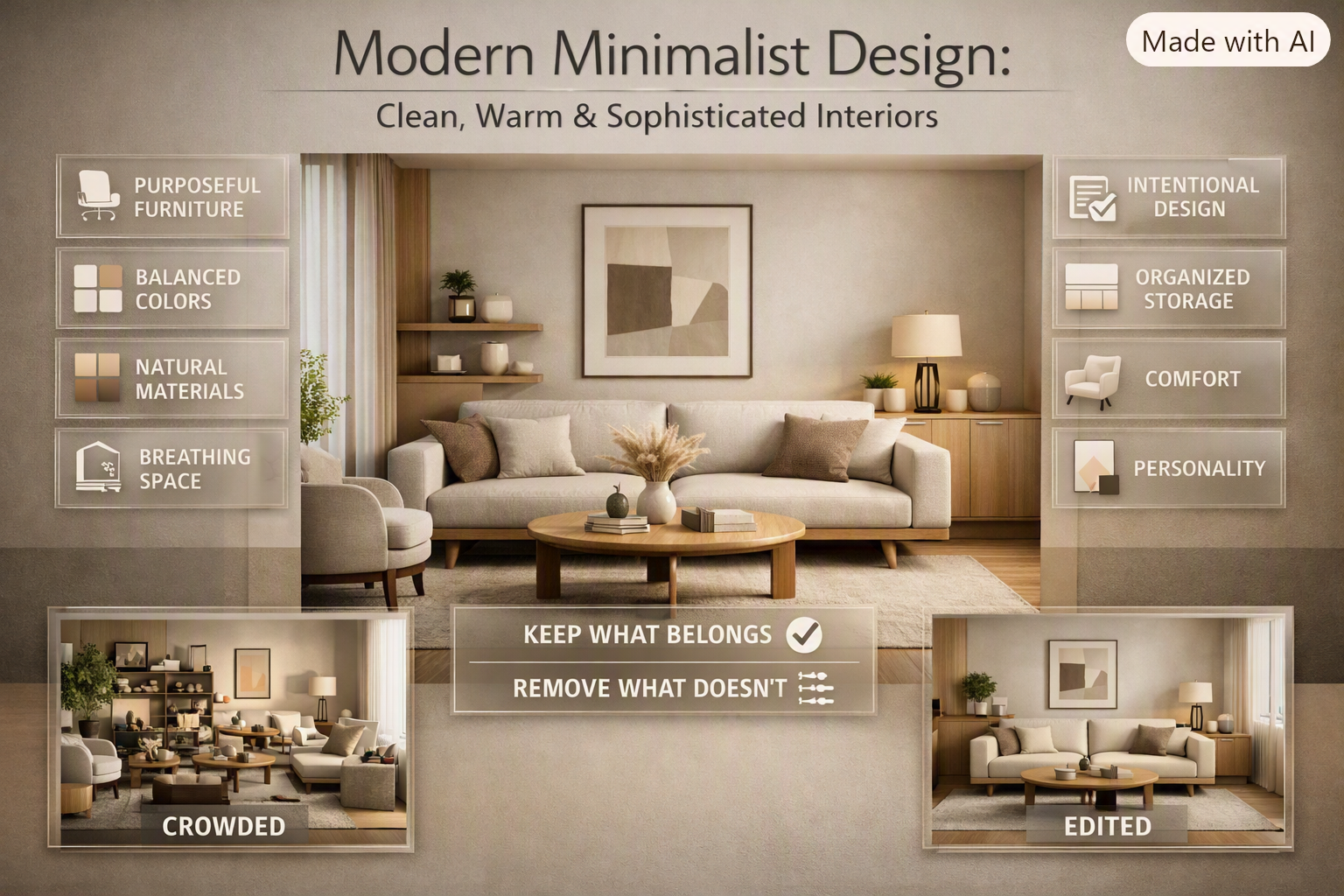
Modern Minimalist Design | A home can have beautiful furniture, expensive finishes, and plenty of space, yet still feel uncomfortable when every surface is crowded and every room contains too many competing elements. On the other hand, a simple room with carefully selected furniture, balanced colors, natural materials, and enough breathing space can feel remarkably sophisticated.
That is the real appeal of modern minimalist design.
Modern minimalism isn’t about making your home completely empty or throwing away everything you own. It’s about deciding what genuinely belongs in your space and removing what doesn’t. The result is an interior that feels organized, intentional, comfortable, and easier to live in.
For homeowners exploring professional interior ideas, DesignMode24 Interior Design offers a useful starting point for understanding different approaches to creating better spaces.
In this guide, you’ll learn how modern minimalist design works, which colors and materials create the right atmosphere, how to select furniture, how to make minimalist rooms feel warm, how to organize storage, how to approach different rooms, which mistakes to avoid, and how to create a minimalist interior without making it look boring or impersonal.
What Is Modern Minimalist Design?
Modern minimalist design is an interior design approach based on simplicity, functionality, clean lines, intentional furniture selection, restrained decoration, and visual balance. It uses space as an active part of the design rather than trying to fill every wall, surface, and corner.
The word modern refers to the contemporary character of the style, while minimalist describes the controlled use of objects, colors, patterns, and visual details.
The combination creates an interior that can feel sophisticated without being excessive.
A modern minimalist living room, for example, might contain a comfortable sofa, a simple coffee table, a textured rug, concealed storage, one large piece of artwork, and carefully layered lighting.
That’s enough.
The room doesn’t need ten cushions, multiple decorative tables, dozens of accessories, and a wall covered with small frames to feel complete.
Is Minimalism the Same as Having an Empty House?
No.
This is one of the biggest misunderstandings surrounding minimalist interiors.
Minimalism is not about owning nothing. It’s about owning and displaying things intentionally.
A family home still needs toys, books, kitchen equipment, clothing, technology, paperwork, and everyday objects. The goal is to give those things appropriate places rather than allowing them to dominate the visual environment.
A minimalist home can therefore be:
- Comfortable
- Family-friendly
- Colorful
- Luxurious
- Warm
- Personal
- Practical
- Sustainable
The difference is that the design has a clear hierarchy.
Why Is Modern Minimalist Design So Popular?
Modern homes often have to perform several jobs at once. A living room may also be a workspace. A kitchen may function as a dining area. A bedroom may contain storage, a dressing area, and a small desk.
When every available surface becomes useful storage, the home can quickly feel crowded.
Minimalist design responds to this problem by prioritizing clarity and organization.
Instead of asking, “What else can I add?” the homeowner asks:
“What does this room actually need?”
That small change in thinking can dramatically improve an interior.
The Main Benefits of Modern Minimalism
1. It Makes Rooms Feel More Spacious
Visual clutter can make even a large room feel smaller.
Removing unnecessary furniture and maintaining clear circulation paths allows more of the floor and architecture to remain visible.
2. It Makes Cleaning Easier
Fewer objects mean fewer surfaces to dust and fewer things to move while cleaning.
This is particularly useful for busy households.
3. It Creates a Calmer Atmosphere
A controlled visual environment generally feels easier to process than a room filled with competing colors, patterns, and objects.
4. It Highlights Quality
When there are fewer objects, materials become more noticeable.
A beautiful oak table, stone surface, or well-made sofa can become a visual feature rather than disappearing into a crowded room.
5. It Can Be More Sustainable
Buying fewer but more durable pieces can reduce unnecessary consumption.
Instead of replacing inexpensive furniture every few years, homeowners can focus on pieces that are useful and long-lasting.
6. It Adapts Easily
A neutral minimalist foundation can be updated with artwork, textiles, plants, or accent colors without redesigning the entire room.
What Are the Core Principles of Modern Minimalist Design?
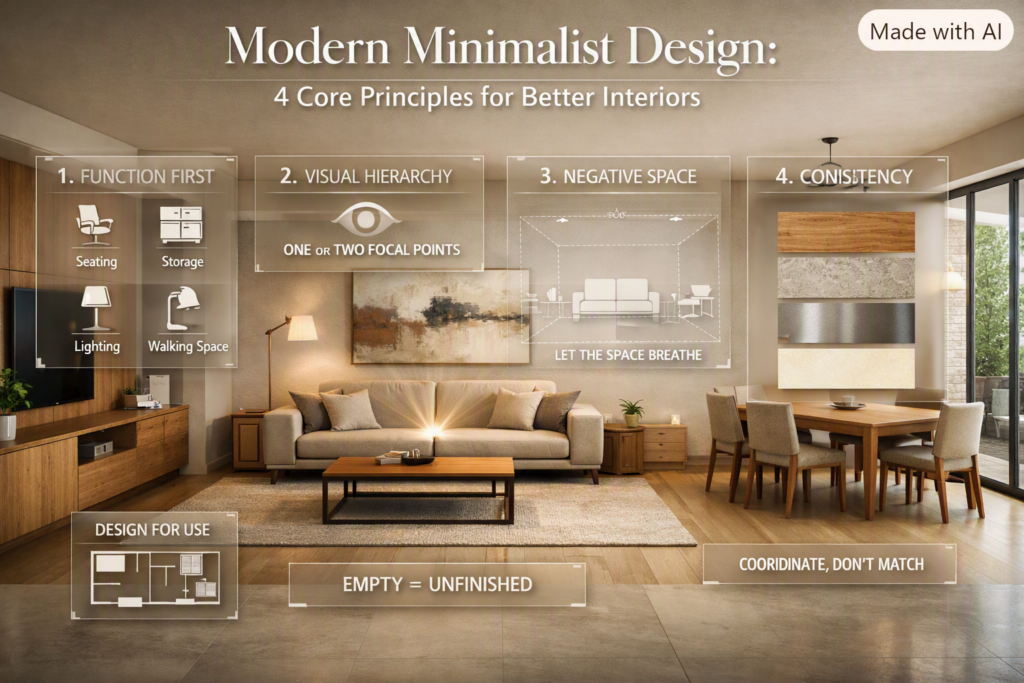
Successful minimalist interiors usually follow several principles. These aren’t rigid rules, but they provide a strong framework when you’re unsure where to begin.
1. Function Comes Before Decoration
Every room should have a clear purpose.
Before buying furniture, determine how the space will actually be used.
For a living room, you might need:
- Comfortable seating
- A coffee table
- Media storage
- Reading light
- Walking space
- A place for books or personal items
For a bedroom, the essentials may include:
- Bed
- Bedside storage
- Wardrobe
- Lighting
- Curtains
- A rug
- Limited decorative elements
This prevents the common mistake of buying attractive items first and trying to find a purpose for them afterward.
2. Create Visual Hierarchy
Not everything in a room should demand attention at the same time.
Choose one or two focal points.
For example:
Living room → sofa + artwork
Bedroom → bed + headboard
Kitchen → island + pendant lighting
Home office → desk + view
Everything else should support those features.
3. Protect Negative Space
Negative space is the area around objects.
It’s often ignored because homeowners think empty areas represent unfinished design.
In reality, negative space helps important furniture and architectural features stand out.
A clear section of wall can make artwork look more powerful. Space around a sofa can make the furniture feel more substantial. A mostly empty countertop can make a kitchen look cleaner.
4. Maintain Consistency
Minimalism becomes stronger when the visual language remains consistent.
If your kitchen has warm oak cabinetry, natural stone, brushed metal, and cream tones, introducing several unrelated materials in the adjacent dining area can make the home feel disconnected.
Consistency doesn’t mean everything has to match.
It means the elements should feel like they belong together.
How Do You Choose the Right Minimalist Color Palette?
Color is one of the easiest ways to establish a minimalist atmosphere.
The safest approach is to begin with a dominant neutral, add a supporting material or tone, and then introduce a small amount of contrast.
Popular minimalist colors include:
- Warm white
- Cream
- Beige
- Taupe
- Greige
- Soft gray
- Sand
- Mushroom
- Muted green
- Charcoal
- Deep brown
- Soft black
Should a Minimalist Home Be All White?
Not necessarily.
An all-white room can look clean, but without texture or tonal variation it may become flat or sterile.
A warmer combination can feel much more sophisticated:
Cream walls + oak furniture + beige upholstery + black accents
Another option is:
Warm white + walnut + charcoal + natural linen
The important point isn’t choosing a specific “minimalist color.” It’s controlling the relationship between colors.
For homeowners working on a broader color strategy, the Paint Color category can provide additional inspiration.
Warm Minimalism vs. Cool Minimalism
There are two broad directions you can take.
| Warm Minimalism | Cool Minimalism |
|---|---|
| Cream and beige | White and cool gray |
| Oak and walnut | Concrete and metal |
| Linen and wool | Glass and polished surfaces |
| Warm lighting | Neutral lighting |
| Organic shapes | Sharper geometric forms |
| Cozy atmosphere | Architectural atmosphere |
Warm minimalism is often easier to live with because natural wood and soft textiles prevent the space from feeling clinical.
Cool minimalism can look extremely sophisticated, especially in contemporary architecture, but it requires careful attention to lighting and texture.
Which Materials Work Best in Modern Minimalist Interiors?
When decoration is limited, materials become more important.
A room with only a few furniture pieces needs those pieces to contribute through texture, shape, and material quality.
Natural Wood
Wood is one of the most useful materials for minimalist interiors because it introduces warmth without visual clutter.
Oak creates a lighter Scandinavian-inspired feeling, while walnut provides deeper contrast and a more sophisticated atmosphere.
Natural Stone
Stone can add subtle luxury without requiring decorative patterns.
Travertine, limestone, marble, and other understated stones work particularly well for:
- Coffee tables
- Kitchen islands
- Bathroom surfaces
- Side tables
- Fireplace surrounds
Metal
Black, bronze, brushed steel, and other restrained finishes can add definition.
Use metal as an accent rather than covering every surface with it.
Glass
Glass is particularly useful in smaller spaces because it maintains visual openness.
A glass coffee table, for example, can provide function without creating the same visual weight as a solid table.
Textiles
Minimalist rooms need texture.
Consider:
- Linen
- Cotton
- Wool
- Bouclé
- Woven rugs
- Soft curtains
- Textured upholstery
⭐ Expert Tip: Keep the color palette simple but let the textures vary. A room becomes much more interesting when smooth stone sits beside natural wood, soft fabric, and woven materials.
How Should You Choose Furniture for a Minimalist Home?
Furniture selection is where many minimalist projects succeed or fail.
A common misconception is that minimalist furniture must be extremely small, thin, or uncomfortable.
That’s not true.
The furniture should be appropriately scaled to the room.
A large comfortable sofa can work beautifully in a minimalist living room if the room is large enough to accommodate it.
Ask These Four Questions Before Buying Furniture
Does it serve a purpose?
If you can’t explain why you need it, reconsider the purchase.
Is it comfortable?
Minimalism shouldn’t sacrifice everyday usability.
Is it correctly proportioned?
A tiny sofa in a large room can look just as awkward as an oversized sofa in a small room.
Does it work with existing materials?
Furniture should contribute to the overall composition rather than introduce a completely unrelated visual language.
How Important Is Proportion in Minimalist Design?
Proportion is one of the invisible factors that makes an interior feel professionally designed.
You may not know why a room feels balanced, but furniture scale, spacing, ceiling height, rug dimensions, and artwork placement are often responsible.
For example, a small rug floating underneath only the center of a large seating arrangement can make the furniture appear disconnected.
A larger rug that anchors the sofa and surrounding chairs usually creates a stronger composition.
The same principle applies to artwork.
One oversized piece can sometimes look more sophisticated than five small pieces scattered across a large wall.
How Do You Make Minimalist Interiors Feel Warm and Comfortable?
This is perhaps the most important practical question.
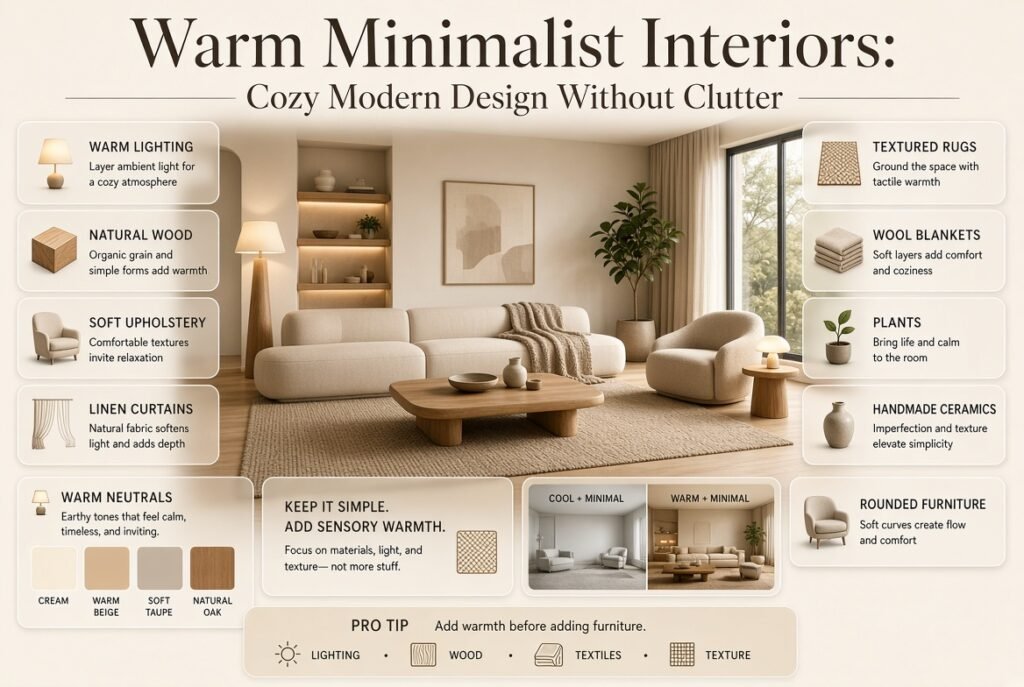
Minimalism becomes uncomfortable when homeowners remove visual clutter without replacing it with texture and sensory warmth.
You can keep the room visually simple while making it physically comfortable.
Use:
- Warm lighting
- Natural wood
- Soft upholstery
- Linen curtains
- Textured rugs
- Wool blankets
- Plants
- Handmade ceramics
- Rounded furniture
- Warm neutral colors
Imagine two rooms.
The first has white walls, gray furniture, polished flooring, glass, and bright ceiling lights.
The second uses cream walls, oak furniture, a soft rug, linen curtains, warm lamps, and one large plant.
Both can be minimalist.
The second simply has more sensory depth.
💡 Pro Tip: When a minimalist room feels cold, don’t immediately add more furniture. First add warmth through lighting, wood, textiles, and texture.
What Role Does Lighting Play in Modern Minimalist Design?
Lighting isn’t simply a technical requirement. In a minimalist interior, it becomes part of the architecture.
Because there are fewer decorative objects, lighting fixtures and shadows become more noticeable.
A good lighting plan normally includes three layers.
Ambient Lighting
This provides general illumination.
Examples include:
- Ceiling fixtures
- Recessed lighting
- Architectural lighting
Task Lighting
This supports specific activities.
Examples include:
- Desk lamps
- Reading lamps
- Under-cabinet kitchen lighting
- Vanity lighting
Accent Lighting
This creates atmosphere and draws attention to selected features.
Use it to highlight:
- Artwork
- Shelves
- Architectural details
- Plants
- Textured walls
Natural daylight should also be considered during furniture placement.
A beautiful minimalist desk is less useful if sunlight constantly creates glare on the computer screen.
How Can You Decorate a Minimalist Home Without Creating Clutter?
The answer is selective decoration.
Minimalism doesn’t mean no accessories.
It means accessories should have a reason for being there.
A large ceramic vase may provide more visual value than six tiny decorative objects.
A single framed artwork may create a stronger focal point than a gallery wall filled with unrelated pieces.
Useful minimalist accessories include:
- Sculptural vases
- Large plants
- Oversized artwork
- Quality books
- Handmade ceramics
- Decorative mirrors
- Simple candles
- Textured cushions
- Carefully selected sculptures
The goal is to create visual punctuation, not constant visual noise.
The One-In, One-Out Approach
If your room already has enough accessories, consider removing one object before introducing another.
This simple habit prevents gradual accumulation.
Over several months, homes often become cluttered not because of one large purchase but because of dozens of small additions.
How Does Storage Support Minimalist Design?
Storage is one of the most important elements of a successful minimalist home.
You can’t maintain visual simplicity if everyday objects have nowhere to go.
Prioritize storage that allows you to keep frequently used items accessible while hiding visual clutter.
Useful options include:
- Built-in wardrobes
- Closed cabinets
- Floating drawers
- Storage beds
- Concealed media units
- Built-in shelving with closed sections
- Ottoman storage
- Multi-purpose furniture
Open shelving can still work, but it needs discipline.
Display only objects that contribute to the room.
If every shelf becomes a place to store random items, the minimalist effect disappears.
For homes with limited floor area, Smart Space-Saving Solutions offers useful ideas for combining storage with functionality.
How Can Modern Minimalist Design Work in the Living Room?
The living room is usually the most visible space in the home, so it’s a good place to establish the overall design language.
Start with the sofa.
Choose something comfortable and proportionate to the room.
Then add a coffee table, rug, lighting, storage, and one or two strong decorative elements.
Avoid automatically filling every empty corner.
A Practical Minimalist Living Room Formula
Sofa → Rug → Coffee Table → Lighting → Storage → Artwork → One Organic Element
The organic element might be a plant, natural wood feature, or textured material.
For homeowners wanting a more polished living-room approach, Elegant Living Room Styling can complement these minimalist principles.
How Do You Create a Modern Minimalist Bedroom?
The bedroom should feel calm rather than visually stimulating.
The bed naturally becomes the focal point.
Choose simple bedding in neutral or muted colors and avoid excessive patterns.
Bedside tables should contain only what you actually use.
A lamp, book, phone charger, and small personal object may be enough.
Focus on These Elements
- Comfortable bed
- Simple headboard
- Soft bedding
- Warm bedside lighting
- Concealed clothing storage
- Soft rug
- Minimal artwork
- Appropriate curtains
Avoid turning the bedroom into an office, storage room, and entertainment center unless the available space requires it.
For homeowners who want minimalism with more warmth, Cozy Bedroom Makeover provides a useful complementary direction.
How Can You Apply Minimalism to a Modern Kitchen?
A minimalist kitchen depends heavily on organization.
The objective is not necessarily to hide every appliance. It’s to make the kitchen visually coherent.
Cabinet fronts should have a consistent appearance, while unnecessary countertop items should be reduced.
Consider:
- Integrated appliances
- Simple cabinet fronts
- Consistent hardware
- Large-format surfaces
- Under-cabinet lighting
- Hidden storage
- Open areas for food preparation
A wood island or natural stone surface can provide a focal point without introducing excessive decoration.
For a broader kitchen planning approach, explore Modern Kitchen Design.
What Does a Modern Minimalist Home Office Need?
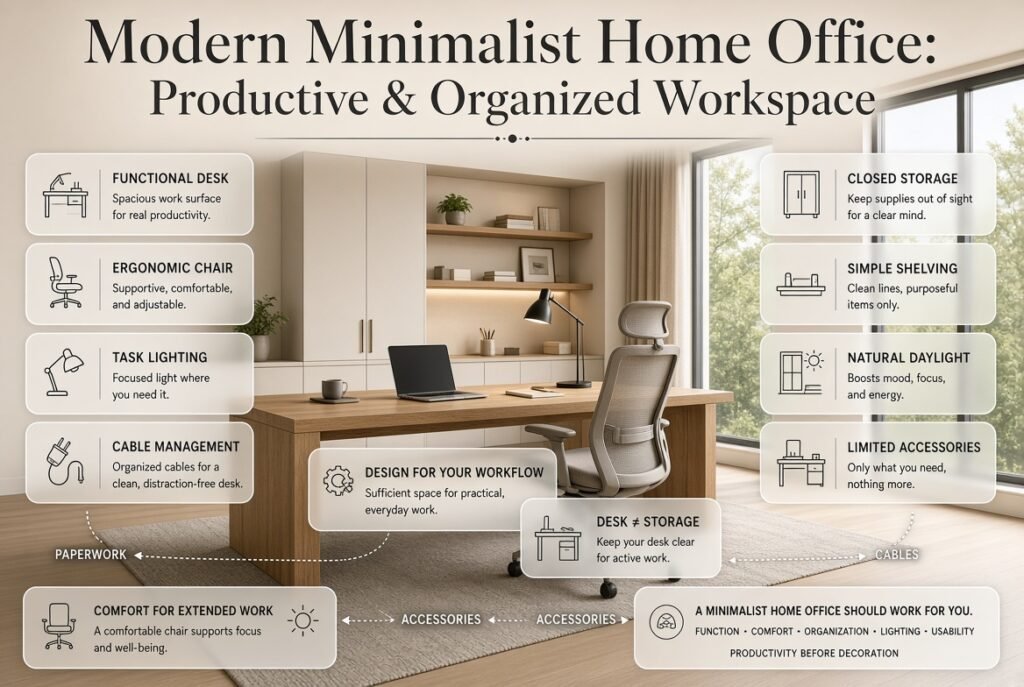
A minimalist home office should prioritize productivity rather than aesthetics alone.
The desk needs enough space for your actual workflow.
The chair should be comfortable for extended periods.
Cables should be managed rather than left hanging around the workspace.
Storage should prevent paperwork and accessories from taking over the desk.
Essential Elements
- Functional desk
- Comfortable ergonomic chair
- Task lighting
- Cable management
- Closed storage
- Simple shelving
- Natural daylight
- Limited desk accessories
The desk should remain a workspace, not become another storage surface.
For more room-specific guidance, see Functional Home Office.
Can Plants Be Used in Modern Minimalist Design?
Absolutely.
Plants are particularly useful because they introduce organic shapes into interiors dominated by straight lines and hard surfaces.
Instead of filling every available corner with plants, choose one or two that have strong visual presence.
A large plant beside a sofa or near a window can become a natural focal point.
You can also introduce nature through:
- Wood
- Stone
- Woven materials
- Natural fibers
- Organic shapes
- Daylight
This approach connects naturally with Biophilic Interior Design, particularly if your goal is to combine minimalist simplicity with a stronger connection to nature.
Can Modern Minimalism Look Luxurious?
Yes.
Luxury doesn’t require visual excess.
In fact, some of the most sophisticated contemporary interiors use relatively few objects.
The difference is often visible in:
- Material quality
- Craftsmanship
- Proportion
- Custom cabinetry
- Lighting
- Joinery
- Natural stone
- Premium textiles
- Bespoke furniture
A simple walnut console with excellent craftsmanship can have more impact than a room full of inexpensive decorative furniture.
This is where minimalism can overlap with Luxury Contemporary Interiors.
The goal is to let quality speak for itself.
Modern Minimalist Design vs. Scandinavian Style
Minimalism and Scandinavian design are closely related, but they aren’t identical.
Scandinavian interiors generally place a stronger emphasis on warmth, comfort, natural light, practical furniture, and cozy textures.
Modern minimalism may be more architectural and restrained.
| Feature | Modern Minimalist | Scandinavian |
| Main focus | Simplicity and function | Simplicity and comfort |
| Colors | Neutral and restrained | Light and warm |
| Materials | Wood, stone, glass, metal | Wood, textiles, natural fibers |
| Decoration | Highly selective | Simple but cozy |
| Atmosphere | Calm and refined | Warm and inviting |
| Shapes | Clean and contemporary | Soft and practical |
You can combine both successfully.
For example, use minimalist furniture and storage with Scandinavian wood, warm textiles, and softer lighting.
For a deeper look at that aesthetic, explore Scandinavian Style.
How Can You Make a Minimalist Home Sustainable?
A thoughtful minimalist approach naturally encourages more responsible consumption.
Instead of constantly buying new furniture to follow trends, focus on products that can remain useful for years.
Look for:
- Durable construction
- Repairable furniture
- Natural materials
- Timeless shapes
- Responsible sourcing
- Multi-functional products
Also consider what you already own.
A furniture piece doesn’t need to be thrown away simply because it isn’t perfectly minimalist.
Sometimes repainting, repairing, reupholstering, reorganizing, or changing hardware can make an existing piece work better.
For broader principles, see Sustainable Home Design.
How Can DIY Projects Support Minimalist Design?
Minimalism doesn’t always require a major renovation.
Small improvements can have a significant effect.
You might:
- Repaint a visually busy wall
- Replace mismatched handles
- Build simple storage
- Improve cable management
- Reorganize shelves
- Install better lighting
- Refinish an old table
- Create a cleaner entryway system
The important thing is to improve function rather than create projects simply for decoration.
For homeowners who enjoy hands-on improvements, DIY Home Projects can provide additional inspiration.
What Are the Biggest Modern Minimalist Design Mistakes?
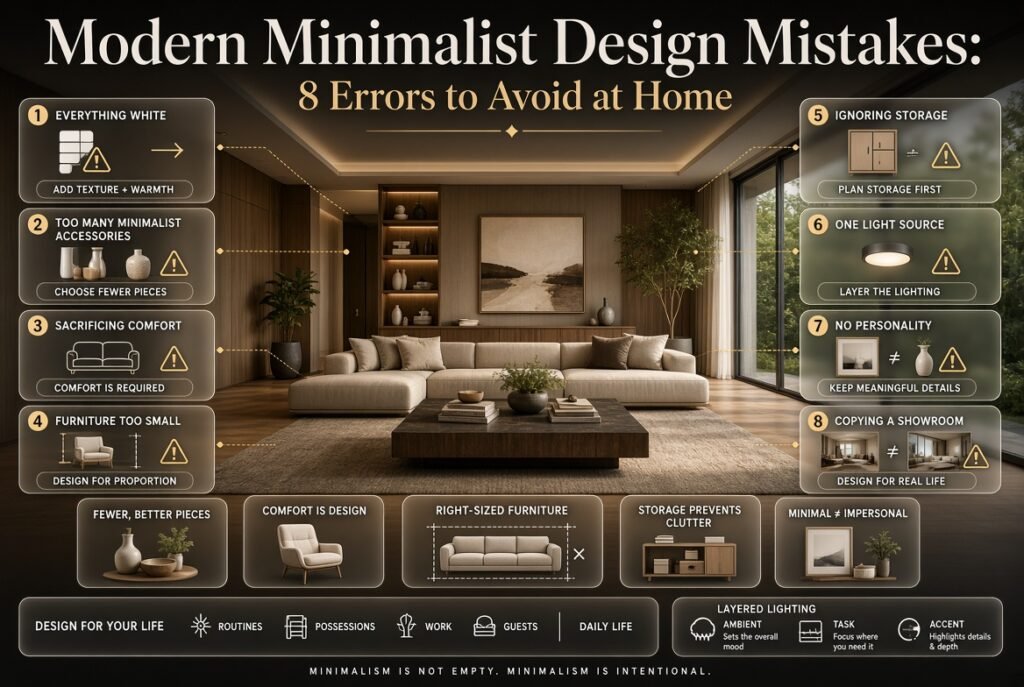
Mistake 1: Making Everything White
White alone doesn’t create sophistication.
Without texture and tonal variation, it can make a room feel unfinished.
Better solution: Add natural wood, textiles, artwork, greenery, and warm lighting.
Mistake 2: Buying Too Many Minimalist Accessories
Calling something “minimalist decor” doesn’t mean you need dozens of it.
A room can become cluttered with minimalist objects just as easily as with traditional decorations.
Better solution: Buy fewer pieces and choose them carefully.
Mistake 3: Sacrificing Comfort
A minimalist sofa that looks beautiful but feels uncomfortable isn’t successful design.
Better solution: Treat comfort as a design requirement.
Mistake 4: Using Furniture That Is Too Small
Minimalism isn’t miniature furniture.
Better solution: Measure the room and choose furniture according to proportion.
Mistake 5: Ignoring Storage
Without enough storage, clutter will eventually return.
Better solution: Plan storage before buying decorative furniture.
Mistake 6: Using One Light Source
A single ceiling light can make even a beautiful interior feel flat.
Better solution: Layer ambient, task, and accent lighting.
Mistake 7: Removing All Personality
A home shouldn’t look like an empty showroom.
Better solution: Keep meaningful artwork, books, photographs, plants, or objects.
Mistake 8: Copying a Showroom
A professionally photographed minimalist room may look perfect, but real homes have routines, possessions, children, work, guests, and daily mess.
Design your home for your life first.
A Step-by-Step Process for Creating a Modern Minimalist Home
Step 1: Define How You Use the Space
Write down the actual activities that happen in each room.
Don’t design based solely on how you want the room to look.
Step 2: Remove Obvious Clutter
Before buying anything new, remove unused or unnecessary items.
This gives you a more accurate understanding of what the room actually needs.
Step 3: Measure Everything
Measure:
- Room dimensions
- Windows
- Doors
- Ceiling height
- Existing furniture
- Circulation paths
Step 4: Select a Color Palette
Choose one dominant neutral, one or two supporting tones, and a small amount of contrast.
Step 5: Choose the Largest Furniture First
Start with:
- Sofa
- Bed
- Dining table
- Desk
- Wardrobe
These pieces establish the room’s scale.
Step 6: Plan Storage
Decide where everyday objects will go.
Don’t leave storage decisions until the end.
Step 7: Add Lighting
Create different lighting layers according to how the room is used.
Step 8: Introduce Texture
Use wood, stone, textiles, rugs, and plants to prevent the space from feeling flat.
Step 9: Add Personality
Introduce artwork, books, photographs, ceramics, or other meaningful objects selectively.
Step 10: Edit the Room
Once everything is in place, remove anything that feels unnecessary.
⚠ Common Mistake: Don’t add accessories simply because a surface looks empty. Sometimes the empty surface is exactly what makes the room feel sophisticated.
How Can You Tell If Your Minimalist Room Is Actually Finished?
A useful professional test is to walk into the room and ask three questions:
What is the focal point?
If everything competes for attention, the room needs editing.
Can I move comfortably?
If furniture blocks pathways, the room isn’t functioning correctly.
Does everything have a purpose?
If several objects exist only because you felt the room “needed something,” reconsider them.
Another useful test is to take a photograph.
A camera often reveals clutter that isn’t obvious when you’re standing inside the room.
Look for:
- Too many small objects
- Uneven furniture spacing
- Competing colors
- Excessive patterns
- Visible cables
- Empty-looking furniture arrangements
- Artwork that is too small
- Rugs that don’t anchor furniture
Photography is a simple but effective design-editing tool.
How Can You Make Modern Minimalist Design Work for Families?
Minimalism and family life can coexist.
The trick is designing storage around actual behavior.
Children need accessible places for toys. Adults need convenient storage for keys, technology, paperwork, shoes, and daily items.
Instead of expecting everyone to maintain an unrealistic showroom, create simple systems.
For example:
Entryway → closed shoe storage + hooks + small tray
Living room → closed media storage + baskets
Bedroom → wardrobe organization + under-bed storage
Kitchen → appliance zones + concealed countertop storage
The goal is not perfection.
The goal is making organization easy enough that the household can maintain it.
How Does Minimalism Affect Everyday Living?
A good minimalist interior should make life easier.
You should be able to clean the room quickly.
You should know where everyday items belong.
You should be able to walk through the space without moving furniture.
You should be able to relax without being surrounded by visual distractions.
This is why minimalism works best when it is treated as a functional design philosophy, not simply an aesthetic trend.
The most successful minimalist home isn’t the one that contains the fewest possessions.
It’s the one where the possessions that remain are useful, meaningful, and properly organized.
Expert Tips for Making Minimalist Interiors Look More Expensive
Focus on Alignment
Cabinet lines, artwork, furniture edges, and lighting positions should feel intentional.
Small alignment errors can make an otherwise expensive room look poorly planned.
Choose Larger Art
One well-proportioned artwork can create more impact than a collection of tiny frames.
Don’t Underestimate Curtains
Curtains influence the entire room.
Floor-length curtains with appropriate fullness can make ceilings feel taller and the interior more finished.
Hide Cables
Visible wires immediately create visual noise.
Use cable channels, concealed outlets, cable boxes, or integrated furniture where practical.
Invest in High-Use Items
If your budget is limited, prioritize:
- Sofa
- Bed and mattress
- Lighting
- Dining table
- Storage
- Window treatments
You can keep accessories affordable.
Mix Textures
A minimalist room becomes sophisticated when materials contrast subtly.
Think:
smooth stone + natural wood + soft fabric + woven rug + matte metal
That combination creates richness without clutter.
A Simple Modern Minimalist Design Checklist
Before considering your room complete, check the following:
Layout
- Is there enough walking space?
- Is furniture correctly scaled?
- Is the focal point obvious?
- Can doors and drawers open comfortably?
Color
- Are the main colors coordinated?
- Is there enough contrast?
- Does the room feel too cold?
- Are accent colors controlled?
Furniture
- Does every major piece have a purpose?
- Is it comfortable?
- Does it fit the room?
Storage
- Is everyday clutter hidden?
- Are frequently used items easy to access?
- Are shelves overfilled?
Lighting
- Is there adequate ambient light?
- Is task lighting available?
- Can accent lighting create atmosphere?
Decoration
- Are the accessories meaningful?
- Is artwork appropriately scaled?
- Is there enough negative space?
Final Test
Remove one unnecessary object.
If the room looks better without it, you’ve learned something important about the space.
Is Modern Minimalist Design Still Trending in 2026?
Modern minimalist design is still highly relevant in 2026, but the style has evolved. The stark version of minimalism—bright white rooms, cold gray surfaces, very little texture, and almost no personal elements—is giving way to warm minimalism. Designers are increasingly combining clean layouts with natural wood, earthy neutrals, tactile fabrics, softer lighting, organic shapes, and meaningful objects.
For homeowners, this is an important distinction. You don’t need to abandon minimalism; you simply need to make it more livable.
What is trending now:
Warm white, cream, beige, taupe, and earthy tones
Natural wood and stone
Linen, wool, and textured fabrics
Rounded and organic furniture shapes
Layered, warmer lighting
Fewer but more meaningful accessories
Personal artwork and collected pieces
The best 2026 minimalist interiors feel edited rather than empty. They maintain clean lines and visual order while allowing enough texture and personality for the home to feel genuinely lived in.
How Do You Make a Modern Minimalist Home Feel Warm and Cozy?
The easiest way to make minimalism feel warm is to add texture, natural materials, and softer lighting instead of adding more decoration. A minimalist room becomes cold when every surface is smooth, pale, hard, and visually identical. Warmth comes from contrast.
Start with a neutral foundation such as warm white, cream, beige, or taupe. Then introduce natural oak or walnut furniture, a textured rug, linen curtains, comfortable upholstery, and warm ambient lighting. Organic shapes can also soften the clean geometry normally associated with minimalist interiors.
A practical combination could be:
Cream walls
Natural oak furniture
Beige or taupe sofa
Wool or textured rug
Linen curtains
Warm-toned lamps
One large plant
One meaningful artwork
The important thing is restraint. If the room feels empty, don’t automatically buy ten accessories. Add one layer at a time and stop when the room feels balanced.
What Colors Work Best for Modern Minimalist Interiors in 2026?
The strongest minimalist palettes in 2026 are moving beyond basic white and gray toward warm, natural, and earthy colors. Cream, ivory, beige, taupe, mushroom, soft brown, muted green, terracotta, sand, and natural wood tones are particularly useful for creating a contemporary minimalist atmosphere.
This doesn’t mean every minimalist home needs to be beige. The better approach is to establish a dominant neutral and then introduce controlled contrast.
For example:
Warm & calm:
Cream + oak + beige + soft brown
Contemporary:
Warm white + walnut + charcoal + black
Natural:
Ivory + sand + olive + natural wood
More dramatic:
Warm beige + dark wood + charcoal + muted brass
A useful professional rule is to consider your permanent elements first—such as flooring, stone countertops, cabinetry, and architectural features—because their undertones can influence which wall and furniture colors will actually work.
The goal isn’t simply to choose “trending colors.” It’s to create a palette that works with the light, materials, architecture, and furniture already present in your home.
How Can You Make a Small Home Look Modern and Minimalist Without Making It Feel Empty?
A small home benefits from minimalist principles because reducing visual clutter can make the available space feel more open. However, the solution isn’t to use tiny furniture or remove everything. The key is better planning, appropriate scale, multifunctional furniture, and smart storage.
Start by keeping only furniture that the room genuinely needs. Choose pieces that perform more than one function where practical, such as storage ottomans, beds with drawers, extendable dining tables, or built-in cabinetry.
Focus on these areas:
Keep walking paths clear
Use closed storage for everyday clutter
Choose furniture according to the room’s actual dimensions
Avoid too many small decorative objects
Use consistent colors across connected spaces
Take advantage of natural light
Use mirrors selectively
Keep floors visually open where possible
The mistake is assuming that a small room needs small everything. One properly proportioned sofa can look better than several undersized chairs. Similarly, one large artwork can create more impact than a collection of tiny frames.
Minimalism should make a small home feel intentional and spacious, not unfinished.
How Do You Make Modern Minimalist Design Look Expensive Without Spending a Fortune?
A minimalist interior can look sophisticated without relying on expensive designer furniture. The secret is to spend less on unnecessary decoration and pay more attention to proportion, materials, lighting, consistency, and finishing details.
When a room contains fewer objects, poor-quality details become easier to notice. A badly sized rug, tangled cables, cheap-looking lighting, or poorly positioned artwork can undermine an otherwise beautiful space.
Prioritize your budget in this order:
Good-quality main furniture
Properly sized rugs
Effective lighting
Quality curtains or window treatments
Functional storage
Durable flooring and finishes
A few distinctive accessories
You can then save money on secondary decoration.
Another important 2026 principle is avoiding the “perfect showroom” effect. Current design commentary increasingly favors spaces with character, patina, craftsmanship, personal objects, and a lived-in quality rather than interiors that look mass-produced or overly staged.
The professional trick is simple: buy fewer things, but make the things you keep count. A well-made wooden table, beautiful lamp, textured rug, or meaningful artwork can give a minimalist room far more character than a large collection of inexpensive décor.
Conclusion
Modern minimalist design is no longer about creating a home that feels empty, cold, or overly perfect. The most successful approach is about intentional living, thoughtful choices, and creating enough visual space for everyday life to feel comfortable.
A well-designed minimalist home starts with function. Choose furniture that you genuinely use, keep the layout open and practical, and invest in storage that prevents everyday clutter from taking over. From there, build a calm visual foundation with warm neutrals, natural wood, stone, soft textiles, and carefully layered lighting.
Don’t be afraid to add personality. A favorite artwork, a meaningful photograph, a beautiful plant, or a handcrafted object can make a minimalist interior feel much more authentic. The goal isn’t to remove everything that makes your home personal; it’s to remove the things that don’t add value.
If you’re starting from scratch, don’t try to transform the entire house in one weekend. Begin with one room, remove unnecessary items, improve the layout, establish a simple color palette, and gradually introduce better materials and purposeful décor.
Ultimately, modern minimalist design is about quality over quantity. When every important element has a purpose and every room has enough space to breathe, your home becomes easier to maintain, more comfortable to live in, and visually timeless.
The best minimalist home isn’t the one with the fewest possessions. It’s the one where everything that remains has a reason to be there.
Leave a Reply