
Introduction
Scandinavian Style | A beautiful home doesn’t have to be crowded with furniture, expensive finishes, or decorative objects. In fact, sometimes the more you add, the less comfortable a room becomes. If your home feels cluttered, visually heavy, cold, or difficult to relax in, Scandinavian Style offers a refreshing alternative.
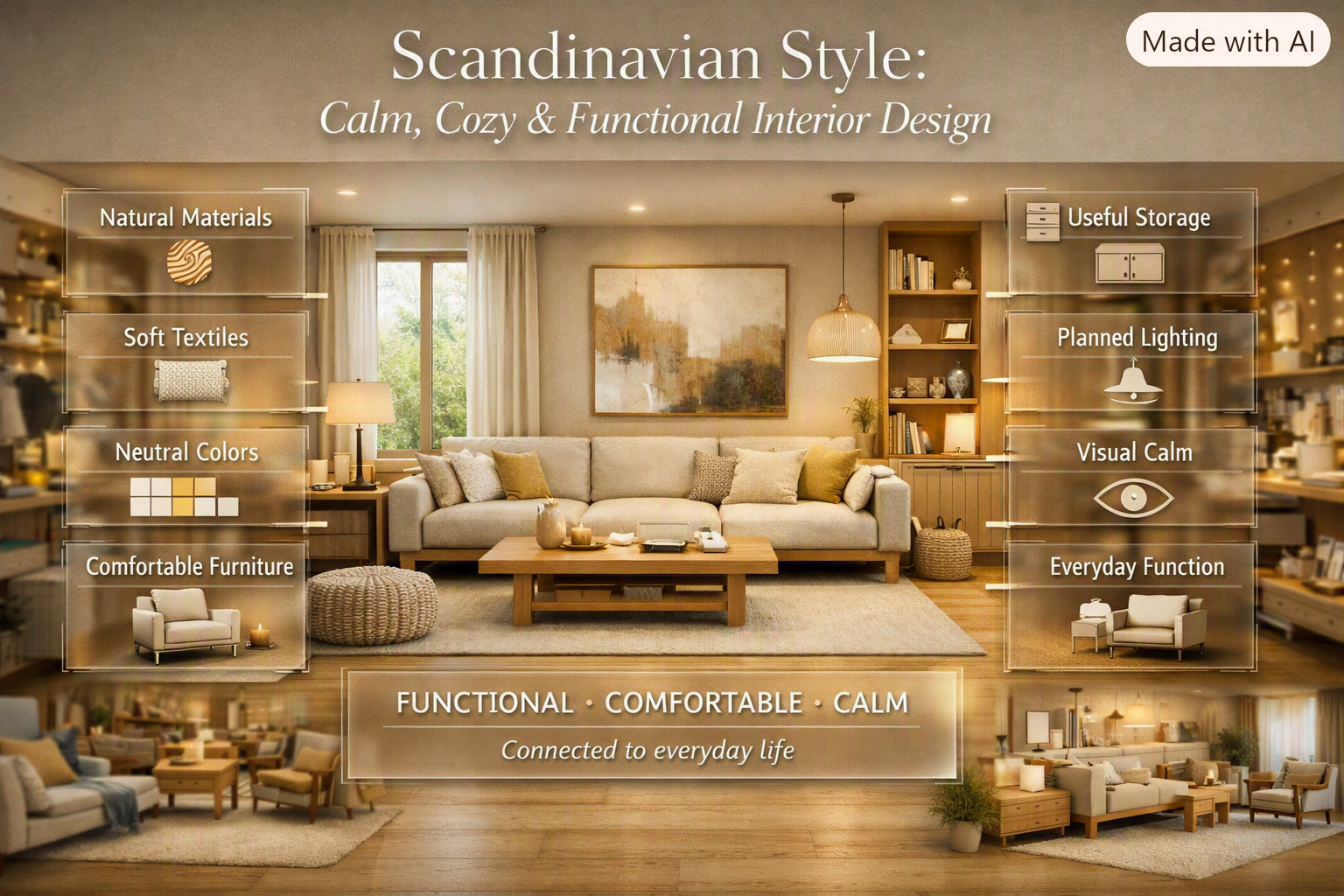
The appeal of Scandinavian interiors comes from their balance. Rooms feel clean without feeling empty, minimal without feeling severe, and stylish without looking overly decorated. Natural wood, soft textiles, neutral colors, comfortable furniture, useful storage, and carefully planned lighting all work together to create an environment that feels effortless.
If you’re exploring Scandinavian Style for your home, DesignMode24 Interior Design can also be a useful starting point for discovering broader interior design ideas and practical inspiration.
But Scandinavian design isn’t simply about painting everything white and buying light-colored furniture. There is a deeper philosophy behind it: make the home functional, comfortable, visually calm, and connected to everyday life.
This guide explains what Scandinavian Style really means, where it comes from, how to choose colors and materials, how to use it in every major room, how to combine it with modern interiors, which mistakes to avoid, and how to create the look without making your home feel generic.
What Is Scandinavian Style in Interior Design?
Scandinavian Style is an interior design approach associated primarily with Denmark, Sweden, and Norway that emphasizes simplicity, functionality, natural materials, soft colors, comfort, and thoughtful use of space. Its goal is to create homes that are practical and visually calm while still feeling warm and welcoming.
The style developed partly in response to the Nordic environment and lifestyle. Natural daylight can be limited during long winter periods, so interiors traditionally place a strong emphasis on light colors, practical lighting, comfortable furnishings, and materials that create warmth.
However, the Scandinavian approach isn’t just about climate.
It reflects a broader attitude toward home life. Furniture should serve a purpose. Spaces should be easy to use. Decoration should have meaning. Materials should feel authentic. And a home should support the people living in it rather than constantly demanding attention.
That distinction is important.
A room with ten minimalist objects isn’t automatically Scandinavian. Likewise, a white room with pale furniture can still feel cold and poorly designed.
The real Scandinavian aesthetic comes from balance between simplicity and comfort.
Why Does Scandinavian Design Feel So Calm?
Scandinavian interiors usually reduce unnecessary visual competition.
Instead of having several large decorative elements fighting for attention, the room may have one comfortable sofa, a simple wooden table, a textured rug, a few carefully chosen accessories, and good lighting.
This creates visual hierarchy.
Your eyes know where to look.
The room also becomes easier to maintain because everything has a purpose or a designated place.
⭐ Expert Tip: When designing a Scandinavian room, don’t ask only, “What should I add?” Ask, “What can I remove without reducing comfort or function?” That question often produces better results.
What Are the Main Principles of Scandinavian Style?
Although Scandinavian interiors can look very different from one home to another, several principles appear repeatedly.
Simplicity Without Emptiness
Scandinavian design values simplicity, but it isn’t about making a home feel unfinished.
A successful room still needs artwork, textiles, plants, books, lighting, and personal objects. The difference is that these elements are selected deliberately.
Function Before Decoration
Furniture should make everyday life easier.
A coffee table needs the right size and height. Storage should be accessible. Dining chairs need to be comfortable. Lighting should support the activities happening in the room.
A beautiful object that makes the room harder to use isn’t a good design decision.
Natural Materials
Wood, wool, linen, cotton, leather, stone, ceramic, and other natural materials are frequently used because they introduce texture and warmth.
Light and Air
Scandinavian interiors generally avoid unnecessary visual weight.
Furniture with slim legs, open pathways, uncluttered surfaces, and light-colored finishes can make rooms feel more spacious.
Comfort
Comfort is essential.
A Scandinavian home should look attractive, but it should also make you want to sit down, read a book, have coffee, talk with family, or simply relax.
Which Colors Are Best for Scandinavian Style?
Color is one of the most recognizable parts of Scandinavian interiors, but the traditional white-and-gray formula is only one interpretation.
The foundation is usually made from soft, understated colors that create a calm background.
Popular choices include:
- Warm white
- Cream
- Soft beige
- Light gray
- Greige
- Taupe
- Pale blue
- Muted green
- Dusty pink
- Warm brown
Black and charcoal can be used as accents to create contrast.
Should Scandinavian Walls Be White?
Not necessarily.
White works well because it reflects natural light and provides a clean background. However, a warm off-white can often feel more comfortable than a stark, cool white.
This is particularly important if your furniture includes pale wood and your room receives warm artificial lighting.
A completely cool white palette can sometimes make a room feel clinical.
A warmer palette creates more depth.
Can You Use Bold Colors?
Yes, but use them intentionally.
Instead of painting an entire room bright orange or saturated blue, consider introducing color through:
- A chair
- Artwork
- Cushions
- A rug
- Curtains
- Ceramic accessories
- A small accent wall
Muted colors tend to integrate more naturally with Scandinavian materials.
📌 Quick Tip: If you’re unsure about color, keep 70–80% of the room visually quiet and use the remaining portion for controlled contrast and personality.
Why Is Natural Wood So Important in Scandinavian Interiors?
Natural wood is one of the easiest ways to introduce warmth into a minimalist space.
Pale oak, ash, birch, and pine are particularly compatible with Scandinavian design because their lighter tones maintain the room’s airy character.
Wood can appear almost anywhere:
- Flooring
- Dining tables
- Coffee tables
- Chairs
- Bed frames
- Shelving
- Cabinets
- Wall details
- Decorative accessories
The objective isn’t to make every surface wooden.
Too much wood can make the room feel visually repetitive.
Instead, use wood as a warm counterpoint to painted walls, upholstery, glass, metal, and textiles.
How Many Wood Tones Should You Use?
There’s no strict rule, but too many competing wood finishes can create unnecessary visual noise.
If you have a dominant oak floor, for example, you don’t necessarily need five different wood finishes in the same room.
Choose a primary wood tone and introduce secondary tones sparingly.
⚠ Common Mistake: Buying furniture pieces individually without considering their relationship to the existing flooring, doors, cabinetry, and other wood elements.
Before purchasing new furniture, look at the room as a complete composition.
How Does Scandinavian Style Use Furniture?
Scandinavian furniture is generally simple, functional, and comfortable.
You won’t typically see excessive ornamentation, complicated profiles, or furniture that exists purely to impress.
Instead, you’ll find:
- Streamlined sofas
- Simple wooden chairs
- Practical storage
- Lightweight tables
- Functional shelving
- Comfortable lounge chairs
- Simple beds
- Multipurpose furniture
This doesn’t mean everything needs to look identical.
In fact, a room becomes more interesting when furniture pieces have slightly different shapes and materials while still sharing a common visual language.
Why Are Furniture Proportions So Important?
A small room can look crowded even when it doesn’t contain many objects if the furniture is oversized.
Likewise, a large room can feel unfinished if every piece is too small.
Measure the space before purchasing.
Consider:
- Sofa width
- Walking clearance
- Coffee table distance
- Dining chair movement
- Door swings
- Window access
- Storage requirements
Scandinavian design works best when the room has enough breathing space.
How Important Is Lighting in Scandinavian Style?
Lighting is fundamental.
The right furniture and colors can still fail if the lighting is harsh, insufficient, or poorly positioned.
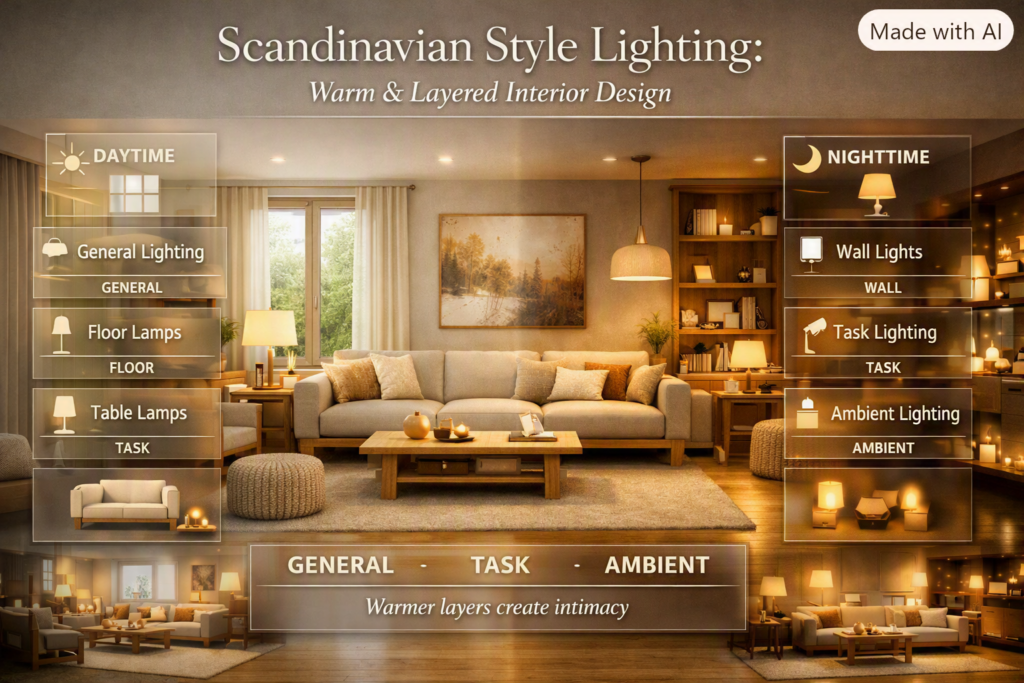
Scandinavian interiors generally benefit from multiple lighting sources rather than relying on a single ceiling fixture.
Consider combining:
- General ceiling lighting
- Floor lamps
- Table lamps
- Wall lights
- Task lighting
- Decorative or ambient lighting
This creates different levels of illumination throughout the room.
During the day, natural daylight should be allowed to do as much work as possible.
At night, warmer layers can create a much more intimate atmosphere.
Why Is Layered Lighting Better Than One Ceiling Light?
A single ceiling fixture illuminates the room broadly but often creates flat lighting.
A floor lamp beside a sofa can create a reading zone.
A table lamp can add warmth to a sideboard.
Under-cabinet lighting can improve a kitchen work area.
Together, these sources create depth.
⭐ Expert Tip: Design lighting according to activities, not just room size. Ask where people read, cook, work, relax, eat, and move through the space.
How Do Textures Make Scandinavian Interiors Warmer?
Minimalist interiors can become cold when every surface is smooth.
Texture solves this problem.
You can create visual depth using:
- Wool rugs
- Linen curtains
- Knitted throws
- Cotton cushions
- Bouclé upholstery
- Natural wood
- Handmade ceramics
- Woven baskets
- Leather
- Stone
Notice that you don’t necessarily need more colors.
You can keep the palette neutral while varying the textures.
This is one of the most effective Scandinavian design techniques.
For example, a cream sofa against a cream wall may initially look plain. Add a wool rug, linen curtains, pale oak table, textured cushions, and warm lighting, and suddenly the same neutral palette has depth.
How Do You Create a Scandinavian Living Room?
The living room should combine comfort, openness, and understated visual interest.
Start with a sofa that is genuinely comfortable rather than selecting one only because it looks minimal.
Then build around it.
A practical Scandinavian living room might include:
- Neutral upholstered sofa
- Pale wood coffee table
- Textured area rug
- Comfortable lounge chair
- Floor lamp
- Small side table
- A few cushions
- Indoor plant
- Simple artwork
- Closed storage
Avoid filling every wall and surface.
Instead, give important pieces room to breathe.
If you’re developing the entire living room rather than just adopting Scandinavian principles, see Elegant Living Room Styling for additional room-specific ideas.
A Simple Scandinavian Living Room Formula
Comfortable neutral sofa + natural wood + soft rug + layered lighting + greenery + restrained decoration
This formula is flexible enough to work in apartments, family homes, and larger contemporary properties.
How Do You Design a Scandinavian Bedroom?
A Scandinavian bedroom should feel calm before it feels decorative.
Start with a simple bed and a restrained color palette.
Warm white walls, natural wood, beige bedding, soft gray textiles, and muted colors work particularly well.
Then layer fabrics.
For example:
- Cotton sheets
- Linen duvet
- Knitted throw
- Soft cushions
- Wool rug
- Lightweight curtains
The result feels comfortable without requiring excessive decoration.
Keep bedside surfaces relatively clear.
A lamp, book, small ceramic piece, or plant may be enough.
For homeowners working on a complete bedroom transformation, Cozy Bedroom Makeover provides another useful direction for creating a comfortable sleeping environment.
What Should You Avoid in a Scandinavian Bedroom?
Avoid excessive visual stimulation.
A bedroom doesn’t need:
- Ten decorative cushions
- Multiple competing patterns
- Bright accent colors everywhere
- Large amounts of glossy furniture
- Excessive decorative objects
The bedroom should help your mind slow down.
How Does Scandinavian Style Work in a Kitchen?
Scandinavian kitchens combine visual simplicity with excellent functionality.
Cabinetry often uses white, cream, soft gray, or natural wood finishes.
Hardware tends to be understated.
Countertops may use wood, stone, or other restrained materials.
The layout should be practical above all.
A beautiful kitchen that creates unnecessary movement between the refrigerator, sink, and cooking area isn’t successful Scandinavian design.
What Should You Display on Open Shelves?
Open shelving can look beautiful, but it should be edited carefully.
Instead of placing every kitchen item on display, use shelves for selected pieces such as:
- Ceramic plates
- Wooden cutting boards
- Glassware
- Cookbooks
- Small plants
- Attractive storage containers
Everything else can remain behind closed cabinetry.
For a broader contemporary kitchen approach, explore Modern Kitchen Design.
Can Scandinavian Style Work in a Small Apartment?
Yes. In fact, many Scandinavian principles are particularly useful in compact spaces.
The key is to reduce unnecessary visual weight while increasing functionality.
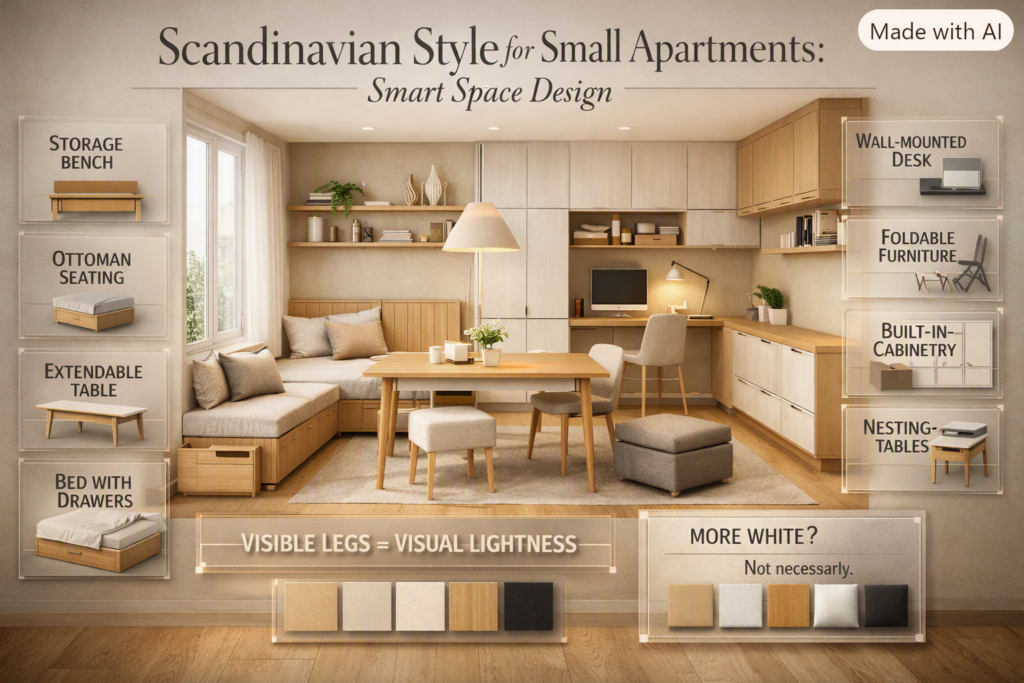
Choose furniture that performs more than one role.
Examples include:
- Storage benches
- Ottoman seating
- Extendable dining tables
- Beds with drawers
- Wall-mounted desks
- Foldable furniture
- Built-in cabinetry
- Nesting tables
Furniture with visible legs can also make a small room appear lighter because more of the floor remains visible.
For additional ideas, Smart Space-Saving Solutions can help when you’re dealing with limited floor area.
Should Small Rooms Have More White?
Not necessarily.
Light colors can help, but a small room also needs contrast and texture.
A warm neutral wall, pale furniture, natural wood, and carefully positioned dark accents can look more sophisticated than an entirely white room.
The goal is visual clarity, not maximum whiteness.
How Do You Declutter a Scandinavian Home?
Decluttering is an important part of Scandinavian interiors, but it shouldn’t turn your home into an empty box.
The better approach is intentional ownership.
For every visible item, ask:
Do I use it, love it, or find it genuinely useful?
If the answer is no, consider removing it.
Then give everything remaining a proper home.
This is especially important for entryways, kitchens, home offices, and living rooms because these areas accumulate everyday objects quickly.
The Scandinavian Decluttering Test
Before keeping an item on display, ask:
- Does it serve a purpose?
- Does it have personal meaning?
- Does it improve the room?
- Does it belong somewhere else?
- Would the room feel better without it?
This simple process can dramatically improve visual calm.
How Can You Add Personality to Scandinavian Style?
This is one of the most important questions because excessive minimalism can make a home look generic.
The solution isn’t adding more decoration.
Instead, use meaningful decoration.
Try incorporating:
- Family photographs
- Artwork you genuinely enjoy
- Books you actually read
- Vintage furniture
- Handmade ceramics
- Travel souvenirs
- Personal collections
- Plants
- One distinctive lamp
- A favorite textile
The difference between a staged Scandinavian room and a real Scandinavian home is personality.
A real home doesn’t need to look perfect.
It needs to feel intentional and lived in.
Can Scandinavian Style Include Plants?
Absolutely.
Plants complement Scandinavian interiors because they introduce organic shapes, natural color, and a stronger connection to nature.
Large plants can soften the geometry of furniture.
Smaller plants can work on shelves, windowsills, side tables, or kitchen counters.
Choose plants according to your actual lighting and maintenance habits.
Don’t buy a difficult plant simply because it looks attractive in a photograph.
Scandinavian Style and Biophilic Design
Scandinavian interiors naturally overlap with several principles of biophilic design.
Both can use:
- Natural wood
- Plants
- Daylight
- Organic textures
- Natural colors
- Stone
- Views of nature
- Natural materials
If you want to take this connection further, explore Biophilic Interior Design.
The combination can create interiors that feel both contemporary and deeply connected to nature.
Is Scandinavian Style Sustainable?
Scandinavian design can support a more sustainable approach because it values durability, practicality, and timelessness.
Instead of replacing furniture every time a new trend appears, choose pieces that can remain useful for years.
A sustainable Scandinavian interior might prioritize:
- Durable construction
- Repairable furniture
- Natural materials
- Secondhand furniture
- Timeless designs
- Energy-efficient lighting
- Fewer unnecessary purchases
Sustainability doesn’t require replacing everything you already own.
Sometimes the most sustainable decision is to keep a good piece of furniture, repair it, refinish it, or use it differently.
For a broader look at environmentally conscious interiors, explore Sustainable Home Design.
How Can Scandinavian Style Work With a Home Office?
A Scandinavian home office should feel organized without becoming sterile.
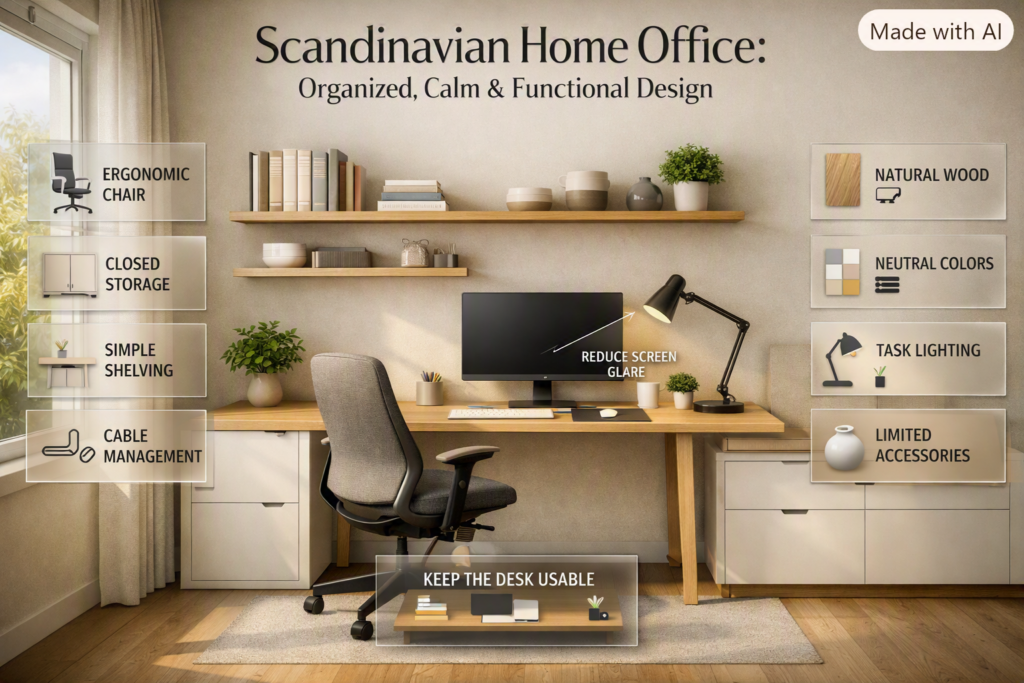
Start with a proper desk and comfortable ergonomic chair.
Then control visual clutter.
Use:
- Closed storage
- Simple shelving
- Cable management
- Natural wood
- Neutral colors
- Task lighting
- A small plant
- Limited desk accessories
The desk should remain usable rather than becoming a storage surface.
Natural daylight is valuable, but position the screen carefully to reduce glare.
For more practical workspace ideas, see Functional Home Office.
How Can You Combine Scandinavian and Modern Interior Design?
Scandinavian and modern design work exceptionally well together.
Modern interiors may introduce stronger geometry, contemporary finishes, larger architectural elements, and more dramatic furniture.
Scandinavian principles can soften those elements.
For example:
Modern architecture + pale wood + warm neutral upholstery + natural textiles + soft lighting = contemporary Scandinavian atmosphere.
The important thing is not to combine every trend simultaneously.
Choose the strongest architectural features and let Scandinavian materials provide warmth.
Can Scandinavian Style Look Luxurious?
Yes, but Scandinavian luxury is generally quieter than traditional luxury.
Instead of relying on excessive ornamentation, focus on:
- Excellent craftsmanship
- High-quality wood
- Premium upholstery
- Natural stone
- Custom cabinetry
- Beautiful lighting
- Carefully selected artwork
- Perfect proportions
A single beautifully made chair can have more impact than a room full of decorative objects.
This philosophy makes Scandinavian design surprisingly compatible with sophisticated contemporary interiors.
If you’re interested in comparing this restrained approach with a more expressive high-end aesthetic, explore Luxury Contemporary Interiors.
Scandinavian Style vs. Minimalism: What’s the Difference?
These styles overlap, but they aren’t identical.
| Feature | Scandinavian Style | Minimalism |
|---|---|---|
| Primary goal | Comfort + function + simplicity | Reduction + simplicity |
| Atmosphere | Warm and welcoming | Calm and restrained |
| Materials | Strong focus on natural materials | Can vary considerably |
| Textures | Frequently layered | Often more controlled |
| Decoration | Limited but personal | Usually highly limited |
| Furniture | Comfortable and practical | Purpose-driven and simple |
| Color | Soft neutrals and muted tones | Often restrained neutrals |
The simplest way to understand the difference is this:
Minimalism asks what can be removed. Scandinavian design asks what can be simplified while preserving comfort.
That’s why Scandinavian interiors can feel more relaxed and approachable for everyday family living.
Scandinavian Style vs. Japandi
Scandinavian Style and Japandi are often confused because both favor simplicity and natural materials.
Scandinavian design generally emphasizes:
- Lightness
- Nordic comfort
- Practicality
- Natural wood
- Soft textiles
- Hygge-inspired warmth
Japandi combines Scandinavian ideas with Japanese design principles, including stronger emphasis on restraint, craftsmanship, natural textures, asymmetry, and quiet spaces.
There is significant overlap, but they create slightly different moods.
A Scandinavian room may feel soft and welcoming.
A Japandi room often feels more contemplative and restrained.
What Are the Most Common Scandinavian Design Mistakes?
1. Making Everything White
White is useful, but too much of it can create a cold atmosphere.
Why it happens: Homeowners associate Scandinavian design with bright white interiors.
Why it’s harmful: The room can lose warmth and visual depth.
Better approach: Combine warm neutrals with wood, textiles, plants, and subtle contrast.
2. Removing Too Much Furniture
Minimalism can become uncomfortable when taken too far.
Why it happens: People assume empty space automatically means better Scandinavian design.
Why it’s harmful: The room may stop functioning properly.
Better approach: Remove unnecessary objects, not necessary comfort.
3. Buying a Matching Furniture Set
Perfectly matching furniture can make a room look like a showroom.
Better approach: Choose pieces that coordinate without being identical.
4. Ignoring Lighting
A beautiful room can feel completely different at night.
Better approach: Build several layers of lighting.
5. Using Too Many Open Shelves
Open shelves quickly become cluttered.
Better approach: Combine display shelving with closed storage.
6. Choosing Style Over Comfort
A minimalist sofa that looks excellent but feels uncomfortable is still a poor purchase.
Better approach: Test furniture before buying it.
7. Mixing Too Many Materials
Natural materials are encouraged, but too many competing materials can create visual confusion.
Better approach: Choose a small family of materials and repeat them throughout the room.
8. Copying a Photograph Exactly
A room photographed in Stockholm may not work identically in your home.
Your daylight, architecture, ceiling height, flooring, climate, lifestyle, and furniture requirements are different.
Use inspiration as a starting point rather than a blueprint.
How Do You Make Scandinavian Design Feel Expensive?
A sophisticated Scandinavian interior is rarely about buying more.
It’s about making better decisions.
Focus on Proportion
Furniture should fit the room.
Prioritize Materials
Natural materials often look better when they age rather than deteriorate visually.
Improve Lighting
Good lighting can make inexpensive furniture look better and expensive furniture look ordinary if done badly.
Edit Decoration
A few meaningful pieces usually have greater impact than dozens of generic accessories.
Keep the Color Palette Controlled
A coherent palette makes different materials feel intentional.
Invest in Everyday Pieces
If your budget is limited, prioritize items you touch and use every day.
For example:
- Sofa
- Mattress
- Dining chairs
- Desk chair
- Lighting
- Flooring
You don’t need an expensive decorative vase if your everyday furniture is uncomfortable.
How to Create Scandinavian Style on a Budget
You don’t need a complete renovation.
Start with changes that have a large visual impact.
Step 1: Declutter
Remove unnecessary objects.
Step 2: Rearrange Furniture
Improve circulation before buying anything.
Step 3: Change Textiles
Introduce neutral curtains, rugs, cushions, or throws.
Step 4: Improve Lighting
Add one floor lamp or table lamp where needed.
Step 5: Introduce Wood
A small wooden table, shelf, tray, or frame can add warmth.
Step 6: Add Greenery
Choose plants that suit your available light.
Step 7: Replace Random Decoration
Keep only objects that genuinely contribute.
Step 8: Add Personal Art
Use artwork or photographs that mean something to you.
This approach is often more effective than purchasing an entire new furniture collection.
How Do You Apply Scandinavian Style Room by Room?
A whole-home approach works best when the same design principles continue from one room to another.
Entryway
Prioritize practical storage, a bench, hooks, a mirror, and a clear walking path.
Living Room
Focus on comfortable seating, natural materials, layered lighting, and limited decoration.
Bedroom
Use calm colors, soft textiles, simple furniture, and minimal bedside clutter.
Kitchen
Emphasize efficient storage, clean cabinetry, natural finishes, and practical lighting.
Bathroom
Use restrained colors, natural textures, simple fixtures, and functional storage.
Home Office
Keep the desk organized, provide task lighting, and use ergonomic furniture.
This room-by-room approach prevents the home from looking like a collection of unrelated spaces.
For broader room-specific inspiration, visit the Room-by-Room Design Hub.
You can also explore the wider Interior Design collection when developing a complete design direction.
How Can Scandinavian Design Evolve With Your Home?
One of the strongest advantages of Scandinavian Style is flexibility.
You don’t have to maintain exactly the same furniture or accessories forever.
A neutral foundation allows you to change:
- Artwork
- Cushions
- Throws
- Plants
- Accent colors
- Small furniture
- Seasonal accessories
without redesigning the entire room.
This makes the style particularly useful for people who like their homes to evolve gradually.
Instead of following every new interior trend, you can update small elements while keeping the foundation stable.
Is Scandinavian Style Suitable for Families?
Yes, provided functionality comes first.
Families need storage, durable materials, comfortable furniture, and surfaces that are easy to maintain.
Scandinavian principles can support all of these needs.
Use closed storage for toys and everyday clutter.
Choose washable textiles where appropriate.
Select durable flooring.
Avoid fragile furniture in high-traffic areas.
And don’t become so focused on maintaining a perfect minimalist appearance that the home stops feeling like a place where people actually live.
A family home should accommodate real life.
What Is the Best Way to Start a Scandinavian Interior?
Don’t start by shopping.
Start by observing.
Walk through the room and identify:
- What feels cluttered?
- What feels too dark?
- What furniture isn’t comfortable?
- Where do people naturally sit?
- Where is storage missing?
- Which materials already exist?
- What colors receive the best daylight?
- Which objects have genuine meaning?
Then create a simple design direction.
For example:
Warm white + pale oak + beige textiles + black accents + greenery + warm lighting.
Once you have that foundation, every purchase becomes easier.
You can ask whether a new item supports the direction instead of buying something simply because you like it in isolation.
Scandinavian Style Checklist
Before considering your room finished, review the following:
- The room has a clear purpose
- Furniture is correctly scaled
- Walking paths are comfortable
- Colors work together
- Natural materials provide warmth
- Textures create visual depth
- Lighting is layered
- Storage controls everyday clutter
- Decoration is intentional
- Plants or organic elements add life
- Furniture is comfortable
- Personal objects give the room character
- No single trend dominates the entire design
If most of these boxes are checked, you’re probably much closer to authentic Scandinavian Style than you would be by simply purchasing white furniture.
Is Scandinavian Style still popular in 2026?
Scandinavian Style remains highly relevant in 2026 because its core principles—functionality, natural materials, comfortable furniture, simple forms, and visual calm—don’t depend on short-lived decorating trends. What has changed is the way designers are interpreting the style. Today’s Scandinavian-inspired interiors are generally warmer and more personal than the extremely white, sparse rooms that became associated with the look in previous years.
Modern interpretations are increasingly using:
Warm whites, cream, beige, and soft greige
Richer natural textures
Wood with more visible character
Muted earthy accent colors
Vintage and handmade pieces
Layered lighting
Personal artwork and meaningful accessories
The important shift is that Scandinavian design no longer needs to look perfectly minimal or showroom-like. A lived-in appearance can actually make the space feel more authentic.
Professional takeaway: If you’re updating a Scandinavian interior in 2026, don’t remove personality just to make the room look minimalist. Keep the clean foundation, but introduce texture, craftsmanship, and objects that reflect the people living there.
What colors work best for Scandinavian Style in 2026?
The strongest Scandinavian color palettes begin with soft, natural neutrals rather than relying exclusively on bright white. Warm white, cream, beige, light taupe, soft gray, and greige create a calm foundation, while muted greens, dusty blues, soft terracotta, or subtle black accents can add depth. Current design guidance increasingly favors warmer, more layered neutrals over cold, clinical palettes.
A practical Scandinavian palette might look like:
Base: warm white or soft cream
Secondary: beige, greige, or light gray
Natural element: pale oak or ash
Accent: sage green or dusty blue
Contrast: small amounts of charcoal or black
The key is not simply choosing “Scandinavian colors.” You also need to consider the permanent elements already present in the room, particularly flooring, countertops, cabinetry, and natural light. These elements influence whether a particular white, beige, or gray will actually look warm and balanced.
Professional takeaway: Don’t select wall paint from a trend chart alone. Test samples in your actual room at different times of day. A color that looks warm in a showroom can appear noticeably cooler under your home’s natural and artificial lighting.
How do you make Scandinavian Style cozy without making it look cluttered?
The secret is layering texture rather than adding more objects. Scandinavian interiors become cozy through natural wood, wool, linen, cotton, rugs, curtains, comfortable upholstery, plants, and warm lighting. This creates visual and physical warmth while preserving the uncluttered character that defines the style.
For example, instead of filling a neutral living room with decorative accessories, you could use:
A textured wool or jute rug
Linen curtains
A soft throw
Two or three cushions
A pale wood coffee table
A warm floor lamp
One or two plants
A small collection of meaningful artwork
This gives the eye several textures to discover without creating visual chaos.
Lighting is equally important. A room can have beautiful furniture and still feel cold if it’s illuminated by one harsh overhead fixture. Combining ceiling lighting with floor lamps, table lamps, wall lighting, or other softer sources creates a much more comfortable evening atmosphere.
Professional takeaway: When a Scandinavian room feels too cold, don’t immediately buy more décor. First ask whether the problem is actually lighting, texture, material balance, or color temperature. Fixing those elements usually produces a better result than adding accessories.
What is the difference between Scandinavian Style and Japandi?
Scandinavian Style and Japandi share a strong preference for simplicity, natural materials, functional furniture, and restrained decoration, but they create different visual moods. Scandinavian interiors generally emphasize Nordic warmth, lightness, comfort, natural wood, soft textiles, and the cozy philosophy associated with hygge. Japandi combines Scandinavian principles with Japanese design ideas such as wabi-sabi, craftsmanship, controlled imperfection, and a stronger appreciation for quiet negative space.
A useful way to distinguish them is:
Scandinavian Style
Japandi
Brighter and lighter
Often warmer and more grounded
Strong focus on comfort
Strong focus on calm and restraint
Pale woods are common
Pale and darker natural woods can work
Soft textiles are important
Texture is important but often more controlled
Hygge-inspired warmth
Japanese-inspired simplicity
Casual and welcoming
Quiet and refined
Neither approach is automatically better.
Choose Scandinavian Style if you want a home that feels bright, relaxed, practical, and welcoming.
Choose Japandi if you prefer something quieter, more restrained, earthy, and contemplative.
You can also combine the two, provided you maintain a clear material and color strategy rather than simply mixing random elements from both styles.
Professional takeaway: If your Scandinavian interior feels too predictable, a few carefully selected Japandi influences—such as handcrafted ceramics, natural stone, deeper wood tones, or more sculptural furniture—can add sophistication without abandoning the Scandinavian foundation.
How can you make a Scandinavian home look expensive without overspending?
A sophisticated Scandinavian interior doesn’t depend on filling the room with expensive furniture or luxury decoration. The biggest visual improvements usually come from proportion, material quality, lighting, consistency, and restraint. Scandinavian design is particularly effective at looking refined because it allows individual pieces and materials to receive attention instead of competing with excessive decoration.
If your budget is limited, prioritize the elements you use every day:
A comfortable, well-proportioned sofa
A quality bed and mattress
Good dining chairs
Proper lighting
Durable flooring
Practical storage
Natural-looking textiles
Then save money on items that are easy to replace, such as small accessories, cushions, artwork, and decorative objects.
Another important trick is avoiding the “everything new” look. A vintage chair, secondhand wooden table, handmade ceramic piece, or inherited accessory can give a Scandinavian interior considerably more character than a room filled entirely with matching new products.
Current interior trends are also placing greater value on authenticity, patina, tactile materials, and individuality rather than perfectly coordinated, mass-market interiors.
Professional takeaway: The expensive-looking Scandinavian home isn’t the one with the highest number of luxury items. It’s the one where every major element looks intentional. Correct furniture scale, good lighting, cohesive colors, natural materials, and controlled decoration will usually create more visual impact than simply increasing the budget.
Conclusion
Scandinavian Style proves that a beautiful home doesn’t need to be complicated. Its real strength comes from creating a thoughtful balance between simplicity, comfort, functionality, and natural beauty. Instead of filling rooms with unnecessary furniture or decoration, the approach focuses on choosing pieces that genuinely improve the way a space looks and feels.
The most successful Scandinavian interiors combine warm neutral colors, natural wood, comfortable furniture, soft textiles, practical storage, layered lighting, and carefully selected personal details. These elements work together to create rooms that feel bright and organized while still having warmth and character.
You also don’t need to completely redesign your home to bring Scandinavian principles into your space. Start with the areas that have the biggest impact: remove unnecessary clutter, improve the furniture layout, introduce natural textures, soften the lighting, and create a consistent color palette. From there, add artwork, plants, vintage pieces, or meaningful accessories that make the space feel personal rather than staged.
Most importantly, don’t treat Scandinavian Style as a rigid formula. Your home should reflect your lifestyle, architecture, and preferences. The goal isn’t to reproduce a picture from a design magazine; it’s to create a space that feels calm, comfortable, functional, and genuinely yours.
When simplicity is combined with warmth and thoughtful design decisions, Scandinavian Style becomes more than an aesthetic. It becomes a practical way to create a home that remains beautiful, useful, and inviting for years to come.
Leave a Reply