
Introduction
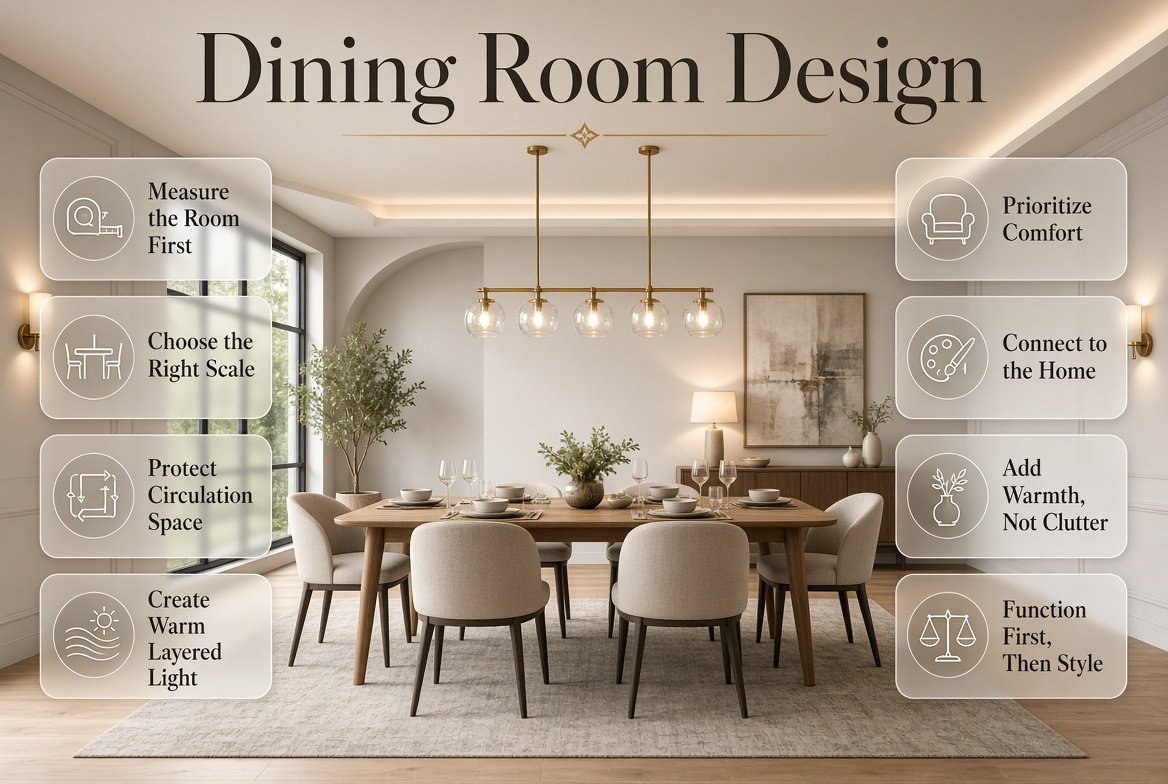
Dining Room Design | A dining room can look beautiful in a photograph and still be frustrating to use every day. The table may be too large, chairs may hit the wall, lighting may feel harsh, or the room may simply lack the warmth that makes people want to sit down and stay awhile. This is why successful Dining Room Design is about much more than choosing attractive furniture.
A well-designed dining room should support real life. It should give everyone enough room to sit comfortably, allow people to move naturally around the table, provide suitable lighting for meals and entertaining, and create a visual connection with the rest of the home. Whether you’re designing a formal dining room, a small apartment dining area, or an open-plan space connected to the kitchen, the same principle applies: function comes first, and decoration should build on that foundation.
Before choosing furniture, it’s worth looking at the bigger picture of your home. The overall style, colors, materials, and furniture choices should feel connected rather than as if every room was designed separately. For broader inspiration, you can explore DesignMode24 Interior Design and then use the ideas that suit your own lifestyle and space.
This guide covers everything you need to know about planning a dining room, including layouts, table shapes, seating, lighting, colors, rugs, wall decoration, storage, small dining rooms, open-plan spaces, different interior styles, common mistakes, budget-friendly updates, and professional design tips.
What Makes a Good Dining Room Design?
A good dining room design balances comfort, proportion, movement, lighting, practicality, and personality. A room doesn’t become successful simply because the furniture is expensive or the decorations are fashionable. The important question is whether the room works for the people using it.
A family dining room, for example, may need durable surfaces, comfortable everyday seating, and easy access to storage. A formal dining room used for occasional entertaining may place more emphasis on atmosphere, statement lighting, and sophisticated finishes.
Before buying anything, ask yourself:
- How many people normally use the dining room?
- How many people should it accommodate occasionally?
- Is it used every day or mainly for entertaining?
- Does it connect with the kitchen?
- Does it share space with the living room?
- Do you need storage for dinnerware?
- Does the room receive natural light?
- Are children using the space?
- Do you prefer modern, traditional, minimalist, or eclectic interiors?
Your answers should guide your design decisions.
The Five Main Foundations
A successful dining room normally depends on five major elements:
- Layout – furniture must fit without restricting movement.
- Dining table – the table should match the room and lifestyle.
- Seating – chairs should be comfortable and proportional.
- Lighting – illumination should support both function and atmosphere.
- Finishing details – colors, rugs, artwork, curtains, and accessories should complete the space.
💡 Pro Tip: Don’t start your dining room by shopping for decorative accessories. Start with the floor plan. Once the furniture layout works, decorating becomes much easier.
How Do You Plan a Dining Room Layout?
The dining table should usually be the starting point because it is the main functional object in the room. The position and size of the table influence where chairs go, where the main light should hang, whether a rug will fit, and how much space remains for storage.
Begin by measuring the room. Record the length and width, but don’t stop there. Also measure door openings, windows, radiators, built-in furniture, and pathways leading to other rooms.
One of the easiest ways to test a layout is to mark the proposed table footprint on the floor using painter’s tape. Then mark the approximate area occupied by chairs. Walk around the room as if people were sitting and moving between the dining area and other rooms.
This simple exercise can reveal problems before you spend money.
What Should You Check Before Finalizing the Layout?
Check:
- Main entrance and exit routes
- Door swings
- Window access
- Chair movement
- Kitchen access
- Storage access
- Lighting location
- Walking paths
- Furniture proportions
The room should feel natural to move through.
A Simple Dining Room Planning Diagram
        SIDEBOARD / STORAGE
   ┌─────────────────────────┐
   │                         │
   │      ○  ○  ○  ○        │
   │                         │
   │    ┌───────────────┐    │
   │ ○  │    TABLE      │  ○ │
   │    └───────────────┘    │
   │                         │
   │        WALKWAY          │
   └────────────┬────────────┘
                │
              ENTRY
The exact dimensions will vary, but the basic principle remains the same: plan for people, not just furniture.
How Much Space Should You Leave Around a Dining Table?
A common mistake is measuring the table but forgetting the chairs. A dining table might physically fit into a room while the people sitting around it have almost no room to move.
As a practical planning target, try to maintain around 36 inches of clearance around the table where possible. Busy pathways may require more.
The space must accommodate more than an empty chair. People need to pull chairs backward, stand up, walk behind seated guests, and carry food in and out.
For example, if you have a 36-inch-wide dining table, the room needs significantly more than 36 inches of total width. You need room for seating on both sides and circulation beyond the chairs.
Why Clearance Matters
Insufficient clearance can lead to:
- Chairs hitting walls
- Difficult seating
- Blocked walkways
- Damaged furniture
- Uncomfortable dinners
- Crowded entertaining
⚠ Common Mistake: Choosing the largest table that can physically fit. A table can fit on paper while making the entire room uncomfortable in practice.
How Do You Choose the Right Dining Table?
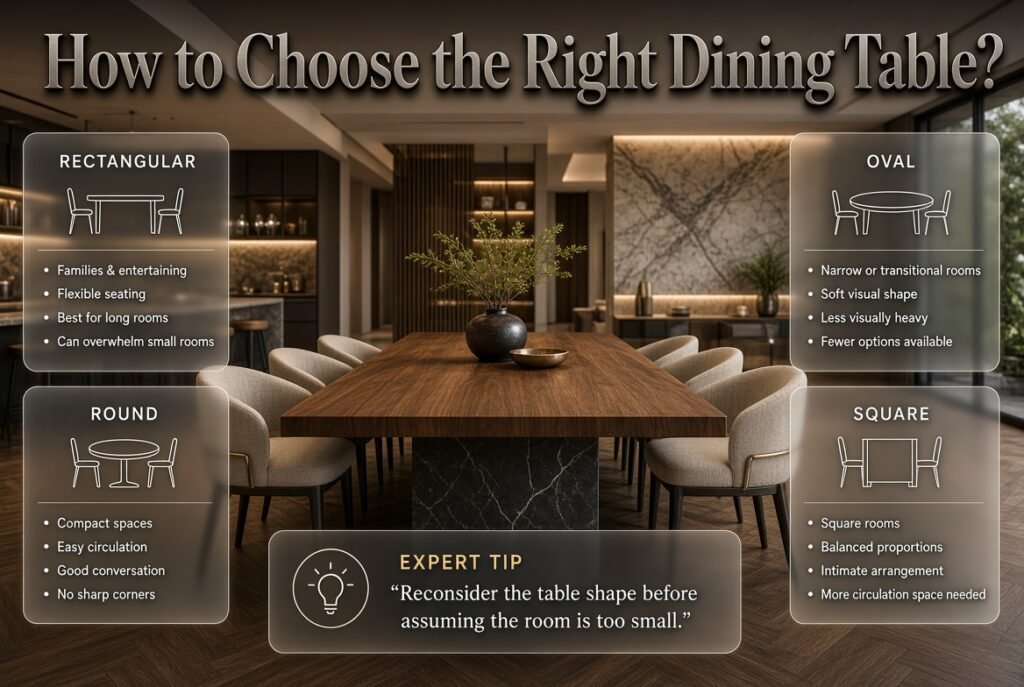
The right dining table depends on the room’s shape, number of users, available space, and lifestyle.
Don’t choose a table only because you like its style. A beautiful table that makes movement difficult will become a daily frustration.
Rectangular Dining Tables
Rectangular tables remain one of the most versatile choices.
They work particularly well in:
- Long rooms
- Family dining rooms
- Large homes
- Formal spaces
- Open-plan interiors
- Homes where entertaining is common
Their long shape can also emphasize the architecture of a rectangular room.
Round Dining Tables
Round tables are excellent for compact spaces and rooms where circulation is important.
They offer several advantages:
- No sharp corners
- Easier movement around the table
- Good conversation
- Strong visual balance
- Comfortable arrangement for smaller groups
They can work especially well in square dining rooms and apartment dining areas.
Oval Dining Tables
Oval tables combine some of the practical qualities of rectangular tables with softer edges.
They can be particularly attractive when a rectangular table feels too visually heavy.
Square Dining Tables
Square tables naturally complement square rooms.
A four-person square table can create an intimate arrangement, although larger square tables may require considerable floor space.
| Table Shape | Best For | Main Advantage | Potential Limitation |
|---|---|---|---|
| Rectangular | Families and entertaining | Flexible seating | Can overwhelm small rooms |
| Round | Small rooms | Easy circulation | Less suitable for very large groups |
| Oval | Narrow or transitional rooms | Soft visual shape | Fewer options available |
| Square | Square rooms | Balanced proportions | Can require more circulation space |
⭐ Expert Tip: If a dining room feels difficult to furnish, reconsider the table shape before assuming the room is too small.
How Many People Should a Dining Table Seat?
A table should provide comfortable seating rather than simply accommodate the maximum number of chairs.
Think about your normal routine.
If four people eat together every day but you host eight people only twice a year, an enormous eight-person table may make the room uncomfortable for most of the year.
Instead, consider:
- Extendable tables
- Drop-leaf tables
- Bench seating
- Stackable or flexible chairs
- Smaller everyday tables
An extendable table is especially useful for households that want a comfortable everyday arrangement but occasionally need additional capacity.
How Do You Choose Comfortable Dining Chairs?
Dining chairs should be attractive, but comfort should be the priority.
People often spend much longer sitting at the dining table than they expect. Dinner can turn into conversation, homework, work, games, or entertaining.
Look for:
- Comfortable seat height
- Supportive backrest
- Appropriate seat depth
- Sufficient width
- Stable construction
- Easy-clean upholstery
- A shape that fits comfortably under the table
If you have children or frequently entertain, consider durable upholstery and finishes that can handle everyday use.
Should Dining Chairs Match the Table?
Not necessarily.
A completely matching table-and-chair set can create a coordinated look, but mixing pieces can create a more layered and sophisticated interior.
For example:
Natural wood table + upholstered dining chairs + black pendant
can create a balanced look without requiring every piece to come from the same collection.
The important thing is visual connection.
Different pieces can be connected through:
- Color
- Material
- Shape
- Finish
- Proportion
Armchairs or Armless Chairs?
Armchairs can make a dining room feel substantial and formal. They work especially well at the ends of rectangular tables.
Armless chairs generally take up less visual and physical space, making them a useful choice for smaller dining rooms.
How Do You Design a Small Dining Room?
Small dining rooms require careful editing. The goal isn’t to make the room look like a smaller version of a huge formal dining room. Instead, every item should serve a useful purpose.
Consider:
- Round tables
- Oval tables
- Slim chairs
- Benches
- Extendable tables
- Wall-mounted lighting
- Mirrors
- Narrow storage
- Light visual furniture
A compact table with comfortable circulation will usually feel better than a large table squeezed into the room.
Use Vertical Space
When floor space is limited, walls become valuable.
A large mirror can reflect light and increase the sense of depth. Shelving can provide display space without consuming much floor area. Artwork can create a focal point without adding physical clutter.
A narrow sideboard can also provide useful storage without making the room feel crowded.
📌 Quick Tip: Empty space isn’t wasted space. In a small dining room, breathing room can make the entire area feel larger.
How Do You Design a Large Dining Room?
Large dining rooms present the opposite problem. Instead of feeling crowded, they can feel empty or disconnected.
The answer isn’t simply buying the largest dining table available.
Think about proportion and visual zoning.
A large dining room may include:
- Large dining table
- Comfortable chairs
- Sideboard
- Statement chandelier
- Large artwork
- Area rug
- Display cabinet
- Additional seating
The furniture should have enough visual weight to relate to the room.
A tiny pendant over a large table can look lost, while small artwork on a large blank wall can feel insignificant.
How Do You Design an Open-Plan Dining Area?
Open-plan dining areas need to connect naturally with the kitchen and living room while still feeling like a defined zone.
One of the easiest ways to create that definition is through lighting.
A pendant over the dining table visually tells the eye, “this is the dining area.”
A rug, artwork, sideboard, or distinctive table can strengthen that identity.
Create Connection Without Making Everything Match
Use repeated materials and colors.
For example:
- Kitchen wood cabinetry → dining table
- Kitchen metal hardware → dining light
- Living room upholstery → dining chair fabric
- Living room accent color → dining artwork
This creates continuity without making every room identical.
For additional planning inspiration, explore Home Design Ideas when creating a connected look across your home.
How Do You Connect the Dining Room With the Kitchen?
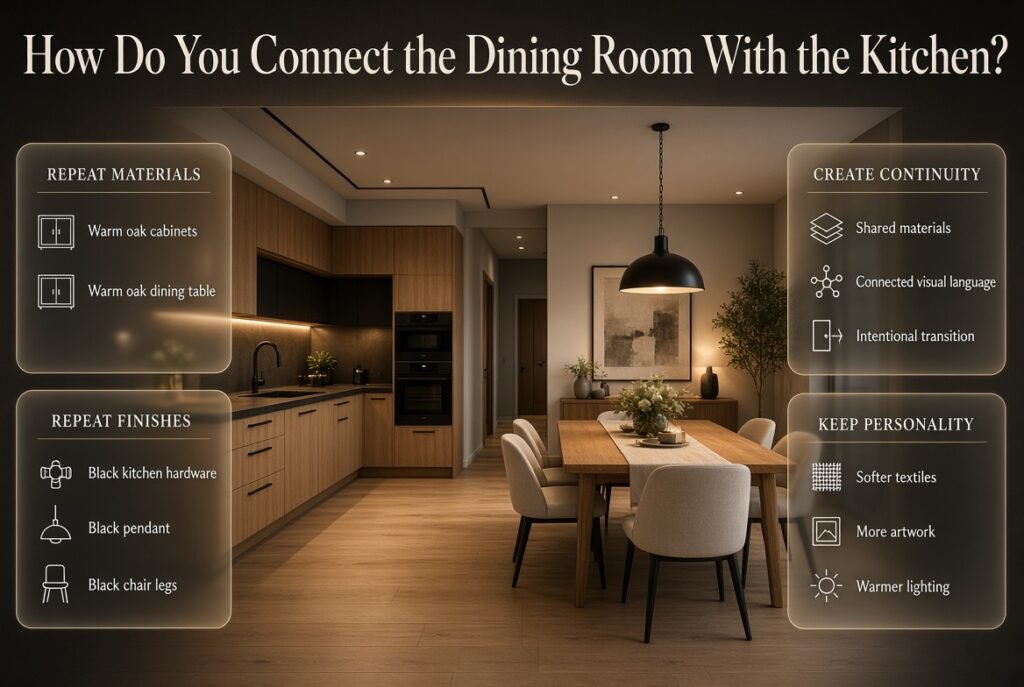
The dining room and kitchen naturally belong together because food preparation and eating are closely connected.
The transition should feel intentional.
Repeat one or two materials from the kitchen in the dining space.
For example:
Kitchen: warm oak cabinets
Dining: warm oak table
Or:
Kitchen: black hardware
Dining: black pendant and chair legs
This creates visual continuity.
However, the dining room can still have its own personality. It might use softer textiles, more artwork, or warmer lighting than the kitchen.
For practical planning ideas, explore Kitchen Design and consider how your dining space supports the kitchen workflow.
What Is the Best Dining Room Lighting?
Lighting can completely change the atmosphere of a dining room.
The strongest approach usually combines three layers.
Ambient Lighting
Ambient lighting provides general illumination.
Examples include:
- Ceiling fixtures
- Recessed lighting
- Flush mounts
- Track lighting
Task Lighting
Task lighting focuses on the dining table.
Pendant lights and chandeliers are common choices.
Accent Lighting
Accent lighting creates atmosphere and highlights selected areas.
Examples include:
- Wall sconces
- Picture lights
- Cabinet lighting
- Decorative lamps
Using several layers gives you greater control over the room.
Should Dining Room Lighting Be on a Dimmer?
Whenever possible, yes.
A bright setting is useful when cleaning or doing practical tasks. A softer setting creates a more relaxed atmosphere during meals.
💡 Pro Tip: A dimmer is one of the simplest ways to make a dining room feel more versatile without changing any furniture.
Where Should a Dining Chandelier Hang?
The primary dining light should generally be centered over the dining table rather than simply centered in the room.
This is particularly important in open-plan homes.
A long rectangular table may look best with:
- Linear pendant
- Long chandelier
- Multiple coordinated pendants
A round table can work with:
- Round chandelier
- Globe pendant
- Sculptural central light
The fixture should be proportional to the table.
How Do You Choose Dining Room Colors?
Color establishes mood.
Warm neutrals can make a dining room feel welcoming and timeless. Darker colors can create a more intimate evening atmosphere. Soft natural colors can support organic or minimalist styles.
Warm Neutral Palette
Consider:
- Cream
- Beige
- Taupe
- Warm white
- Natural wood
Contemporary Palette
Consider:
- Soft gray
- Off-white
- Charcoal accents
- Natural oak
- Black details
Organic Palette
Consider:
- Sage green
- Warm brown
- Sand
- Cream
- Natural wood
Dramatic Palette
Consider:
- Deep green
- Navy
- Charcoal
- Rich brown
- Warm metallic accents
Always test paint in the actual room because natural and artificial light can change how a color appears.
For more help choosing suitable shades, visit Paint Color before committing to a final palette.
How Do You Decorate Dining Room Walls?
Dining room walls provide an opportunity to establish character.
You don’t need to decorate every wall.
Often, one strong focal wall works better than several competing displays.
Popular choices include:
- Large artwork
- Oversized mirror
- Gallery wall
- Wallpaper
- Wood paneling
- Decorative molding
- Accent paint
- Textured wall finishes
Large Artwork
One large piece can create a strong focal point.
The artwork should be appropriately scaled to the table and wall.
A tiny frame over a large sideboard can look lost.
Mirrors
Mirrors can reflect light and increase visual depth.
They’re especially useful in small or darker dining rooms.
Gallery Walls
Gallery walls work well in eclectic, traditional, and casual spaces.
Keep some relationship between the pieces through color, frame style, spacing, or subject matter.
⭐ Expert Tip: Before hanging artwork, use paper templates to test the arrangement. It’s much easier to move paper than repair unnecessary holes in the wall.
Should You Use a Rug Under the Dining Table?
A rug isn’t mandatory, but it can make a dining room feel warmer and more defined.
The biggest issue is size.
Dining chairs should remain comfortably on the rug when pulled away from the table.
Good Dining Rug Characteristics
Choose a rug that is:
- Large enough
- Low pile
- Durable
- Easy to clean
- Suitable for chair movement
- Appropriate for the room’s style
Flatweave rugs can be particularly practical because chairs move more easily across them.
⚠ Common Mistake: Buying a rug that looks perfect underneath the table but is too small for the chairs.
What Furniture Should a Dining Room Have?
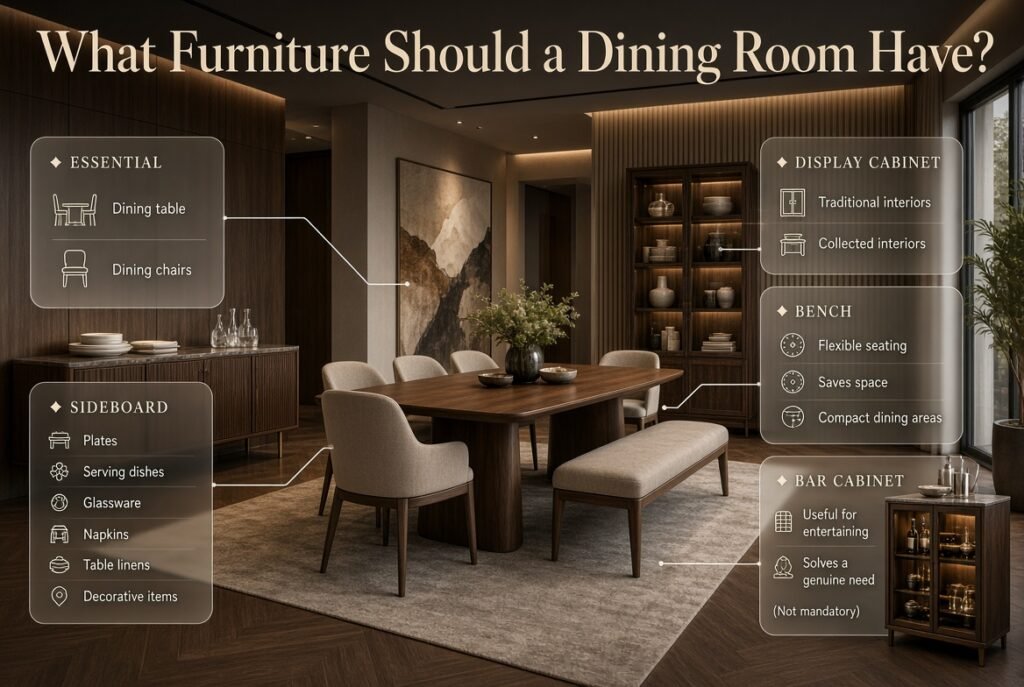
The essential furniture is straightforward:
- Dining table
- Dining chairs
Additional furniture depends on your lifestyle.
Sideboards
Sideboards provide storage for:
- Plates
- Serving dishes
- Glassware
- Napkins
- Table linens
- Decorative items
They can also create a useful surface for lamps, artwork, or decorative objects.
Cabinets
Display cabinets can work particularly well in traditional or collected interiors.
Benches
Benches provide flexible seating and can save space in compact dining areas.
Bar Cabinets
A bar cabinet can be useful for entertaining, but it should solve a genuine need rather than simply fill an empty corner.
How Do You Make a Dining Room Feel Luxurious?
Luxury doesn’t necessarily mean expensive furniture.
A more convincing sense of luxury usually comes from:
- Good proportions
- Quality lighting
- Comfortable seating
- Rich textures
- Natural materials
- Controlled color
- Good craftsmanship
- Visual restraint
A simple wood table can look elegant when paired with comfortable upholstered chairs and a beautifully scaled pendant.
By contrast, adding too many luxury materials can make a room feel busy.
A strong combination might be:
Wood + linen + metal
or:
Stone + upholstery + wood
Keep the palette controlled.
How Do You Make a Dining Room Feel Warm and Inviting?
Warmth comes from layers.
Consider:
- Warm lighting
- Natural wood
- Soft textiles
- Curtains
- Rugs
- Artwork
- Plants
- Personal objects
Don’t make every surface completely empty.
A dining room should feel organized but lived in.
Personal objects can make the room feel more genuine than a collection of generic accessories.
How Do You Style a Dining Table?
The dining table should remain practical.
A centerpiece should never make conversation difficult.
Good choices include:
- Low vase
- Bowl
- Small floral arrangement
- Candles
- Seasonal decoration
- Decorative tray
If the table is used every day, choose something easy to move.
📌 Quick Tip: If guests have to lean around your centerpiece to see one another, the centerpiece is too tall or too large.
What Window Treatments Work in a Dining Room?
Curtains can soften the room, control sunlight, improve acoustics, and introduce texture.
Choose them according to the overall interior style.
Natural-looking fabrics work well in relaxed interiors. More structured drapery can suit formal dining rooms.
Curtains should also work with the furniture layout.
Don’t allow fabric to interfere with chairs, doors, or access to windows.
What Materials Work Best in Dining Rooms?

Different materials provide different benefits.
Wood
Wood is warm, versatile, and timeless.
Glass
Glass can make furniture appear visually lighter.
It can be especially useful in smaller spaces, although it requires regular cleaning.
Stone
Stone provides a substantial and luxurious appearance but may require careful maintenance.
Metal
Metal works well for lighting, table bases, chair details, and decorative accents.
Upholstery
Upholstered chairs provide comfort and softness but should be selected according to lifestyle and maintenance needs.
How Do You Make a Dining Room More Functional?
Function depends on what happens in the room.
A family dining room may need durable surfaces.
An entertaining space may need serving storage.
A multipurpose dining area may need flexible furniture.
Ask:
- Where will serving dishes go?
- Where will extra chairs be stored?
- Where are table linens kept?
- Can people walk around the table?
- Is the lighting flexible?
- Can the table be cleared quickly?
- Are surfaces easy to maintain?
These questions are more important than simply asking whether the room looks attractive.
Dining Room Design for Families
Family dining rooms need to handle everyday life.
Consider:
- Durable furniture
- Easy-clean surfaces
- Washable textiles
- Stable chairs
- Practical storage
- Rounded edges where appropriate
You don’t need to sacrifice style.
A sophisticated family dining room can still use beautiful lighting, natural materials, artwork, and attractive furniture.
When broader repairs, upgrades, or practical changes are needed, see Home Improvement for additional home-focused ideas.
Dining Room Design for Entertaining
If you frequently host guests, think about the entire movement of the meal.
Food needs to travel from the kitchen to the table.
Guests need to sit, stand, talk, and move around.
Serving dishes need somewhere to go.
A sideboard can become extremely useful.
An extendable table is another excellent solution because it can remain compact during everyday use and expand when guests arrive.
How Do You Create a Minimalist Dining Room?
Minimalism is not about making the room empty.
It’s about choosing fewer elements carefully.
A minimalist dining room might contain:
- Simple dining table
- Comfortable chairs
- One statement light
- One artwork
- Neutral colors
- Functional storage
Avoid adding objects simply because a surface feels empty.
The furniture itself should provide enough visual interest.
How Does Japandi Style Work in a Dining Room?
Japandi combines Japanese simplicity with Scandinavian warmth.
A Japandi dining room might feature:
- Natural wood
- Soft neutral colors
- Simple furniture
- Organic textures
- Warm lighting
- Handmade ceramics
- Minimal decoration
The room should feel calm rather than cold.
A simple wooden table, woven pendant, neutral chairs, and one ceramic centerpiece can create a strong Japandi atmosphere without excessive decoration.
How Do You Create a Traditional Dining Room?
Traditional dining rooms often use classic furniture, symmetry, richer finishes, and detailed architectural elements.
Common features include:
- Wooden tables
- Upholstered chairs
- Classic chandeliers
- Framed artwork
- Sideboards
- Decorative molding
- Curtains
Traditional doesn’t have to mean old-fashioned.
Mixing classic furniture with simpler accessories and contemporary lighting can create a timeless result.
How Do You Create a Contemporary Dining Room?
Contemporary dining rooms generally emphasize clean forms, current materials, and a controlled palette.
Try combining:
- Sculptural chairs
- Natural wood
- Matte finishes
- Minimal lighting
- Neutral colors
- Large-scale artwork
The goal isn’t to chase every trend.
Choose elements that are likely to remain attractive as your home evolves.
How Do You Coordinate the Dining Room With the Living Room?
The dining room should feel related to nearby rooms, especially in open-plan homes.
You don’t need matching furniture.
Instead, repeat selected elements.
For example:
Living room: warm wood + cream upholstery
Dining room: warm wood table + cream chairs
Or:
Living room: black metal accents
Dining room: black pendant + black chair details
This creates continuity.
For more inspiration on creating a comfortable and coordinated adjoining space, explore Living Room Design.
How Can a Bathroom and Dining Room Share a Design Language?
Although the dining room and bathroom serve completely different functions, a home’s overall design can still connect them through finishes and colors.
For example:
- Same brass finish
- Similar stone tones
- Related wall colors
- Consistent wood tones
- Similar lighting temperature
This doesn’t mean the rooms should look identical.
The connection should be subtle.
For ideas on maintaining a consistent approach across other functional spaces, see Bathroom Design.
How Can the Dining Room Connect With the Entryway?
The entryway often establishes the first impression of the home, so the transition into the dining area should feel intentional.
If the entry uses:
- Warm wood
- Neutral walls
- Black accents
you can repeat one or two of those elements in the dining room.
This creates a sense of continuity.
If the dining room is visible from the entrance, consider whether the dining table, lighting, and artwork create an attractive first view.
For additional ideas on creating a strong transition into the home, explore Entryway & Hallway Ideas.
Can a Dining Room Work as a Home Office?
Yes, especially in smaller homes where dedicated rooms are limited.
An extendable dining table or comfortable dining table can sometimes support temporary work.
If the room is frequently used for work, however, consider:
- Task lighting
- Cable management
- Comfortable seating
- Storage
- A dedicated work surface
The key is making sure work equipment can be cleared away when meals begin.
For more ideas about creating productive spaces without sacrificing interior style, see Home Office Design.
How Do You Create a Cohesive Home Through Room-by-Room Design?
A cohesive home doesn’t require every room to look the same.
Instead, choose a few recurring themes.
For example:
- Natural wood throughout
- Warm neutral walls
- Black lighting details
- Similar flooring
- Repeated textile colors
Then allow each room to interpret those elements differently.
Your dining room may be more formal, the living room more relaxed, and the home office more functional, but the materials and colors can still create a visual relationship.
For a broader room-by-room approach, use Room-by-Room Design Hub as a planning reference.
What Are the Most Common Dining Room Design Mistakes?
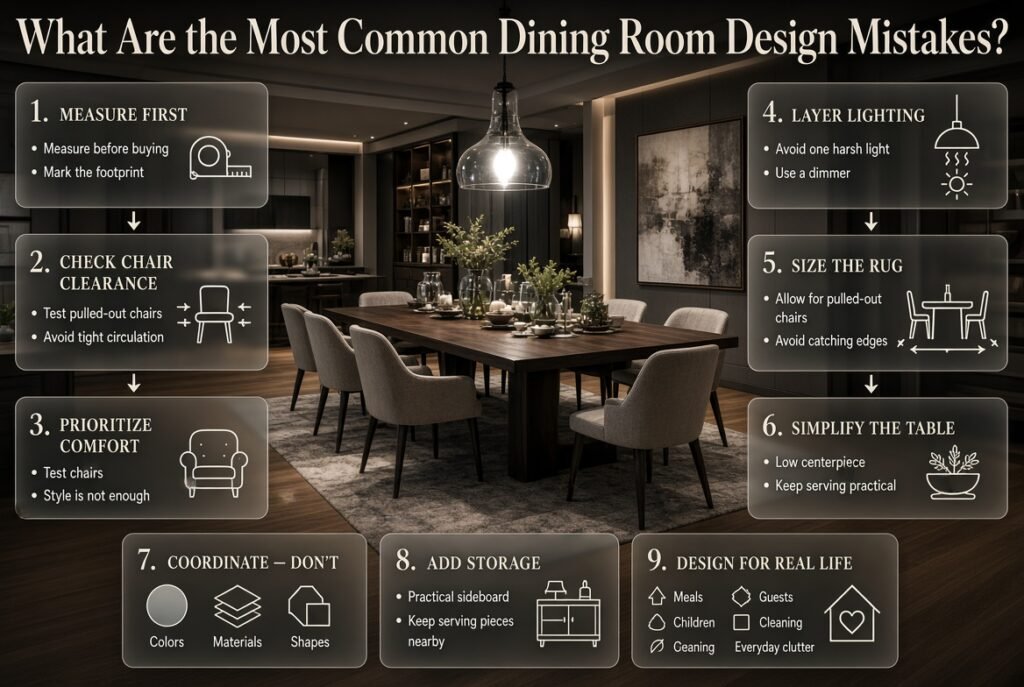
1. Buying Furniture Before Measuring
Why it happens: A table looks perfect online.
Why it’s harmful: It may overwhelm the actual room.
How to avoid it: Measure first and mark the footprint on the floor.
2. Ignoring Chair Clearance
Why it happens: People measure only the tabletop.
Why it’s harmful: Chairs become difficult to use.
How to avoid it: Test the space with chairs pulled out.
3. Choosing Style Over Comfort
Why it happens: A chair looks beautiful.
Why it’s harmful: People don’t want to sit on it for long.
How to avoid it: Test chairs before buying.
4. Using One Harsh Light
Why it happens: A single ceiling fixture seems sufficient.
Why it’s harmful: The room can feel flat and uncomfortable.
How to avoid it: Use layered lighting and a dimmer.
5. Choosing a Rug That Is Too Small
Why it happens: A smaller rug is cheaper or looks proportional when the chairs are pushed in.
Why it’s harmful: Chairs catch on the edge.
How to avoid it: Measure for pulled-out chairs.
6. Overdecorating the Table
Why it happens: Empty tables can feel unfinished.
Why it’s harmful: Conversation and serving become difficult.
How to avoid it: Use a low, simple centerpiece.
7. Matching Everything
Why it happens: Matching furniture feels safe.
Why it’s harmful: The room can look generic.
How to avoid it: Coordinate colors, materials, and shapes instead.
8. Ignoring Storage
Why it happens: Storage seems less exciting than decoration.
Why it’s harmful: Dinnerware and serving pieces are stored far away.
How to avoid it: Add a practical sideboard if the room allows.
9. Designing Only for Photos
Why it happens: Inspiration images show perfectly styled rooms.
Why it’s harmful: Real homes involve meals, children, guests, cleaning, and everyday clutter.
How to avoid it: Design around your actual routine.
What Do Interior Designers Prioritize First?
Professionals generally solve practical issues before decorative ones.
A useful priority order is:
- Measurements
- Layout
- Table
- Chairs
- Lighting
- Storage
- Color
- Rug
- Window treatments
- Artwork
- Accessories
This order reduces expensive mistakes.
There’s little value in spending money on beautiful accessories if the table blocks the doorway.
⭐ Expert Tip: If your budget is limited, spend more on the things you touch and use every day. Comfortable chairs, a good table, and quality lighting usually have more long-term value than numerous decorative accessories.
How Can You Refresh a Dining Room Without Replacing Everything?
A dining room doesn’t always need a complete renovation.
Start with the problem.
If the room feels dark, improve lighting.
If it feels crowded, remove unnecessary furniture.
If it feels outdated, repaint.
If the chairs are uncomfortable, replace or reupholster them.
If the room lacks personality, introduce artwork, textiles, or a statement light.
Small changes can have a surprisingly large impact.
For hands-on updates and practical decorating projects, explore DIY Home Projects.
How Do You Add Personality to a Dining Room?
Personality comes from the things that mean something to you.
Consider using:
- Family artwork
- Handmade ceramics
- Vintage furniture
- Books
- Plants
- Travel objects
- Personal photographs
- Heirloom pieces
Not every item needs to match.
A room that is too perfectly coordinated can feel like a showroom.
A small amount of individuality makes the space feel like someone’s home.
The 80/20 Approach
A useful strategy is to keep around 80% of the room visually coordinated and allow roughly 20% to express personality.
This gives the room structure while preventing it from becoming generic.
What Is the Best Dining Room Design for an Apartment?
Apartment dining areas often need flexibility.
Consider:
- Round tables
- Extendable tables
- Drop-leaf tables
- Bench seating
- Slim chairs
- Wall-mounted lighting
- Multipurpose furniture
If the dining space shares the living room, use lighting or a rug to define the dining zone.
Avoid oversized storage unless it solves a genuine need.
How Do You Make a Dining Room Feel Bigger?
You don’t always need structural changes.
Try:
- Removing unnecessary furniture
- Choosing correctly scaled pieces
- Using a mirror
- Improving lighting
- Keeping colors connected
- Using visually lighter furniture
- Protecting circulation
- Avoiding oversized accessories
Sometimes removing one large piece makes a room feel dramatically bigger.
This is why editing is just as important as adding.
Dining Room Design on a Budget
A limited budget doesn’t mean you need a limited imagination.
Start with changes that have high visual impact.
Paint
A new wall color can completely alter the atmosphere.
Lighting
Replacing an outdated fixture can immediately change the room.
Artwork
One large artwork can establish a focal point without requiring extensive decoration.
Upholstery
If the table is good but the chairs look tired, new upholstery may be more sensible than replacing everything.
Secondhand Furniture
A quality vintage or secondhand table can become the foundation of a beautiful dining room.
Accessories
Add gradually.
You don’t need to buy everything at once.
📌 Quick Tip: A room usually looks more expensive when it contains fewer well-chosen pieces than when it contains many inexpensive decorations.
How Do You Make a Formal Dining Room More Relaxed?
Formal dining rooms can sometimes feel too serious.
To soften the atmosphere, consider:
- Upholstered chairs
- Natural wood
- Warm lighting
- Simple artwork
- Relaxed curtains
- Contemporary accessories
- Fewer decorative objects
Mixing traditional and modern elements can also make the room feel more current.
For example, a traditional wooden table with modern upholstered chairs and a contemporary pendant can create a comfortable balance.
How Do You Design a Dining Room for Everyday Family Life?
The best family dining room is practical without looking purely functional.
Think about what happens every day.
Children may do homework.
Parents may work temporarily.
Food may spill.
Guests may arrive unexpectedly.
The table may need to support different activities.
Choose durable materials and furniture that can handle those situations.
Comfortable chairs become particularly important because the dining table may serve multiple purposes.
How Do You Design a Dining Room for Special Occasions?
For occasional entertaining, atmosphere becomes more important.
Consider:
- Extendable dining table
- Statement lighting
- Elegant tableware
- Flexible chairs
- Sideboard
- Layered lighting
- Attractive centerpiece
The room should still work for everyday use.
The goal isn’t to create a room that is beautiful only when twelve guests arrive.
What are the biggest dining room design trends for 2026?
The biggest dining room design trend for 2026 is moving away from cold, overly formal spaces toward dining rooms that feel warm, comfortable, personal, and useful every day. Designers are increasingly using natural wood, earthy colors, textured walls, sculptural lighting, comfortable seating, and more relaxed furniture arrangements. Dedicated dining rooms are also becoming more intentional spaces for conversation and entertaining rather than rooms used only on special occasions.
The important thing is not to copy every trend. A dining room should still work with your home’s architecture and your lifestyle. For example, a beautiful sculptural chandelier may be trending, but it won’t improve the room if it is too large for the table or creates uncomfortable glare.
Useful ideas to apply:
Choose warm neutrals, earthy browns, muted greens, or deeper natural tones.
Use natural materials such as oak, walnut, stone, linen, and wool.
Consider a statement pendant or chandelier as the room’s focal point.
Mix modern and traditional furniture instead of buying an identical furniture set.
Add texture through curtains, rugs, upholstery, wallpaper, or wall finishes.
Prioritize comfortable seating over purely decorative chairs.
⭐ Professional advice: Choose trends that improve the experience of the room. A timeless dining table, comfortable chairs, good lighting, and appropriate proportions will usually outlast a trendy decorative accessory.
What is the best dining table shape for a dining room?
The best dining table shape depends on the size and shape of your room, the number of people you need to seat, and how people move through the space. Rectangular tables remain highly practical for larger rooms and families, while round and oval tables are particularly useful when you want softer circulation or have a compact dining area. Round tables are also gaining attention in current design because they create a more intimate and conversational arrangement.
For a small square dining room, a round table can make movement feel easier because there are no corners interrupting the circulation path. In a long room, a rectangular or oval table may follow the architecture more naturally. If you regularly host guests but don’t need a large table every day, an extendable table can be a much smarter choice than permanently using an oversized table.
Choose based on your space:
Round: Small rooms, apartments, intimate dining, easier circulation.
Oval: Narrow rooms where you want softer edges.
Rectangular: Families, larger rooms, frequent entertaining.
Square: Square rooms and smaller groups.
Extendable: Homes that need flexible seating for occasional guests.
⚠ Common mistake: Don’t measure only whether the tabletop fits. You also need enough space for chairs to pull out and for people to walk behind them.
Professional tip: Before buying, mark the table dimensions on the floor with painter’s tape. Add the approximate chair positions and walk around the arrangement. This simple test can prevent an expensive furniture mistake.
How can I make a small dining room look bigger and more functional?
A small dining room becomes much easier to design when you stop trying to fit too much furniture into it. The most effective approach is to choose appropriately scaled furniture, protect walking space, and use pieces that perform more than one function. Current small-space design advice also favors thoughtful table shapes, benches, flexible furniture, and strong visual elements such as wallpaper or statement lighting rather than filling the room with accessories.
Start with the dining table. A round or oval table can be especially useful when corners are causing circulation problems. A bench can provide flexible seating while taking up less visual space, and an extendable table can give you additional seating when guests arrive without occupying that space every day.
You can also make the room feel larger by keeping the visual palette connected. A light or warm neutral wall color, a mirror positioned to reflect natural light, slim-profile furniture, and a well-scaled pendant can make a compact room feel much more intentional.
Best small dining room solutions:
Use a round or oval table when appropriate.
Choose slim, comfortable chairs.
Consider a bench against a wall.
Use an extendable table for occasional guests.
Avoid oversized sideboards and cabinets.
Use a mirror to increase visual depth.
Choose one strong focal point instead of many small decorations.
Keep pathways clear.
Use layered lighting instead of relying on one harsh ceiling light.
📌 Quick professional tip: In a small dining room, empty space is part of the design. Don’t try to fill every corner. A room with fewer, correctly scaled pieces will usually feel larger and more expensive than a crowded room full of furniture.
What type of lighting is best for a dining room?
The best dining room lighting combines a statement fixture over the table with softer, layered lighting throughout the room. In 2026, designers are moving toward warmer illumination, sculptural fixtures, dimmable lighting, and multiple light sources that allow the atmosphere to change from everyday meals to evening entertaining.
The main fixture should generally be centered over the dining table rather than simply centered in the room. A long rectangular table can work well with a linear pendant or elongated chandelier, while a round table can be paired with a centralized pendant or chandelier.
Don’t stop with the main fixture. Wall sconces, picture lights, lamps, or other ambient sources can create softer layers and prevent the dining room from feeling flat.
A dimmer is particularly valuable because dining rooms need different lighting levels at different times. Bright light may be useful while cleaning or doing homework, while warmer and softer light can create a more relaxed atmosphere during dinner.
A practical lighting plan:
Main light: Pendant or chandelier above the dining table.
Ambient light: Ceiling or wall lighting for general illumination.
Accent light: Sconces or picture lights for atmosphere.
Control: Dimmers for flexibility.
Light quality: Warm, comfortable illumination rather than harsh glare.
⭐ Professional advice: Don’t select a dining light based only on how attractive the fixture looks in a showroom. Consider its scale, light distribution, ceiling height, table shape, and whether the light creates glare when people are seated.
A good dining light should become part of the room’s design without making the people around the table uncomfortable.
Should a rug go under a dining table, and what size should it be?
A rug can make a dining room feel warmer, more finished, and visually connected, but size is more important than pattern. The rug should be large enough that dining chairs remain on it when they are pulled away from the table. A common practical guideline is to allow roughly 24–28 inches of rug beyond the table on each side, although the exact size depends on the table, chairs, and room.
For example, if your dining table is 72 inches long, a rug around 10 feet long may provide a more comfortable chair zone than a rug that barely extends beyond the tabletop. The goal isn’t simply to make the table sit on a rug; the goal is to allow the entire seating arrangement to function naturally.
Material also matters. A dining room is exposed to food, drinks, crumbs, and chair movement, so a low-pile, durable, and relatively easy-to-clean rug is often more practical than a very thick or delicate option.
Before buying a dining rug, check:
Will every chair remain on the rug when pulled out?
Is the rug large enough for the entire table?
Can chairs move easily across its surface?
Is the material suitable for spills?
Does the pattern complement the dining furniture?
Does the rug define the dining zone without overwhelming the room?
⚠ Common mistake: Choosing a rug based on how it looks when the chairs are pushed under the table. The real test is what happens when someone sits down and pulls the chair backward.
Best practice: Mark the proposed rug dimensions on the floor with painter’s tape before purchasing. You’ll immediately see whether the rug will feel appropriately scaled.
Conclusion
A well-designed dining room should do more than look beautiful—it should feel comfortable, practical, welcoming, and connected to the rest of your home. From choosing the right table shape and leaving enough space for movement to selecting comfortable chairs, layered lighting, suitable colors, and a properly sized rug, every decision should support the way you actually use the room.
You don’t need an oversized budget or a perfectly matched furniture set to create an impressive dining space. Focus first on proportion, comfort, lighting, and functionality, then add personality through artwork, textures, natural materials, and carefully chosen accessories. Whether you’re designing a compact dining corner or a large formal dining room, thoughtful planning will always make a bigger difference than simply following trends.
For more inspiration and practical ideas for creating a beautiful, functional home, explore DesignMode24 Interior Design and continue building a dining space that feels genuinely yours.
Leave a Reply