
Introduction
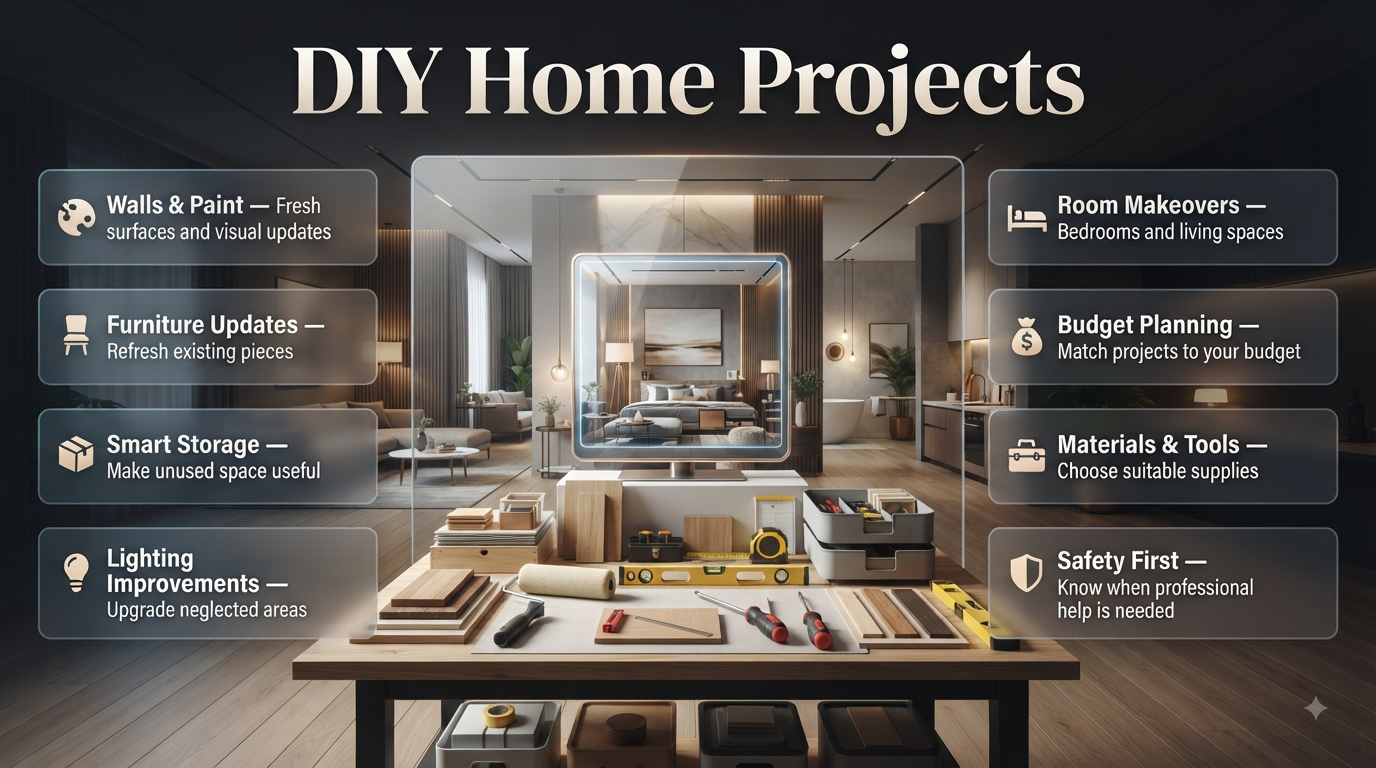
DIY Home Projects | A home doesn’t need a complete renovation to feel newer, more comfortable, and more personal. Sometimes, the biggest difference comes from a fresh coat of paint, better storage, an updated piece of furniture, or a neglected corner that finally gets a purpose.
That’s where DIY home projects can make a real difference. Instead of spending heavily on a full remodel, homeowners can tackle smaller improvements that solve everyday problems while adding personality and visual appeal.
The important part is choosing the right project. A good DIY project should match your skill level, budget, available tools, and the needs of your home. It should also be practical enough to finish properly rather than becoming another half-completed task.
This guide covers beginner-friendly and intermediate DIY ideas for walls, furniture, storage, lighting, bedrooms, living rooms, kitchens, bathrooms, entryways, and other areas. You’ll also learn how to plan a project, estimate costs, avoid common mistakes, choose materials, and recognize when professional help is the safer option.
What Are DIY Home Projects?
DIY home projects are improvements, repairs, decorating tasks, or practical upgrades completed by homeowners themselves rather than relying entirely on contractors or professional installers.
They can be as simple as repainting a wall or replacing cabinet handles, or as involved as building shelving, refinishing furniture, creating wall paneling, or reorganizing an entire room.
The best projects usually fall into four categories:
- Decorative: painting, artwork, wall treatments, accessories
- Functional: storage, shelving, organization, workspace improvements
- Restorative: repairing or refinishing furniture and surfaces
- Lifestyle-focused: reading corners, home offices, hobby spaces, plant areas
DIY doesn’t mean doing everything yourself. It means understanding which tasks you can safely and competently handle and which ones should be left to qualified professionals.
For broader inspiration and ideas that connect practical improvements with interior planning, explore DesignMode24 Interior Design.
Why Are DIY Home Projects Worth Doing?
DIY projects can offer more than a temporary visual change. A well-planned improvement can make a room easier to use, reduce clutter, refresh outdated finishes, and help your home reflect your personal taste.
They can also give homeowners more control over timing and budget.
Instead of replacing an entire room, you might:
- Repaint existing walls
- Refinish an old cabinet
- Replace outdated hardware
- Build simple storage
- Improve lighting
- Rearrange furniture
- Add wall treatments
- Create a functional corner
- Restore something you already own
The financial benefit depends on the project. DIY isn’t automatically cheaper because tools and materials still cost money. However, when you already own the necessary equipment and can complete the work correctly, avoiding labor costs can make smaller improvements considerably more affordable.
More importantly, DIY allows you to make gradual improvements instead of waiting until you can afford a major renovation.
How Do You Choose the Right DIY Project?
The smartest way to choose a project is to start with a problem rather than a trend.
Walk through your home and ask:
What currently isn’t working well?
Maybe the entryway collects shoes and bags. Perhaps the living room lacks lighting. Your bedroom might feel bland, or your kitchen cabinets may look dated even though they’re structurally sound.
Once you’ve identified the problem, choose a project that directly addresses it.
| Problem | Suitable DIY Project | Difficulty |
|---|---|---|
| Plain walls | Paint or accent wall | Easy |
| Poor storage | Shelves or organizers | Easy–Medium |
| Dated furniture | Refinishing | Easy–Medium |
| Dark room | Layered lighting | Easy |
| Empty wall | Gallery wall | Easy |
| Boring entryway | Hooks, mirror and bench | Easy |
| Unused corner | Reading nook | Easy |
| Old cabinets | Paint and hardware | Medium |
| Lack of character | Wall molding | Medium |
| Cluttered workspace | DIY organization | Easy–Medium |
💡 Pro Tip: Choose projects based on impact, not difficulty. A simple project that solves a daily problem is often more valuable than a complicated project that only looks impressive.
What Are the Best DIY Home Projects for Beginners?
Beginners should start with projects that require basic tools and have relatively low consequences if something goes wrong.
The following ideas are particularly practical.
1. Paint a Room or Accent Wall
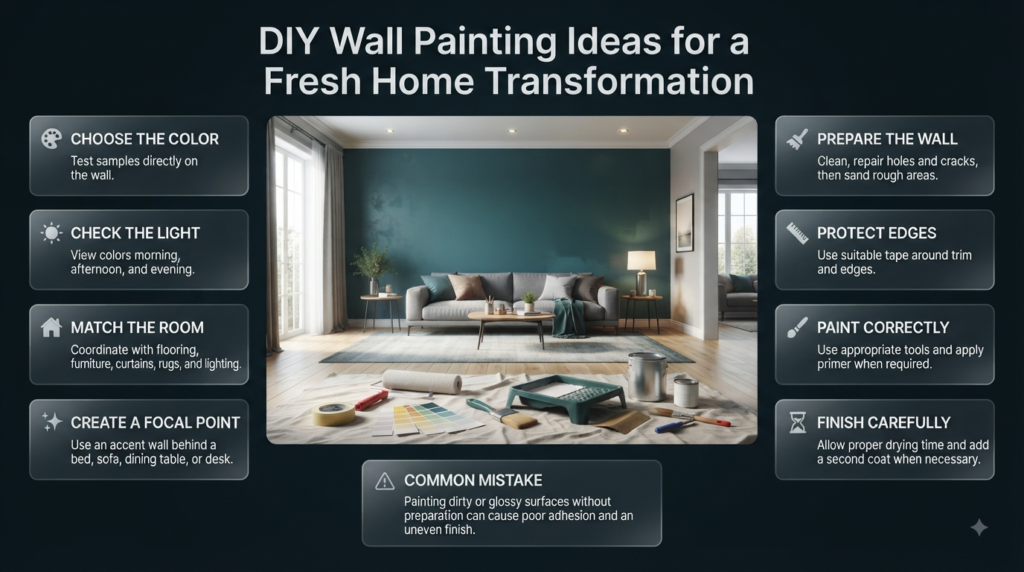
Painting remains one of the easiest ways to transform a room.
A new color can change how large, bright, warm, or intimate a space feels. You don’t necessarily need to repaint every wall. An accent wall can create a focal point behind a bed, sofa, dining table, or desk.
Before buying paint, test samples directly on the wall. Look at them during morning, afternoon, and evening light.
Color also needs to work with existing:
- Flooring
- Furniture
- Curtains
- Rugs
- Natural light
- Artificial lighting
For additional inspiration, explore Paint Color ideas.
How to Paint Properly
- Remove or protect furniture.
- Clean the wall.
- Repair holes and cracks.
- Sand rough areas.
- Protect trim and edges with suitable tape.
- Apply primer if required.
- Paint using appropriate tools.
- Allow proper drying time.
- Apply a second coat when necessary.
- Remove tape carefully and inspect the finish.
⚠ Common Mistake: Painting over dirty or glossy surfaces without preparation. The new paint may not adhere properly, leaving an uneven or disappointing finish.
2. Replace Cabinet Handles and Knobs
Changing cabinet hardware is one of the simplest ways to refresh a kitchen, bathroom, dresser, or storage unit.
You don’t need to replace the entire cabinet when the doors and boxes are still in good condition.
Before buying new handles, measure:
- Existing hole spacing
- Handle length
- Door thickness
- Clearance around neighboring doors
You can then choose a finish that supports the room’s design.
Popular options include:
- Matte black
- Brushed nickel
- Brass
- Chrome
- Bronze
- Wood
⭐ Expert Tip: Repeat important finishes. If you use brass cabinet handles, consider repeating a related brass tone in lighting or another small detail so the hardware feels intentional.
3. Build Simple Floating Shelves
Floating shelves make unused wall space useful without consuming much floor area.
They’re suitable for:
- Kitchens
- Bathrooms
- Home offices
- Bedrooms
- Living rooms
- Entryways
Before drilling, understand the wall construction and use suitable fixings. Heavy objects require stronger support than lightweight décor.
A shelf can display:
- Books
- Plants
- Ceramics
- Framed photographs
- Small artwork
- Decorative objects
Avoid filling every inch. Negative space helps the arrangement look cleaner.
For more practical home improvement ideas, visit the Home Improvement collection.
4. Refresh an Old Piece of Furniture
Before throwing away an outdated table, dresser, chair, or cabinet, consider whether its structure is still good.
A furniture makeover can include:
- Deep cleaning
- Sanding
- Repairing loose joints
- Filling small damage
- Priming
- Painting
- Staining
- Replacing hardware
- Adding protective finishing
The most important part is preparation.
A poorly prepared surface can cause peeling, uneven color, visible scratches, or poor adhesion.
A Basic Furniture Makeover Process
Clean → Repair → Sand → Prime → Paint/Finish → Cure → Reassemble
Don’t confuse drying with curing. A surface can feel dry while remaining vulnerable to scratches or pressure.
5. Create a DIY Entryway Organizer
Entryways become cluttered because they’re used constantly.
A simple organizer can combine:
- Wall hooks
- A narrow shelf
- Small baskets
- A bench
- A mirror
- Shoe storage
The goal is to give everyday objects a designated location.
For example, a family entryway might have:
Hooks → coats and bags
Shelf → keys and small items
Bench → sitting area
Baskets → accessories
Shoe storage → footwear
This turns an area that normally collects clutter into an organized transition zone.
What Are the Best DIY Living Room Projects?

The living room is often the best place to start because relatively small changes can affect the entire appearance of the home.
6. Create a Gallery Wall
A gallery wall can transform a large blank surface without requiring expensive artwork.
You can combine:
- Family photos
- Prints
- Artwork
- Mirrors
- Travel memories
- Children’s drawings
- Handmade pieces
Before drilling holes, arrange the frames on the floor.
Experiment with:
- Frame sizes
- Spacing
- Alignment
- Colors
- Orientation
A common mistake is placing frames too far apart. Another is making every piece identical when a more varied arrangement would suit the room better.
7. Build a Reading Nook
An unused corner can become a comfortable reading or relaxation area with surprisingly little work.
You need:
- One comfortable chair
- A small side table
- A reading lamp
- A rug
- A few books
- Optional shelving
Place the chair where natural light is useful during the day, then add dedicated lighting for evening use.
The project works especially well in bedrooms, living rooms, landings, and larger hallways.
The key is not filling the corner with furniture. The corner should remain visually calm.
8. Add Wall Molding
Wall molding can make a simple room feel more architectural.
DIY-friendly options include:
- Picture-frame molding
- Simple rectangular panels
- Chair rails
- Vertical battens
- Geometric arrangements
The biggest challenge isn’t the material. It’s accuracy.
Uneven measurements can make an otherwise attractive project look unfinished.
Measure the wall carefully and plan the layout before cutting anything.
For ideas involving texture and decorative surface treatments, explore Decorative Finishes.
9. Create a DIY Media or Display Wall
A blank television wall can sometimes feel unfinished.
Instead of adding random décor, create a simple visual composition around the main element.
Depending on the room, you could use:
- Wood slats
- Painted panels
- Shelves
- Low cabinets
- Artwork
- Integrated lighting
Keep cables organized and make sure ventilation requirements around electronic equipment aren’t blocked.
The objective is to create a balanced wall rather than simply adding more objects.
What Are the Best DIY Bedroom Projects?
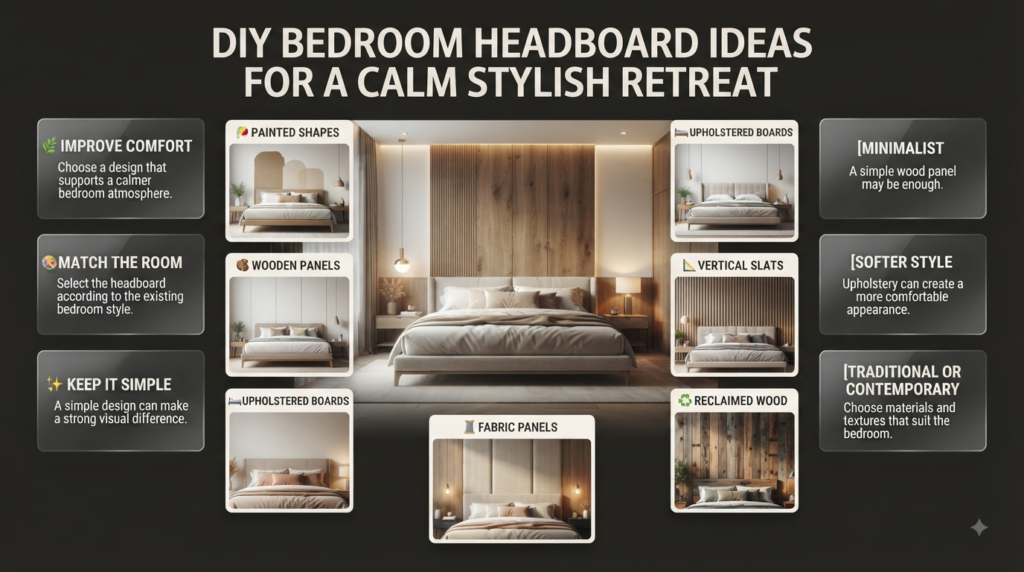
Bedrooms benefit from projects that improve comfort and create a calmer atmosphere.
10. Create a Simple Headboard
A DIY headboard can completely change the appearance of a bedroom.
Possible approaches include:
- Painted headboard shapes
- Wooden panels
- Upholstered boards
- Vertical slats
- Fabric panels
- Reclaimed wood
Choose the design according to the room.
For a minimalist bedroom, a simple wood panel may be enough. A softer upholstered headboard can create a more comfortable appearance in a traditional or contemporary bedroom.
11. Create a Bedroom Accent Wall
A bedroom accent wall can provide a focal point without overwhelming the entire space.
The wall behind the bed is usually the natural choice.
Options include:
- Paint
- Molding
- Wallpaper
- Wood
- Fabric
- Decorative finishes
Color should work with bedding, curtains, flooring, and natural light.
For broader styling guidance, explore Home Styling.
12. Build Better Bedroom Storage
Bedrooms quickly become cluttered when storage doesn’t match everyday habits.
Instead of simply adding another cabinet, identify what actually needs storage.
For example:
Open shelves → books and décor
Closed drawers → clothing
Baskets → accessories
Under-bed storage → seasonal items
Wall hooks → frequently used clothing
This creates a storage system based on behavior rather than available space alone.
What Are the Best DIY Kitchen Projects?
Kitchen DIY projects should improve appearance or organization without interfering with important utilities.
13. Refresh Kitchen Cabinets
If cabinet boxes are structurally sound, painting them can be considerably cheaper than replacing the entire kitchen.
The process generally involves:
- Removing doors and hardware.
- Cleaning grease and residue.
- Sanding where appropriate.
- Repairing imperfections.
- Priming with a suitable product.
- Applying compatible paint.
- Allowing adequate curing time.
- Reinstalling hardware carefully.
Kitchen cabinets receive frequent handling, so don’t rush the curing process.
14. Create Open Kitchen Shelving
Open shelving can make a kitchen feel lighter and provide quick access to frequently used items.
However, it also exposes clutter.
Use open shelves for things that are:
- Used frequently
- Visually attractive
- Easy to organize
Keep rarely used or visually messy items behind closed doors.
15. Create a DIY Pantry Organization System
A pantry can become dramatically easier to use without structural changes.
Try organizing food by category:
- Breakfast
- Baking
- Pasta and grains
- Snacks
- Canned goods
- Spices
- Cooking ingredients
Clear containers can help with visibility, but don’t buy dozens before understanding what storage system your pantry actually needs.
Measure shelf depths and heights first.
What Are the Best DIY Bathroom Projects?
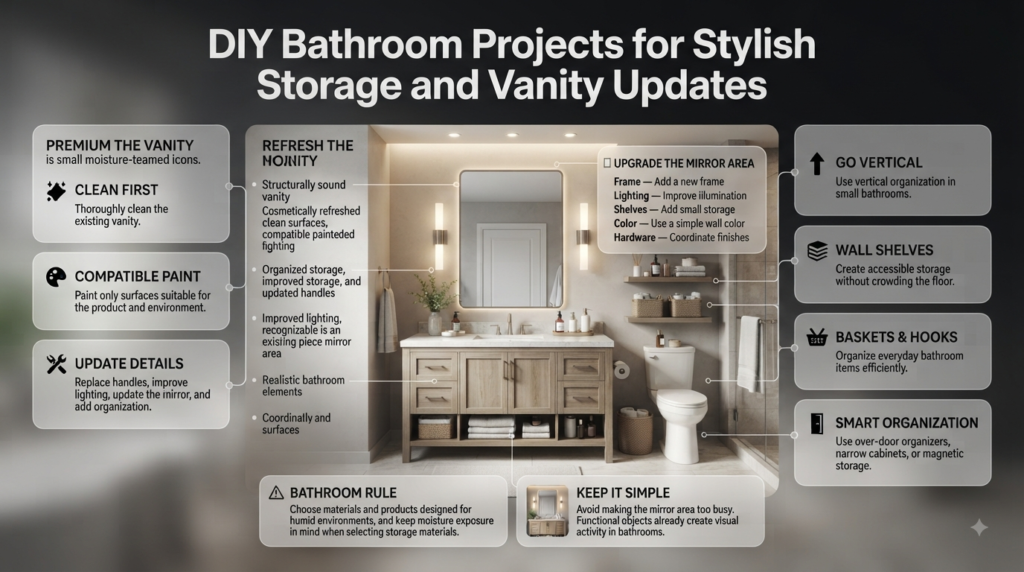
Bathrooms require moisture-resistant materials and careful installation, but several cosmetic improvements are accessible to DIYers.
16. Refresh a Bathroom Vanity
If the vanity is structurally sound, consider:
- Cleaning it thoroughly
- Painting compatible surfaces
- Replacing handles
- Updating the mirror
- Improving lighting
- Adding organization
Avoid using products that aren’t designed for humid environments.
17. Improve Bathroom Storage
Small bathrooms benefit from vertical organization.
Possible DIY additions include:
- Wall shelves
- Over-door organizers
- Baskets
- Hooks
- Narrow cabinets
- Magnetic storage for small metal accessories
Keep moisture exposure in mind when selecting materials.
18. Upgrade the Bathroom Mirror Area
A mirror is one of the strongest visual elements in a small bathroom.
You can improve the area with:
- A new frame
- Better lighting
- Small shelves
- Simple wall color
- Coordinated hardware
Avoid making the area too busy. Bathrooms already contain many functional objects, so visual simplicity often works better.
What Are the Best DIY Projects for Small Homes?
Small homes require projects that preserve floor space.
The best solutions usually use walls and vertical areas.
19. Install Wall-Mounted Hooks
Hooks can replace bulky storage for:
- Coats
- Bags
- Towels
- Hats
- Cleaning tools
- Kitchen utensils
Place hooks according to the people who will use them.
For children, lower hooks are easier to access.
20. Build Vertical Storage
Vertical shelving can take advantage of unused wall height.
Instead of a wide storage unit, consider a taller and narrower design where appropriate.
This can work in:
- Bathrooms
- Kitchens
- Bedrooms
- Offices
- Entryways
Make sure tall storage is properly secured where necessary.
21. Use Mirrors Strategically
Mirrors don’t physically enlarge a room, but they can increase reflected light and create a stronger sense of openness.
Place them where they reflect:
- Windows
- Attractive views
- Light fixtures
- Bright surfaces
Avoid positioning a mirror where it simply reflects clutter.
How Can DIY Projects Make a Home Look More Expensive?
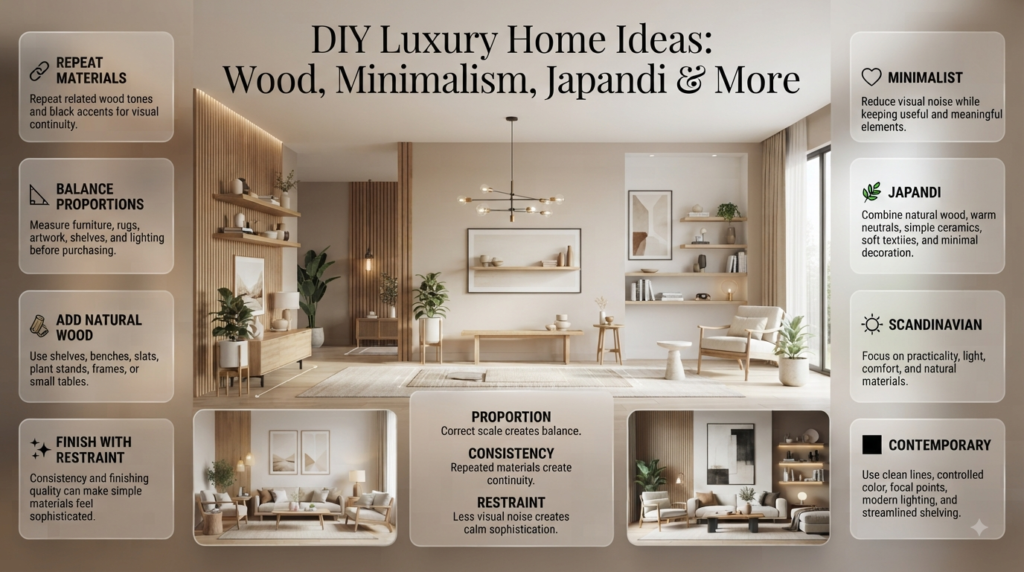
A sophisticated home isn’t necessarily created by expensive materials. Proportion, consistency, restraint, and finishing quality matter enormously.
22. Repeat Materials
If you introduce wood, repeat related wood tones elsewhere.
If you use black hardware, consider repeating black in lighting or furniture.
This creates visual continuity.
23. Improve Visual Proportions
A room can feel expensive simply because its furniture is correctly scaled.
Avoid:
- Tiny rugs under large furniture
- Oversized furniture in narrow rooms
- Artwork that is too small for a large wall
- Shelves that don’t suit the wall dimensions
- Excessively small lighting fixtures
Before purchasing anything, measure the surrounding area.
24. Create a Natural Wood Feature
Wood adds warmth and texture and can work with many interior styles.
DIY options include:
- Floating shelves
- Simple benches
- Wall slats
- Plant stands
- Frames
- Small side tables
Natural materials can soften spaces dominated by painted surfaces and manufactured finishes.
For more inspiration, explore Natural Wood Interior.
25. Simplify a Room for a Minimalist Look
Minimalism is often misunderstood as making a room completely empty.
In practice, it means reducing unnecessary visual noise while keeping the things that genuinely serve a purpose.
A DIY minimalist refresh could involve:
- Removing unused objects.
- Rearranging furniture.
- Improving storage.
- Repainting walls.
- Reducing decorative clutter.
- Choosing a few meaningful accessories.
For more guidance, explore Minimalist Home Design.
You can also explore Minimalist Interior Design for broader design principles.
26. Try a Japandi-Inspired DIY Project
Japandi combines Japanese simplicity with Scandinavian warmth.
You can introduce the look without redesigning the whole home.
Consider:
- Natural wood
- Warm neutrals
- Simple ceramics
- Soft textiles
- Low-profile furniture
- Handmade-looking objects
- Minimal decoration
For more inspiration, explore Japandi Interior Design.
The key is restraint. Adding too many decorative elements defeats the calm quality that makes the style attractive.
27. Create a Scandinavian-Inspired Corner
Scandinavian interiors often emphasize practicality, light, comfort, and natural materials.
A simple DIY Scandinavian-inspired corner could include:
- Light-colored walls
- Natural wood
- A comfortable chair
- Soft textiles
- A simple lamp
- One or two plants
Avoid turning the space into a collection of stereotypical accessories. Focus on function first.
Explore Scandinavian Interior Design for more ideas.
28. Create a Contemporary Feature
Contemporary spaces usually benefit from clean lines, controlled color, and carefully selected focal points.
A DIY contemporary update could involve:
- A large-scale artwork
- A simple accent wall
- Modern lighting
- Streamlined shelving
- Updated hardware
- A restrained material palette
For additional inspiration, explore Contemporary Interior Design.
Can DIY Projects Be Customized to Your Home?
Yes. One major advantage of DIY is that you can adapt dimensions, finishes, colors, and storage solutions to your actual space instead of buying something designed for a generic room.
This is particularly useful when:
- Walls have unusual dimensions
- Storage needs are specific
- Furniture doesn’t fit standard sizes
- You have awkward corners
- You want a particular finish
- You need a solution for a specific lifestyle
This is where the idea of bespoke design becomes useful.
You can learn more about the concept through Bespoke Design.
DIY doesn’t have to reproduce something you’ve seen online exactly. Adapt the principle to your own home.
How Can DIY Projects Create Statement Interiors?
A statement interior doesn’t require dozens of bold objects.
Often, one strong feature is enough.
Consider making one element the focal point:
- A dramatic wall
- A large artwork
- A sculptural light
- A distinctive furniture piece
- A strong material
- A custom-looking feature wall
This approach prevents the room from becoming visually chaotic.
For more inspiration, explore Statement Interiors.
⭐ Expert Tip: If everything is trying to be the focal point, nothing actually feels special. Choose one dominant feature and let the surrounding elements support it.
What Tools Do You Need for DIY Home Projects?
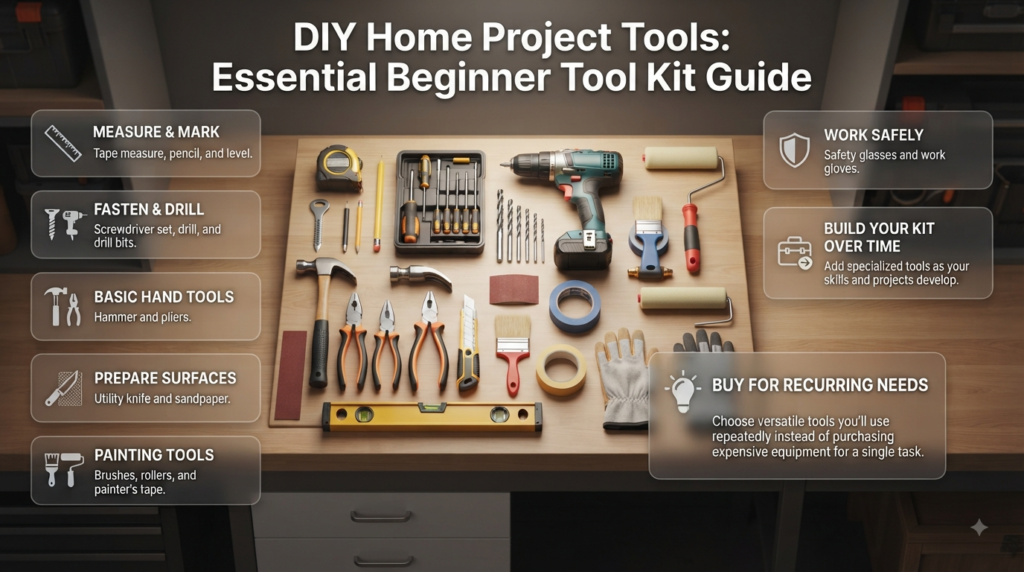
You don’t need to purchase every tool available.
A practical beginner kit can include:
- Tape measure
- Pencil
- Screwdriver set
- Drill
- Drill bits
- Level
- Hammer
- Pliers
- Utility knife
- Sandpaper
- Paint brushes
- Rollers
- Painter’s tape
- Safety glasses
- Work gloves
As your skills develop, you can purchase specialized tools based on actual projects.
A good rule is to buy tools for recurring needs rather than purchasing expensive equipment for a single task.
How Much Do DIY Home Projects Cost?
Costs vary widely depending on the project, room size, materials, and tools you already own.
A simple way to budget is:
Materials + tools + safety equipment + finishing supplies + contingency = estimated project cost
Keep a small contingency because DIY projects frequently reveal unexpected issues.
For example, repainting a wall may reveal cracks that need repair. Installing shelves may require different anchors than originally expected. Refinishing furniture may require more sanding or primer than planned.
Don’t budget only for the final decorative material.
How Long Do DIY Home Projects Take?
The project itself isn’t always the only time requirement.
You also need to account for:
- Planning
- Measuring
- Shopping
- Surface preparation
- Drying
- Curing
- Cleanup
- Adjustments
A small painting project might take several hours of active work but require additional time before the room can return to normal use.
Furniture refinishing can take several days because finishes may require extended curing periods.
📌 Quick Tip: If you only have a weekend, choose a project with a predictable timeline. Don’t begin a major renovation simply because you have two free days.
What DIY Projects Should You Not Do Yourself?
DIY should never mean ignoring safety.
Some work requires specialized knowledge, licensing, permits, or professional equipment.
Be particularly cautious with:
- Gas systems
- Major electrical work
- Structural walls
- Major roof work
- Complex plumbing
- Structural modifications
- Serious waterproofing problems
- Hazardous materials
The potential consequences matter more than the difficulty.
If a mistake could cause fire, flooding, structural damage, serious injury, or expensive property damage, professional assistance is usually the better decision.
What Are the Most Common DIY Home Project Mistakes?
Mistake 1: Skipping Measurements
A project can fail before it begins if the measurements are wrong.
Measure the actual wall, floor area, furniture clearance, doorways, and access routes.
Better approach: Measure twice before cutting or ordering materials.
Mistake 2: Choosing Materials Based Only on Appearance
A beautiful material isn’t automatically suitable.
Bathrooms require moisture-resistant solutions. High-traffic surfaces need durability. Kitchen finishes need to withstand frequent cleaning.
Better approach: Consider performance as well as appearance.
Mistake 3: Ignoring Preparation
Preparation often feels boring because it doesn’t produce an immediate visual transformation.
But cleaning, sanding, repairing, priming, and measuring are what make the final result look professional.
Better approach: Spend more time preparing than you initially think necessary.
Mistake 4: Rushing the Finish
Many DIY projects look acceptable until the final details are examined.
Uneven paint edges, visible filler, crooked shelves, loose hardware, and poor caulking can ruin the overall appearance.
Better approach: Reserve time specifically for finishing and inspection.
Mistake 5: Starting Too Many Projects
A home filled with half-finished DIY projects becomes stressful rather than inspiring.
Finish one project before beginning another whenever possible.
Mistake 6: Copying a Trend Blindly
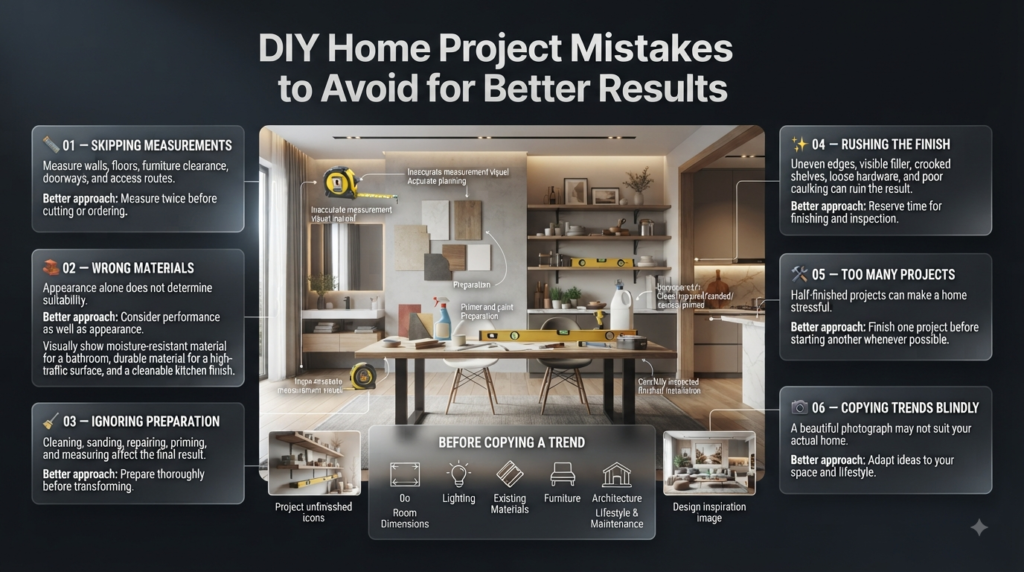
An idea can look excellent in a photograph but fail in your actual home.
Always consider:
- Room dimensions
- Lighting
- Existing materials
- Furniture
- Architecture
- Lifestyle
- Maintenance requirements
How Do Professionals Make DIY Work Look Better?
Professionals don’t necessarily use more expensive materials. They usually pay greater attention to planning, proportion, alignment, preparation, and finishing.
A useful process is:
Problem → Measure → Plan → Prepare → Build → Finish → Review
Before starting, decide what success looks like.
For example, if you’re creating shelves, success isn’t simply “shelves on the wall.”
Success might mean:
- The shelves are level.
- They’re strong enough for their intended load.
- Spacing feels balanced.
- The finish matches the room.
- Objects can be accessed easily.
- The installation looks intentional.
This mindset changes how you approach DIY.
How Can DIY Projects Improve Energy Efficiency?
Some DIY improvements can support energy efficiency, particularly when they address lighting, drafts, shading, or everyday energy use.
Examples include:
- Switching suitable lighting to efficient LEDs
- Improving window coverings
- Adding appropriate draft sealing
- Using shading to reduce unwanted heat
- Improving room organization around heating and cooling
- Using suitable smart controls
However, energy performance depends heavily on the building envelope, insulation, windows, climate, HVAC system, and construction quality.
For more detailed ideas, explore Energy-Efficient Homes.
How Do You Make DIY Projects Fit Your Interior Style?
A DIY project should look like it belongs in the home.
Before choosing colors or materials, identify the main characteristics already present.
For example:
Modern or Contemporary
Choose:
- Clean lines
- Simple hardware
- Controlled colors
- Smooth finishes
Scandinavian
Choose:
- Light wood
- Soft neutrals
- Practical storage
- Natural textures
Japandi
Choose:
- Warm wood
- Neutral colors
- Minimal decoration
- Handmade textures
Minimalist
Choose:
- Simple forms
- Limited accessories
- Functional storage
- Visual calm
You can explore broader Interior Design Styles before committing to a major aesthetic change.
Should You Follow DIY Trends?
Trends can provide inspiration, but they shouldn’t determine every decision.
A good DIY project should survive beyond the trend cycle.
Before starting a fashionable project, ask:
- Do I actually like it?
- Does it work with my existing home?
- Will I still like it in several years?
- Is it practical?
- Is it easy to maintain?
- Can I reverse it if necessary?
If the answer to most of these is yes, the trend may be worth adapting.
How Can You Plan a DIY Home Project Step by Step?
A simple planning process can prevent most beginner problems.
Step 1: Identify the Problem
Don’t start with materials. Start with the reason.
Example:
Problem: Entryway is cluttered.
Solution: Create dedicated storage for shoes, coats, and keys.
Step 2: Measure the Space
Record:
- Width
- Height
- Depth
- Door clearance
- Furniture clearance
- Wall conditions
Take photographs as well.
Step 3: Set the Budget
Write down expected expenses before purchasing.
Include a contingency for unexpected materials.
Step 4: Choose Materials
Select materials based on:
- Durability
- Moisture
- Cleaning
- Appearance
- Cost
- Availability
- Compatibility
Step 5: Prepare the Workspace
Protect floors and nearby furniture.
Keep tools organized.
Wear suitable safety equipment.
Step 6: Complete the Project
Don’t rush.
Follow product instructions and check measurements during the work rather than assuming everything is correct.
Step 7: Inspect the Finished Work
Stand back and inspect the result from different angles.
Look for:
- Uneven lines
- Gaps
- Loose hardware
- Paint marks
- Poor alignment
- Unfinished edges
Correct small problems immediately.
What Are the Best DIY Projects for Increasing Storage?
Storage is one of the most practical areas for DIY because you can customize solutions to your lifestyle.
Good options include:
- Floating shelves
- Pegboards
- Wall hooks
- Under-bed storage
- Entryway organizers
- Pantry organizers
- Bathroom shelves
- Desk organizers
- Cabinet inserts
- Narrow vertical shelving
The most effective storage isn’t necessarily the largest.
It’s the storage you can reach easily and use consistently.
A basket placed exactly where clutter accumulates may be more useful than an expensive storage system located across the room.
How Can DIY Improve a Home Without Making It Look Overdecorated?
The answer is restraint.
Choose fewer projects, but execute them properly.
For example, instead of:
- Three accent walls
- Multiple gallery walls
- Numerous decorative shelves
- Several contrasting finishes
You might choose:
- One strong feature wall
- One useful shelving system
- One upgraded furniture piece
This creates visual hierarchy.
A well-designed home needs breathing room.
What Are the Best DIY Home Projects for Beginners?
The best DIY home projects for beginners are those that create a noticeable improvement without requiring advanced construction skills or specialized equipment. Interior painting, cabinet-hardware replacement, floating shelves, furniture makeovers, gallery walls, simple storage solutions, and basic room organization are excellent starting points. Painting remains especially popular because it can transform a room without changing its structure, while small storage projects solve everyday problems at the same time.
Before starting, choose a project that matches your current abilities rather than trying to recreate a complicated renovation from a social-media video. A successful first project should teach you useful skills such as measuring, surface preparation, drilling, sanding, fastening, or finishing.
Good beginner projects include:
Painting an accent wall or small room
Updating cabinet knobs and handles
Creating a simple gallery wall
Installing suitable floating shelves
Refinishing a small piece of furniture
Building basic entryway storage
Organizing a pantry, closet, or workspace
Creating a small reading or plant corner
Professional advice: Start with a project where mistakes are relatively easy to correct. Once you understand your tools and materials, you can gradually move toward more complex DIY work.
What DIY Home Projects Add the Most Value to a Home?
The most worthwhile DIY projects are usually the ones that improve appearance, functionality, maintenance, or everyday comfort rather than simply adding decoration. Fresh interior paint, better storage, updated hardware, repaired surfaces, improved lighting, and carefully planned organization can make a home feel significantly better without requiring a major renovation.
However, it’s important to separate personal value from resale value. A project that makes your home more comfortable may be extremely worthwhile even if it doesn’t produce a measurable increase in market price. Current homeowner trends also show stronger interest in practical, contained improvements rather than automatically committing to large renovations.
High-impact DIY improvements often include:
Repainting tired or damaged walls
Improving storage in frequently used areas
Updating dated cabinet hardware
Refreshing old but structurally sound furniture
Improving lighting
Repairing visible cosmetic damage
Creating a more functional entryway
Improving outdoor or garden areas where appropriate
A useful rule: Fix function before decoration. A well-organized room with good lighting and clean finishes usually feels more valuable than a room filled with decorative accessories but lacking practical storage.
Professional advice: Don’t spend money on a DIY upgrade simply because it is trendy. Choose improvements that suit your home’s architecture, your lifestyle, and the condition of the existing space.
What Are the Best Low-Cost DIY Home Projects?
The best low-cost DIY projects are those that change a visible surface or solve a practical problem without requiring expensive materials. Painting, reorganizing storage, changing cabinet hardware, creating a gallery wall, refinishing existing furniture, adding hooks, and improving the arrangement of lighting can all produce meaningful results without the cost of a major renovation.
The smartest low-budget approach is to use what you already have before buying something new. An old dresser may only need sanding and new handles. A blank wall may need paint rather than expensive artwork. An awkward entryway may need three well-placed hooks rather than a large storage cabinet.
Try these budget-friendly ideas:
Paint one feature wall instead of an entire room
Reuse existing frames for a gallery wall
Refinish furniture instead of replacing it
Replace only outdated handles and knobs
Repurpose wooden boards into simple shelves
Use baskets to improve existing storage
Rearrange furniture before purchasing new pieces
Create a small plant or reading corner from existing furniture
Budget checklist:
Measure before buying materials.
Make a complete shopping list.
Check what tools you already own.
Compare material options.
Allow a small amount for unexpected expenses.
Avoid buying decorative products before solving the main problem.
Professional advice: A limited budget doesn’t mean the finished project has to look cheap. Clean measurements, good preparation, consistent finishes, and careful installation often have a greater visual impact than expensive materials.
Which DIY Home Projects Are Trending in 2026?
In 2026, DIY interest is increasingly centered around practical, contained improvements rather than homeowners attempting every part of a large renovation themselves. Research from the Home Improvement Research Institute shows that homeowners are increasingly combining DIY work with professional help as projects become more technically demanding. Interior painting, gardening and landscaping, small repairs, and maintenance remain common DIY areas.
Several design directions are particularly useful for homeowners looking for current inspiration.
1. Functional wall upgrades
Blank walls are increasingly being treated as opportunities for storage, display, plants, mirrors, and personalized features rather than simply hanging one piece of artwork.
2. Personalized interiors
Homeowners are showing greater interest in spaces designed around their own lifestyle rather than making every decision around future resale. Custom storage, practical organization, distinctive colors, and personal details are becoming more important.
3. Outdoor living improvements
Backyards, patios, gardens, and outdoor entertaining areas continue to receive attention as homeowners look for ways to extend usable living space.
4. Practical storage
DIY shelving, entryway organization, pantry systems, and built-in-looking storage are useful because they combine visual improvement with everyday function.
5. Warm and natural materials
Natural wood, tactile surfaces, softer colors, and simple handcrafted details can make DIY projects feel less mass-produced and more personal.
Professional advice: Don’t copy a trend exactly. Take the underlying idea and adapt it to your home’s size, lighting, architecture, budget, and maintenance needs. That produces a more timeless result.
Which DIY Home Projects Should You Avoid Doing Yourself?
You should avoid DIY work when an incorrect installation could create serious safety risks, structural damage, fire, flooding, or expensive repairs. Complex electrical work, gas systems, major structural changes, significant plumbing alterations, roofing, and other specialized work generally require appropriate professional knowledge, tools, and—in some locations—licensing or permits.
This doesn’t mean homeowners need to hire professionals for every improvement. Current home-improvement behavior increasingly reflects a hybrid approach: homeowners handle suitable cosmetic or simpler tasks themselves while bringing in professionals for technical work.
Be especially cautious with:
Major electrical rewiring
Gas lines or gas appliances
Structural wall removal
Major plumbing changes
Roof repairs
Significant waterproofing work
Structural modifications
Hazardous-material removal
Complex HVAC work
Use this simple decision test:
Can I safely correct a mistake myself?
If the answer is yes, the project may be suitable for DIY depending on your skills.
If a mistake could cause injury, fire, flooding, structural failure, or major property damage, professional help is the safer choice.
Professional advice: Don’t measure success by how much work you can avoid paying someone to do. Measure it by how safely and effectively you improve your home. A hybrid DIY-and-professional approach can often deliver the best balance of cost, quality, and confidence.
Conclusion
DIY home projects don’t have to mean taking on a major renovation or spending every weekend working with tools. The most successful projects are often the smaller improvements that solve a real problem, make a room more comfortable, or give an existing space a fresh sense of personality.
From painting and furniture updates to better storage, wall treatments, lighting, and personalized décor, there are plenty of ways to improve your home without changing everything at once. The key is to choose projects that match your budget, skills, available time, and the way you actually use your space.
Good planning also makes a major difference. Measure before buying materials, prepare surfaces properly, choose products for their intended use, and allow enough time for drying and finishing. If a project involves complex electrical, gas, structural, or other high-risk work, bringing in a qualified professional is a smarter choice than taking an unnecessary risk.
Most importantly, don’t feel pressured to copy every design trend. Use current ideas as inspiration, then adapt them to your home’s architecture, lifestyle, and personal taste. A well-planned DIY improvement should feel like it belongs in your home—not like something temporarily added because it was popular online.
Start with one project that will genuinely improve your everyday life. Complete it carefully, learn from the process, and let that experience guide your next improvement. Over time, these small and thoughtful changes can turn an ordinary house into a home that feels more functional, comfortable, personal, and truly your own.
Leave a Reply