Introduction
Bespoke Design Meaning | Have you ever found a piece of furniture that looks perfect in a showroom, only to discover that it doesn’t fit your room, storage needs, or personal style? Maybe the wall is an unusual size, the ceiling slopes, or you need a feature that simply isn’t available in standard products.
That’s where bespoke design becomes useful.
The bespoke design meaning is the creation of a product, furniture piece, interior element, or complete space specifically around an individual’s requirements. Instead of choosing from predetermined sizes and designs, the solution is developed around the client’s space, lifestyle, preferences, and practical needs.
But bespoke doesn’t simply mean “expensive” or “custom-looking.” Good bespoke design solves problems that standard products often can’t.
In this guide, you’ll learn what bespoke design means, how it differs from custom and made-to-measure work, where it’s used, what the process involves, its advantages and drawbacks, common mistakes, and how to decide whether it’s actually worth the investment.
What Does Bespoke Design Mean?
Bespoke design means creating something specifically for a particular person, property, or purpose rather than selecting a standard, mass-produced solution. The design considers exact dimensions, functionality, materials, appearance, lifestyle, and individual preferences from the beginning.
The important part is the word specifically.
A standard wardrobe is designed for a general market. A bespoke wardrobe is designed for one particular room and one particular user.
That could mean creating storage around an awkward corner, designing drawers for a specific collection of clothing, matching cabinetry to existing architecture, or integrating lighting and electrical connections into the furniture.
A simple example of bespoke design
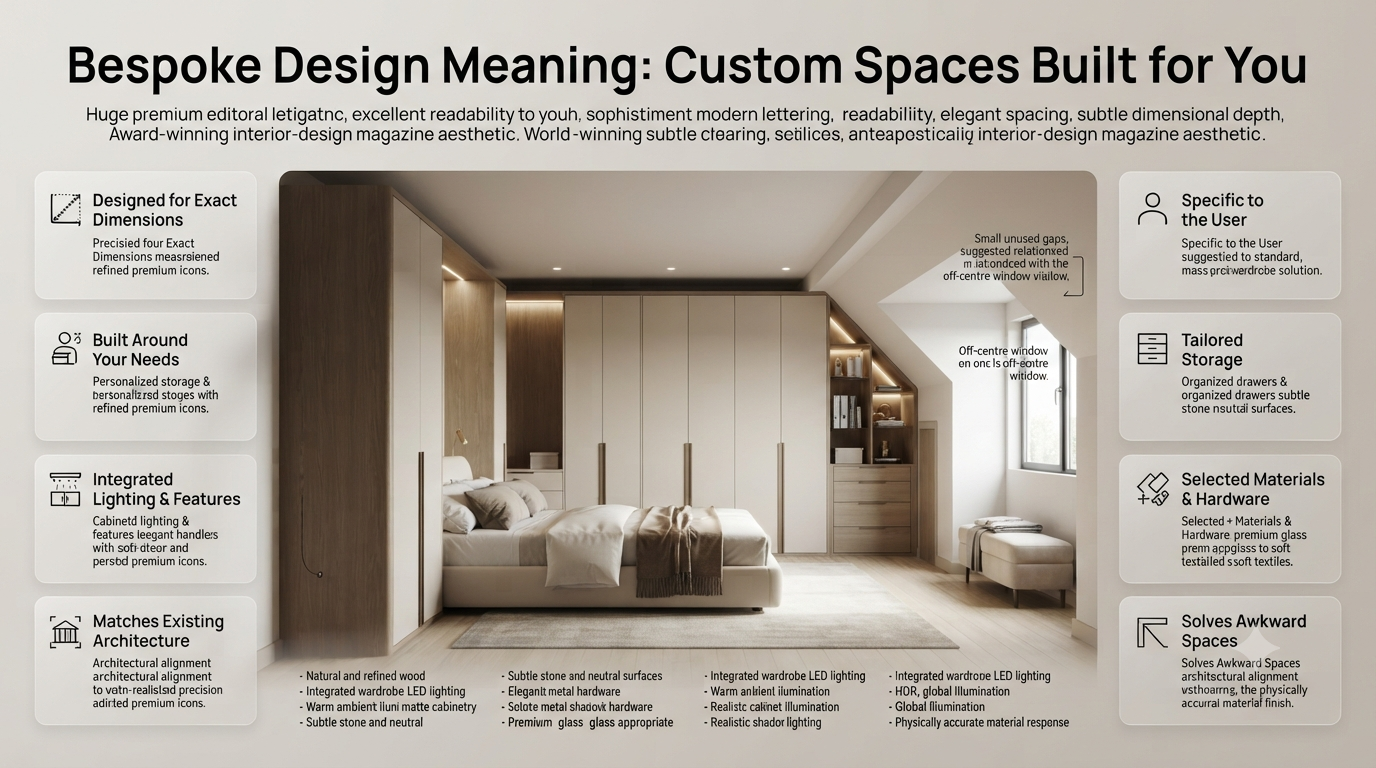
Imagine a bedroom with a wall that is 3.7 metres wide, a window positioned slightly off-centre, and a ceiling that drops near one side.
A standard wardrobe might leave gaps around the edges or block part of the window.
A bespoke designer can create a wardrobe specifically around those conditions.
The result may include:
- Exact wall-to-wall dimensions
- Storage designed around your belongings
- Integrated lighting
- Specific drawer heights
- Selected handles and hardware
- Materials matching the room
- Concealed areas for cables or accessories
- Finishing details that connect with the rest of the interior
That’s the basic principle of bespoke design: the solution is adapted to the client instead of forcing the client to adapt to the product.
Why Does Bespoke Design Matter?
Bespoke design matters because homes and people aren’t standardized.
Two bedrooms can have identical floor areas but completely different requirements. One homeowner may need extensive clothing storage, while another may prioritize a dressing area, bookshelves, or a compact workspace.
Standard furniture can only offer a limited number of configurations.
Bespoke design gives the designer more freedom to solve the actual problem.
This becomes particularly valuable when dealing with:
- Small rooms
- Unusual layouts
- Sloping ceilings
- Narrow spaces
- Architectural features
- Limited storage
- Open-plan interiors
- Specific accessibility requirements
- Strong personal design preferences
For a broader understanding of how different spaces are planned and coordinated, exploring Interior Design can help put bespoke elements into the context of an entire home.
What Is the Difference Between Bespoke, Custom, and Made-to-Measure?
These terms are often treated as identical, but there can be an important difference in how much of the product is actually personalized.
Bespoke design
Bespoke design generally starts with the individual client.
The designer considers:
- Space
- Measurements
- Lifestyle
- Function
- Aesthetic preferences
- Materials
- Construction
- Budget
- Installation requirements
The result is developed specifically for that project.
Custom design
Custom usually means an existing product or design can be modified.
For example, a furniture manufacturer might allow you to select the:
- Fabric
- Colour
- Finish
- Dimensions
- Hardware
The underlying design may remain largely unchanged.
Made-to-measure
Made-to-measure focuses primarily on dimensions.
For example, a cabinet may be manufactured to fit a 2.85-metre wall rather than a standard 2.4-metre unit.
It can be highly useful, but it doesn’t necessarily involve completely redesigning the product around the user’s lifestyle.
Quick comparison
| Feature | Standard | Made-to-Measure | Custom | Bespoke |
|---|---|---|---|---|
| Fixed dimensions | Yes | No | Sometimes | No |
| Personal measurements | Limited | Yes | Usually | Yes |
| Design flexibility | Low | Medium | Medium-High | High |
| Material choices | Limited | Moderate | High | Very high |
| Lifestyle-based design | Rare | Limited | Possible | Central |
| Individual design development | No | Sometimes | Sometimes | Yes |
| Typical cost | Lower | Moderate | Moderate-High | Higher |
The exact terminology varies between designers and manufacturers, so don’t rely only on the label. Ask what is actually being designed specifically for you.
What Does Bespoke Design Mean in Interior Design?
In interior design, bespoke means creating elements specifically for a particular home, room, client, or lifestyle.
It can involve a single item or an entire interior scheme.
Common examples include:
- Bespoke kitchens
- Built-in wardrobes
- Custom media walls
- Home offices
- Dressing rooms
- Built-in bookcases
- Vanity units
- Architectural joinery
- Custom furniture
- Feature walls
- Integrated lighting
- Tailored storage
- Bespoke window treatments
The important distinction is that bespoke interior design isn’t limited to decoration.
It can influence how the space functions.
A built-in cabinet, for example, can hide appliances, organize cables, provide storage, create visual balance, and become an architectural feature at the same time.
If you’re planning a complete interior rather than one isolated feature, Home Design Ideas can help you think about the relationship between layout, furniture, finishes, and overall style.
What Are the Main Benefits of Bespoke Design?
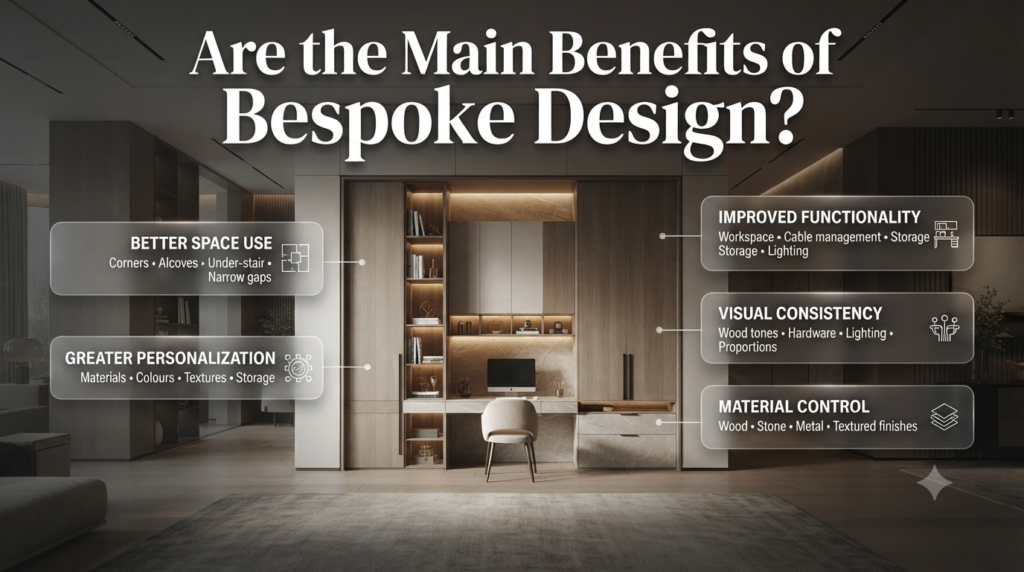
1. Better use of available space
One of the strongest reasons to choose bespoke design is space efficiency.
Standard furniture often leaves unusable gaps.
A bespoke solution can use areas such as:
- Corners
- Alcoves
- Under-stair spaces
- Full-height walls
- Low-ceiling areas
- Narrow gaps
- Irregular walls
This is particularly valuable in apartments and smaller homes where every centimetre matters.
2. Greater personalization
Bespoke design allows you to make decisions about details that standard products may not offer.
You can influence:
- Materials
- Colours
- Textures
- Handles
- Profiles
- Storage
- Lighting
- Hardware
- Proportions
- Finishing
If colour is an important part of the project, you can also explore Paint Color ideas when coordinating bespoke furniture with surrounding walls and finishes.
3. Improved functionality
A good bespoke solution starts with how the item will actually be used.
For example, a home office can be designed around:
- Monitor sizes
- Cable management
- Printer storage
- Document organization
- Lighting
- Desk height
- Equipment
- Background appearance for video calls
The result isn’t simply attractive furniture. It’s a workspace designed around a specific routine.
4. Stronger visual consistency
Bespoke elements can connect different parts of a room.
A wood tone used in cabinetry can be repeated in shelving. Metal hardware can coordinate with lighting. Wall panels can align with furniture proportions.
These details can make an interior feel intentional rather than assembled piece by piece.
5. More control over materials
Standard furniture gives you a limited selection.
Bespoke work may allow you to choose exactly how different materials interact.
For example:
Natural wood + stone + metal + textured wall finish
can create a much more specific visual identity than selecting an entire room from one furniture collection.
When Should You Choose Bespoke Design?
Bespoke design is most useful when a standard solution creates compromises.
Consider it if:
- Your room has unusual dimensions.
- You need maximum storage.
- You want furniture integrated into the architecture.
- You have specific functional requirements.
- You want a unique material combination.
- You’re designing a long-term home.
- You need a highly coordinated interior.
- Standard products don’t fit properly.
- You want control over small design details.
On the other hand, bespoke may not be necessary when a ready-made product already does the job well.
A practical decision question
Ask yourself:
“What problem will bespoke design solve that a standard product can’t?”
If the answer is clear, the additional investment may make sense.
If you don’t have a specific problem to solve, bespoke may simply add cost without adding enough value.
How Does the Bespoke Design Process Work?
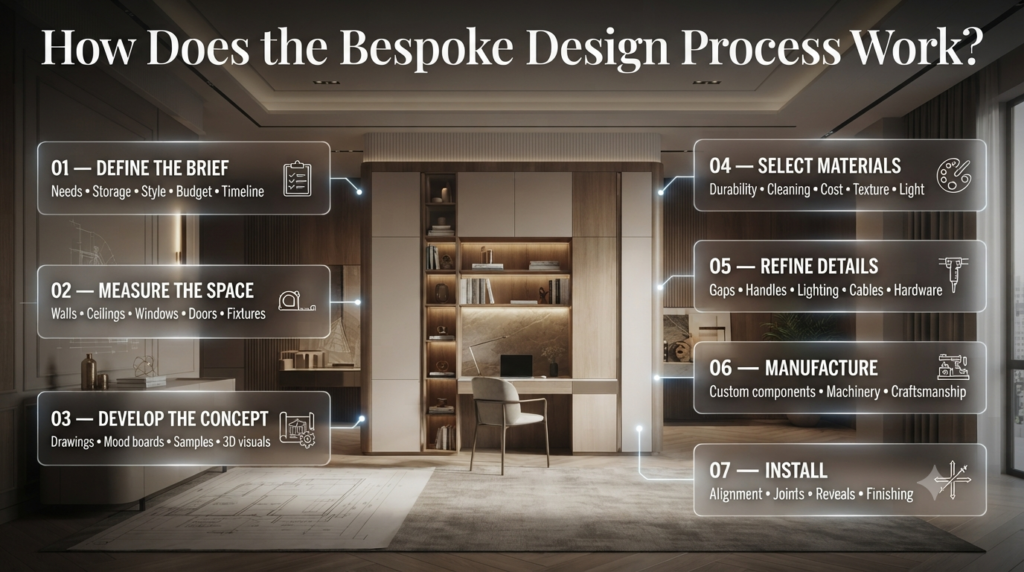
A successful project usually follows a structured process.
Step 1: Define the brief
Before designing anything, identify what you need.
Consider:
- What isn’t working now?
- What needs to be stored?
- Who will use the space?
- How often will it be used?
- What style do you prefer?
- What materials interest you?
- What is your realistic budget?
- What is your desired timeline?
A clear brief prevents the project from becoming a collection of attractive but disconnected ideas.
Step 2: Measure the space
Measurements need to be accurate.
A professional may record:
- Wall lengths
- Ceiling heights
- Windows
- Doors
- Electrical points
- Plumbing
- Structural columns
- Floor levels
- Existing fixtures
Even a small error can create problems when bespoke components are manufactured to exact dimensions.
Step 3: Develop the concept
The designer turns the brief into a visual direction.
This may involve:
- Layout drawings
- Mood boards
- Material samples
- Sketches
- 3D visuals
- Colour palettes
- Storage concepts
At this stage, the goal isn’t simply to make something beautiful. It’s to make sure the idea actually works.
Step 4: Select materials and finishes
Material selection affects much more than appearance.
It influences:
- Durability
- Cleaning
- Maintenance
- Cost
- Texture
- Light reflection
- Aging
- Overall atmosphere
For projects where walls play an important visual role, Decorative Finishes can provide useful direction on how surface treatments can complement bespoke furniture and architectural details.
Step 5: Refine the details
This is where professional design often makes the biggest difference.
Small decisions include:
- Door gaps
- Drawer heights
- Handle positions
- Lighting locations
- Cable routes
- Material transitions
- Hardware
- Edge profiles
- Ventilation
- Access for maintenance
These details may not be obvious in an initial concept, but they strongly affect the finished result.
Step 6: Manufacturing
Once the design is approved, components are manufactured or constructed.
The manufacturing method may depend on the material and level of customization.
Some work is handcrafted, while other components are produced using advanced machinery.
Bespoke does not automatically mean everything must be made by hand.
Step 7: Installation
Installation is not a minor final step.
It affects:
- Alignment
- Level
- Joints
- Reveals
- Door operation
- Finishing
- Overall appearance
A beautifully designed piece can still look poor if installation is rushed.
How Much Does Bespoke Design Cost?
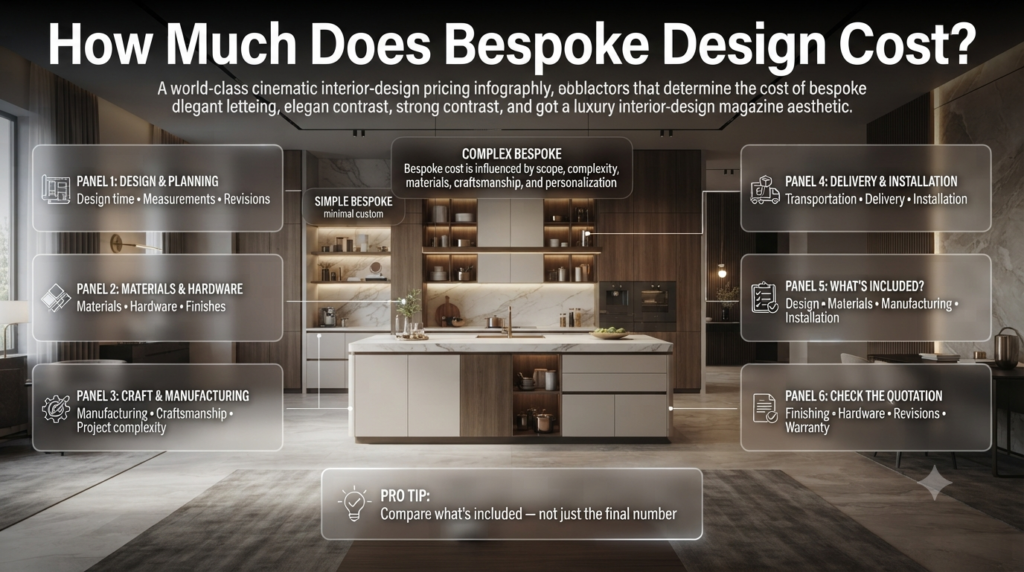
There is no universal price for bespoke design.
The cost depends on the size and complexity of the project and the level of personalization required.
Important factors include:
- Design time
- Materials
- Hardware
- Manufacturing
- Craftsmanship
- Finishing
- Transportation
- Installation
- Project complexity
- Number of revisions
A simple bespoke shelf can be relatively affordable, while a full bespoke kitchen with premium cabinetry, stone, specialist hardware, and integrated lighting can become a substantial investment.
💡 Pro Tip
When comparing quotations, don’t compare only the final number.
Ask each designer or manufacturer exactly what the price includes.
Check whether the quotation covers:
- Design
- Measurements
- Materials
- Manufacturing
- Delivery
- Installation
- Finishing
- Hardware
- Changes or revisions
- Warranty
A cheaper quotation may not actually be cheaper if important services are excluded.
Is Bespoke Design Worth the Extra Cost?
It can be, but only when the additional investment produces meaningful value.
Bespoke design is often worth considering when:
- You plan to stay in the property for years.
- The room has difficult dimensions.
- Storage is a major concern.
- Functionality matters as much as appearance.
- Standard furniture creates wasted space.
- You want architectural integration.
- You care about specific materials and detailing.
It may not be worthwhile for:
- Temporary accommodation
- Very short-term use
- Extremely limited budgets
- Simple furniture requirements
- Situations where standard products already fit perfectly
The goal shouldn’t be to make everything bespoke.
The goal should be to make the right things bespoke.
Can Bespoke Design Work With Minimalist Interiors?
Yes. In fact, bespoke design can be particularly effective in minimalist interiors.
Minimalist spaces depend on visual control.
That means:
- Fewer visible objects
- Clean lines
- Consistent proportions
- Hidden storage
- Limited materials
- Simple detailing
Bespoke cabinetry can be designed to sit flush with walls, conceal clutter, and maintain a clean visual rhythm.
For this approach, Minimalist Interior Design offers a useful reference for understanding how simplicity can be achieved without making a room feel empty.
You can also explore Minimalist Home Design when considering how bespoke furniture fits into the wider home.
How Does Bespoke Design Fit Different Interior Styles?
Bespoke design isn’t an interior style by itself.
It’s a design approach that can work with almost any style.
Contemporary interiors
Clean cabinetry, integrated storage, slim profiles, and carefully controlled materials work particularly well in contemporary spaces.
Scandinavian interiors
Natural materials, functional furniture, simple shapes, and warm neutral colours make bespoke Scandinavian pieces feel practical rather than overly decorative.
Japandi interiors
Japandi combines Japanese simplicity with Scandinavian warmth. Bespoke furniture can support this style through natural materials, restrained forms, and carefully planned storage.
For more decorative applications, Japandi Home Decor can help with the relationship between furniture, accessories, materials, and atmosphere.
A more contemporary interpretation can also be explored through Modern Japandi Interior.
Natural interiors
If natural materials are central to the design, timber can become both a functional and visual element.
Can Bespoke Design Be Used for DIY Projects?
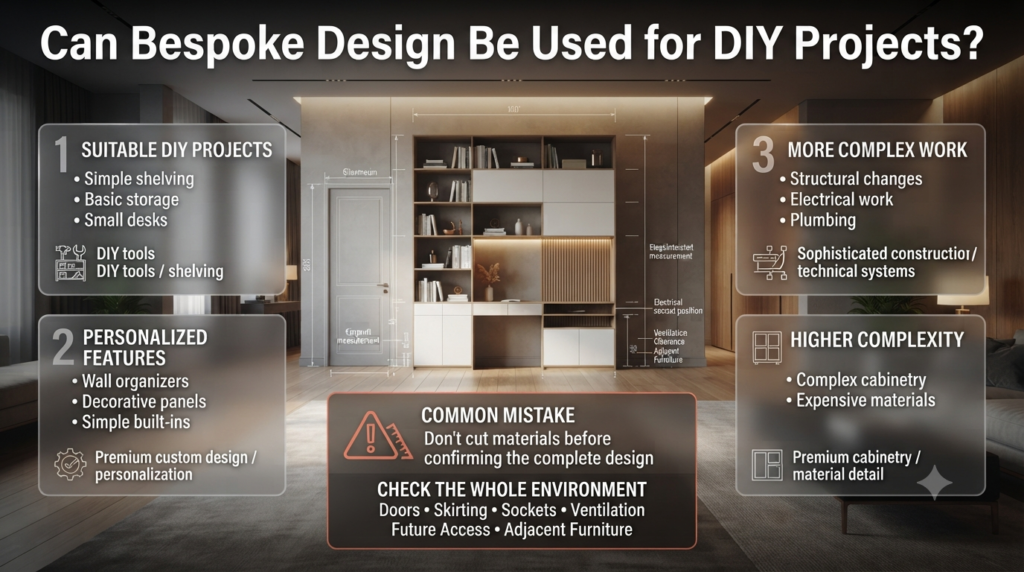
Some smaller bespoke projects can certainly be approached as DIY.
Examples include:
- Simple shelving
- Basic storage units
- Small desks
- Wall-mounted organizers
- Decorative panels
- Simple built-ins
However, DIY becomes more complicated when projects involve structural changes, electrical work, plumbing, complex cabinetry, or expensive materials.
If you’re considering making a smaller personalized feature yourself, DIY Projects can provide inspiration.
⚠ Common Mistake
Don’t start cutting materials before confirming the complete design.
A common DIY problem is making a component fit one measurement without considering doors, skirting boards, sockets, ventilation, future access, or adjacent furniture.
Measure the whole environment, not just the space where the object will sit.
Common Bespoke Design Mistakes
Choosing appearance over function
A design may look impressive but become frustrating to use.
Think about everyday actions.
Can the cabinet doors open fully?
Can you reach the upper shelves?
Is there enough workspace?
Can the furniture be cleaned easily?
Function should be resolved before decorative details.
Making everything bespoke
Not every object needs to be custom designed.
Trying to make every piece unique can unnecessarily increase the budget and create visual inconsistency.
Use bespoke design where it solves a real problem.
Ignoring maintenance
Some materials look beautiful but require more care than expected.
Before choosing a finish, ask:
- How is it cleaned?
- Does it stain?
- Does it scratch?
- Will it change colour?
- Can damaged components be repaired?
- Is replacement material available?
Changing the design during manufacturing
Late changes can cause delays, additional costs, and material waste.
Finalize important decisions before production whenever possible.
Assuming expensive means better
A high price doesn’t automatically guarantee good design or craftsmanship.
Look at:
- Previous projects
- Material quality
- Construction details
- Hardware
- Installation quality
- Communication
- Warranty
Ignoring the rest of the room
A bespoke item shouldn’t look like it belongs to a different house.
Consider the surrounding:
- Flooring
- Walls
- Ceiling
- Lighting
- Furniture
- Windows
- Architecture
This is where broader Home Styling ideas can be useful because styling helps connect individual bespoke pieces with the wider interior.
How Can You Make a Bespoke Project More Successful?
Before approaching a designer, create a simple project brief.
Bespoke design checklist
- Define the problem.
- Measure the space.
- Take photographs.
- Collect useful reference images.
- Identify must-have features.
- Separate needs from wants.
- Set a realistic budget.
- Decide on your preferred style.
- Consider maintenance.
- Ask about materials.
- Ask who manufactures the work.
- Confirm the installation process.
- Review drawings carefully.
- Confirm the timeline.
- Understand the warranty.
⭐ Expert Tip
Don’t simply send a designer ten photographs and say, “I want this.”
Explain what you like about each reference.
For example:
“I like the warm oak, concealed handles, full-height storage, and simple vertical lines, but I don’t want the open shelving.”
That gives the designer useful information while leaving room for a better solution.
What does bespoke design mean in simple terms?
Bespoke design means creating something specifically for a particular person, space, or project rather than selecting a standard product from an existing range. The design is developed around the client’s exact requirements, including dimensions, functionality, materials, style, and personal preferences.
In interior design, this could mean a wardrobe built precisely for an awkward wall, a kitchen planned around the homeowner’s cooking habits, or a media unit designed to integrate with the room’s architecture. The important point is that the design starts with the individual requirement, not with a fixed product.
Key points:
Designed around the client’s needs
Can use exact measurements
Offers greater material and finish choices
Can improve functionality and space utilization
Often provides a more personalized result
What is the difference between bespoke and custom-made design?
Bespoke and custom-made are closely related, but bespoke generally suggests a deeper level of personalization. Custom-made work may involve modifying an existing design, while bespoke design is more likely to be developed specifically around the client’s space, lifestyle, and requirements.
For example, choosing the colour and fabric of an existing sofa could be considered custom-made. Designing an entirely new sofa around a specific room size, seating preference, material selection, and ergonomic requirements is closer to bespoke design.
The main difference is usually the level of design freedom:
Custom-made: an existing design is modified.
Made-to-measure: dimensions are adjusted.
Bespoke: the solution is developed specifically for the client.
Standard: the product comes in predetermined specifications.
Because terminology varies between companies, always ask what exactly is being customized before comparing quotations.
Is bespoke design worth the extra cost?
Bespoke design can be worth the additional cost when it solves a problem that standard products cannot handle effectively. The strongest value usually comes from better space utilization, improved functionality, exact fit, and greater control over the final appearance.
For example, paying more for a bespoke wardrobe may make sense if it uses an entire wall, incorporates difficult corners, provides storage designed around your belongings, and eliminates unused gaps. However, if an affordable ready-made wardrobe already fits the room and meets your needs, bespoke construction may not provide enough additional value.
Bespoke is usually worth considering when:
The room has unusual dimensions.
Storage is limited.
You need specific functionality.
You want architectural integration.
You’re planning for long-term use.
Standard products force too many compromises.
The goal shouldn’t be to make everything bespoke. The smarter approach is to use bespoke design where customization genuinely improves the result.
Why is bespoke interior design becoming more popular?
Bespoke interior design appeals to homeowners because modern interiors increasingly need to balance appearance with practical living. People want spaces that reflect their personality while also making better use of storage, technology, awkward layouts, and available floor area.
Bespoke solutions are particularly useful for creating built-in storage, home offices, entertainment walls, dressing rooms, kitchens, and multifunctional spaces. They can also help create a more cohesive look because materials, proportions, finishes, and furniture can be coordinated from the beginning.
Popular applications include:
Built-in wardrobes
Bespoke kitchens
Home offices
Custom media walls
Dressing rooms
Integrated storage
Built-in shelving
Personalized furniture
Architectural joinery
The real trend isn’t simply toward expensive interiors. It’s toward more purposeful spaces designed around how people actually live.
What are the main benefits of bespoke design for a home?
The biggest benefit of bespoke design is that the finished solution can be created around the home’s actual conditions instead of forcing a standard product into the space. This can improve both functionality and visual harmony.
A well-planned bespoke element can make use of awkward corners, maximize vertical storage, conceal cables and equipment, coordinate with existing finishes, and provide features that aren’t available in mass-produced products.
Key benefits include:
Exact fit: Designed around the available dimensions.
Better storage: Storage can reflect your actual belongings and habits.
Personal style: Materials, colours, textures, and details can be selected individually.
Improved functionality: Features can be designed around everyday use.
Visual consistency: Furniture can coordinate with the architecture and wider interior.
Efficient space planning: Difficult or unused areas can become useful.
For homeowners, the biggest advantage isn’t simply owning something unique. It’s having a solution that works better for the way the home is actually used.
Conclusion
Understanding bespoke design meaning becomes much easier when you look beyond the idea of simply making something “custom.” Bespoke design is about creating a solution around a specific person, space, lifestyle, and set of requirements. Whether it’s a built-in wardrobe, personalized kitchen, home office, custom furniture, or a complete interior, the real value comes from making the design work for the individual rather than forcing a standard product to fit.
The best bespoke projects balance function, aesthetics, materials, craftsmanship, and practicality. They don’t make everything unique just for the sake of being different. Instead, they focus customization where it can genuinely improve the way a space looks, feels, and functions.
If you’re planning a personalized interior and want more practical guidance on layouts, styling, materials, and home design ideas, explore DesignMode24 Interior Design for further inspiration.
Ultimately, good bespoke design isn’t about spending the most money. It’s about creating the right solution for the right space—and making sure every design decision has a purpose.
Leave a Reply